SearchOS-: Towards Robust Open-Domain: Evidence from V1
This paper discusses a new system called SearchOS that helps information-seeking agents perform better web searches by keeping track of what they have found and what they still need to look for.
Content & Liability Disclaimer
This article and its accompanying video are automated summaries derived from SearchOS-V1 : Towards Robust Open-Domain Information-Seeking Agent Collaboration by Yuyao Zhang, Junjie Gao, Zhengxian Wu, Jiaming Fan, Jin Zhang, Shihan Ma, Yao Yao, Weiran Qi, Chuyan Jin, Guiyu Ma, Xingzhong Xu, Kai Yang, Ji-Rong Wen, Zhicheng Dou. The original research was conducted solely by the paper's authors; PDFdigest did not conduct any of the research and makes no claims of ownership over the underlying scientific work.
The video narration is generated by artificial intelligence and references the paper's authors for attribution. The video is not narrated by any of the paper's authors. This content may contain inaccuracies, omissions, or misinterpretations of the original research. First-person language (e.g., "we found", "our results") reflects the original authors' voice, not PDFdigest's. Always read the original paper for accurate, verified information before making any decisions based on this content.
This content is provided "as is" without any warranties, express or implied. Simulated systems OÜ, its officers, directors, employees, and agents shall not be liable for any direct, indirect, incidental, special, consequential, or punitive damages arising from your use of, reliance on, or access to this content, including but not limited to errors, omissions, or misinterpretations of the original research. This disclaimer applies to the fullest extent permitted by applicable law.
- 1 We first test whether fixed schema structure suits all tasks.
- 2 Each projection is regenerated from the latest state to avoid stale model context.
- 3 We use Evidence Extraction Middleware to extract schema-bound candidates from observation o t because a visited page is not necessarily evidence.
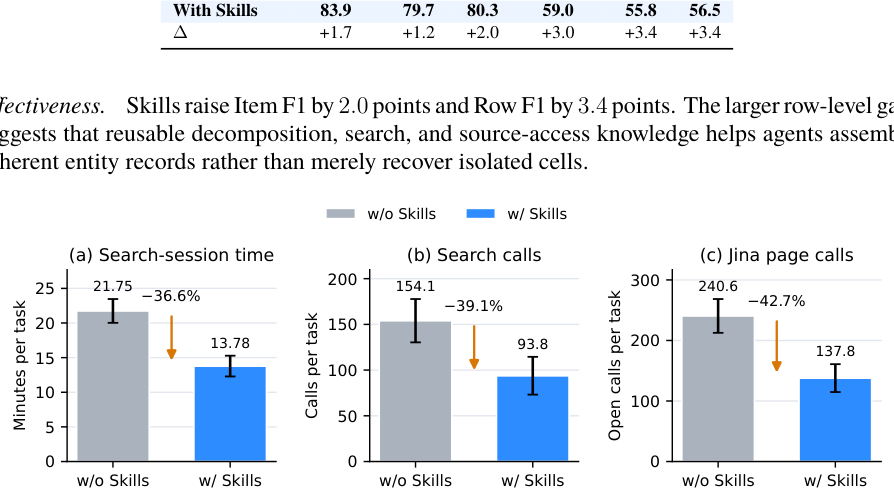
- 4 The gain is concentrated in recall, consistent with the design goal of using coverage-aware dispatch to reduce missing cells, while precision remains the highest among all methods.
Introduction
Recent advances in tool-integrated large language models (LLMs) have made web search a core capability of information-seeking agents. These agents iteratively search, browse, and reason over external sources to extend language models beyond their parametric knowledge.
Stronger search capability alone does not make this process reliable.
Agents lose track of established facts and unresolved issues as interaction histories grow.
Research Question
We first test whether fixed schema structure suits all tasks.
Methodology
The system should retain effective search and access patterns across sessions instead of rediscovering them for every task. We formulate an information-seeking task as relational schema completion with grounded citations.
Study Design
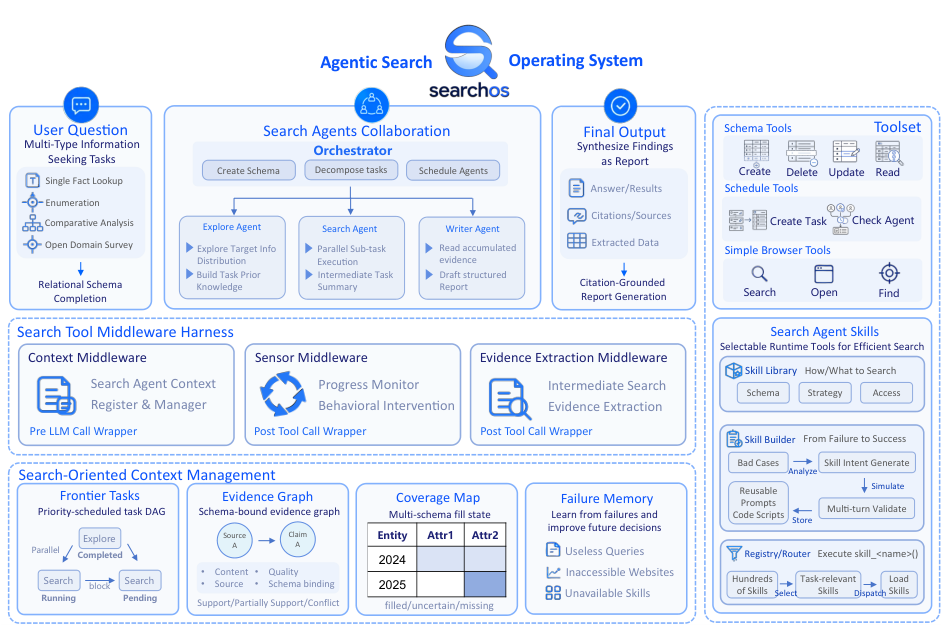
We introduce Search-Oriented Context Management (SOCM) to externalize execution state and share Frontier Task, an Evidence Graph, a Coverage Map, and Failure Memory across all agents.
The system routes these skills by task and source and refines them from successful and failed trajectories.
How PDFdigest Helps You Understand Research
Instant Paper Analysis
Get structured summaries and key findings from dense PDFs in seconds.
Visual Explanations
Turn complex methods, figures, and results into clearer visual breakdowns.
AI-Powered Q&A
Ask focused questions and get answers grounded in the paper.
Results & Findings
Agents must gather facts, reconcile evidence, and produce structured answers with verifiable citations for broad, open-domain, and long-horizon tasks. Buried evidence in context makes omissions, redundant collection, and conflicting claims difficult to detect.
- Agents must gather facts, reconcile evidence, and produce structured answers with verifiable citations for broad, open-domain, and long-horizon tasks.
- Buried evidence in context makes omissions, redundant collection, and conflicting claims difficult to detect.
- Conventional agents treat plans, progress, evidence, and failures as transient conversation content, causing these failures.
- A long-horizon search system should expose covered entities and attributes, preserve value provenance, coordinate workers around explicit gaps, and intervene when execution stalls.
- We present SearchOS, a multi-agent framework for structured and observable open-domain information seeking, based on this principle.
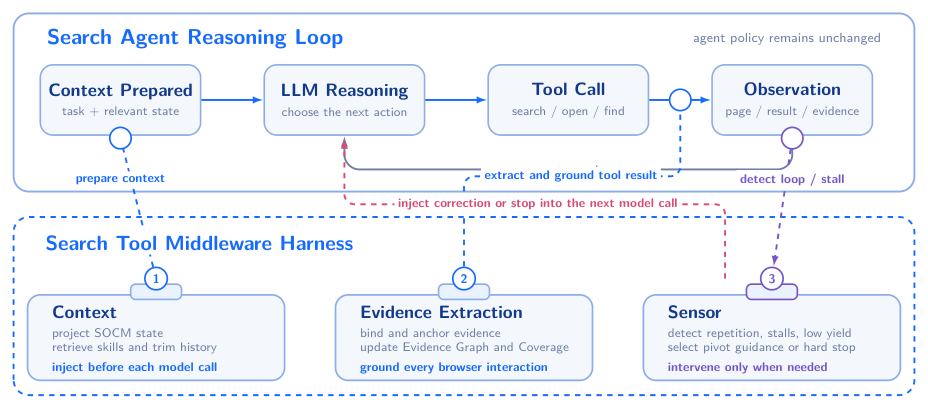
We introduce a system-level Search Tool Middleware Harness that intercepts the agent loop at model and tool boundaries because prompt-level safeguards cannot reliably cover heterogeneous post-trained agents.
Each projection is regenerated from the latest state to avoid stale model context.
Practical Applications
A single agent may waste its budget and degrade the final answer by repeatedly issuing similar searches or exploring dead ends. Adding more agents does not eliminate these problems because parallel workers may duplicate effort, disagree, or leave execution slots idle.
A relational search schema may contain multiple tables connected through primary-foreign-key relations, following relational modeling and normalization principles.
Tasks with concentrated entity attributes and simple relations may be better represented by a single table, whereas those involving one-to-many relations, multiple entity types, shared attributes, or cross-entity organization are more likely to benefit from multiple tables.
Problem Formulation
Open-domain information seeking is formulated as relational schema completion with grounded citations, using primary and foreign keys to identify entities and express relations, respectively. The system constructs a relational search schema based on user queries.
Failure Memory
The system learns from failures to improve future decision-making processes.
Useless Queries
The system identifies queries that lead to inaccessible websites, which do not contribute to the search process.
Source Paper Figures and Captions

Frequently Asked Questions
Multi-agent search requires a shared record of unsuccessful actions to prevent one agent from repeating a path that another has already exhausted. We first test whether fixed schema structure suits all tasks.
The Coverage Map shows multi-schema fill state, Frontier Tasks, and single fact lookup, enumeration, comparative analysis, and open domain survey. F t is Frontier Task, G t is the Evidence Graph, C t is the Coverage Map, and W t is Failure.
Each projection is regenerated from the latest state to avoid stale model context. We use Evidence Extraction Middleware to extract schema-bound candidates from observation o t because a visited page is not necessarily evidence.
A single agent may waste its budget and degrade the final answer by repeatedly issuing similar searches or exploring dead ends. Tasks with concentrated entity attributes and simple relations may be better represented by a single table, whereas those involving one-to-many relations.
We introduce a system-level Search Tool Middleware Harness that intercepts the agent loop at model and tool boundaries because prompt-level safeguards cannot reliably cover heterogeneous post-trained agents.
This paper discusses a new system called SearchOS that helps information-seeking agents perform better web searches by keeping track of what they have found and what they still need to look for.