Mask-Aware Policy Gradients for: Evidence from Diffusion Language Models
This paper discusses a new method for improving language models using reinforcement learning, specifically focusing on how to better handle masked tokens during text generation.
Content & Liability Disclaimer
This article and its accompanying video are automated summaries derived from Mask-Aware Policy Gradients for Diffusion Language Models by Haran Raajesh, Kulin Shah, Adam Klivans, Philipp Krähenbühl. The original research was conducted solely by the paper's authors; PDFdigest did not conduct any of the research and makes no claims of ownership over the underlying scientific work.
The video narration is generated by artificial intelligence and references the paper's authors for attribution. The video is not narrated by any of the paper's authors. This content may contain inaccuracies, omissions, or misinterpretations of the original research. First-person language (e.g., "we found", "our results") reflects the original authors' voice, not PDFdigest's. Always read the original paper for accurate, verified information before making any decisions based on this content.
This content is provided "as is" without any warranties, express or implied. Simulated systems OÜ, its officers, directors, employees, and agents shall not be liable for any direct, indirect, incidental, special, consequential, or punitive damages arising from your use of, reliance on, or access to this content, including but not limited to errors, omissions, or misinterpretations of the original research. This disclaimer applies to the fullest extent permitted by applicable law.
- 1 We provide a counterexample where the token-only gradient is zero along a direction that strictly increases the true objective.
- 2 The true objective is not stationary along this direction, i.e., ∃θ such that ⟨∇ θ J(θ), v⟩ ̸ = 0.
- 3 In our experiments, we approximate the token component of the policy gradient objective using the conditional distribution over each unmasked token, π θ (z t i | c, z t-1 ).
- 4 Differentiating the true objective with respect to θ 2 yields ∂ θ 2 J(θ) = ∂ θ 2 p unmask (2 | z 1 ) σ(θ 3 )σ(θ 1 ) .
Introduction
Reinforcement learning improves large language models for instruction following, alignment, and complex reasoning. The autoregressive log-likelihood is tractable because the generation trajectory is a sequence of token prediction actions and the log-likelihood is their product.
Masked Diffusion Language Models replace the fixed left-to-right generation order with iterative unmasking from a fully masked sequence.
Masked Diffusion Language Models enable parallel decoding and flexible generation orderings.
Research Question
We provide a counterexample where the token-only gradient is zero along a direction that strictly increases the true objective. In our experiments, we approximate the token component of the policy gradient objective using the conditional distribution over each unmasked token, π θ (z t i | c, z t-1 ).
The true objective is not stationary along this direction, i.e., ∃θ such that ⟨∇ θ J(θ), v⟩ ̸ = 0.
Increasing the true objective J(θ) along v direction.
Methodology
Appendix F provides details on the StepMerge method and approximation error analysis. Our method achieves the best results in every configuration.
Study Design
Our method shows consistent gains against evidence bound methods like GDPO and SPG.
Our method generalizes to the Dream-7B base model and to Sudoku and Countdown planning tasks.
How PDFdigest Helps You Understand Research
Instant Paper Analysis
Get structured summaries and key findings from dense PDFs in seconds.
Visual Explanations
Turn complex methods, figures, and results into clearer visual breakdowns.
AI-Powered Q&A
Ask focused questions and get answers grounded in the paper.
Results & Findings
Policy gradient algorithms sample group rollouts autoregressively and estimate their log-likelihoods. A masked diffusion language model generates text by iteratively predicting tokens and remasking positions over T denoising steps.
- Policy gradient algorithms sample group rollouts autoregressively and estimate their log-likelihoods.
- A masked diffusion language model generates text by iteratively predicting tokens and remasking positions over T denoising steps.
- Masked Diffusion Language Models lack tractable log-likelihood estimation and are trained via an evidence lower bound.
- The Masked Diffusion Language Model generation trajectory has a richer structure than its autoregressive counterpart.
- A Masked Diffusion Language Model trajectory involves selecting tokens for masked positions and deciding which positions to remask at each step.
The model learns to predict the original token at each masked position while leaving unmasked positions unchanged.
Changes to the unmasking order can affect the final reward even when token probabilities are unchanged.
Our contributions are as follows
The authors present a formalization of MDLM generation, derive position log-probabilities, and achieve state-of-the-art results in benchmarks, emphasizing the theoretical grounding for optimizing the unmasking order.
Preliminaries
This section outlines the foundational concepts of language models, particularly the differences between autoregressive models and MDLMs, and describes the process of generating sequences through iterative denoising.
Reinforcement learning for language models
The paper explains how reinforcement learning optimizes language models using policy gradients, detailing the challenges faced with MDLMs in computing log-likelihoods and the existing methods to approximate them.
Source Paper Figures and Captions
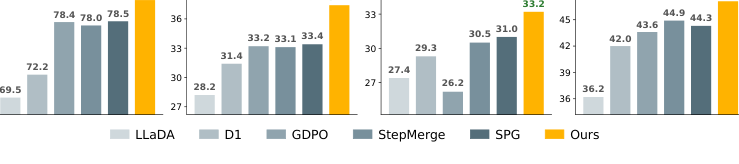
Demonstrates the effectiveness of the proposed method compared to existing approaches.
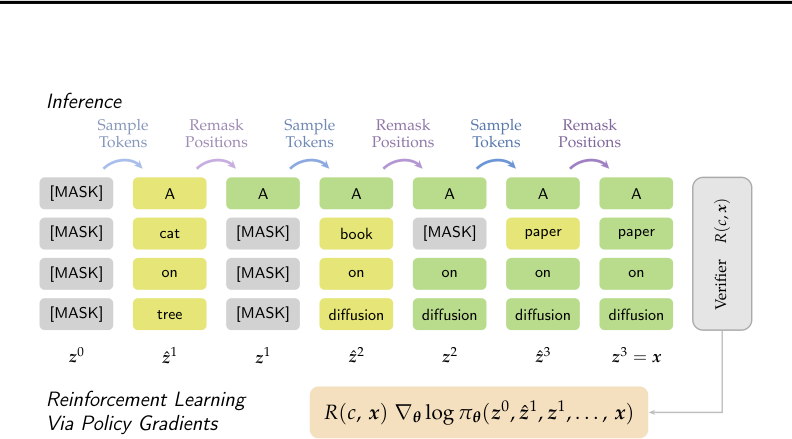
Illustrates the process of generating text using the proposed masked diffusion language model.
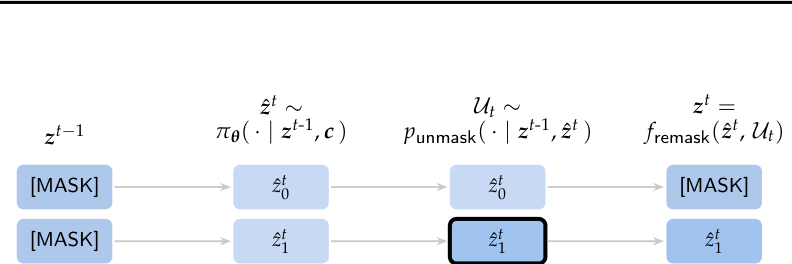
Highlights the key steps in the proposed method, emphasizing the remasking strategy.
Frequently Asked Questions
We provide a counterexample where the token-only gradient is zero along a direction that strictly increases the true objective. The true objective is not stationary along this direction, i.e., ∃θ such that ⟨∇ θ J(θ), v⟩ ̸ = 0.
Our method shows consistent gains against evidence bound methods like GDPO and SPG. Figure 1 shows test accuracy versus wall-clock training time for our method and SPG.
The model learns to predict the original token at each masked position while leaving unmasked positions unchanged. Changes to the unmasking order can affect the final reward even when token probabilities are unchanged.
There exists a direction v such that the token-only policy gradient is orthogonal to this direction, and therefore, does not move parameters along the direction of v:. Therefore, keeping θ 1 and θ 3 fixed, the objective J(θ) is maximized when θ.
This paper discusses a new method for improving language models using reinforcement learning, specifically focusing on how to better handle masked tokens during text generation.
Yes. PDFDigest can turn this paper into a structured explanation, key takeaways, visual summaries, and a narrated video when available.