Error Correction Agents Maps Experience Memory Graph: One-Shot
This paper introduces a new method for helping AI agents learn from their mistakes more effectively. Instead of relying on trial-and-error, the proposed system uses a structured approach to remember and correct errors, leading to better performance in complex tasks.
Content & Liability Disclaimer
This article and its accompanying video are automated summaries derived from Experience Memory Graph: One-Shot Error Correction for Agents by Wenjun Wang, Yuchen Fang, Fengrui Liu, Zibo Liang, Kai Zheng Kai Zheng. The original research was conducted solely by the paper's authors; PDFdigest did not conduct any of the research and makes no claims of ownership over the underlying scientific work.
The video narration is generated by artificial intelligence and references the paper's authors for attribution. The video is not narrated by any of the paper's authors. This content may contain inaccuracies, omissions, or misinterpretations of the original research. First-person language (e.g., "we found", "our results") reflects the original authors' voice, not PDFdigest's. Always read the original paper for accurate, verified information before making any decisions based on this content.
This content is provided "as is" without any warranties, express or implied. Simulated systems OÜ, its officers, directors, employees, and agents shall not be liable for any direct, indirect, incidental, special, consequential, or punitive damages arising from your use of, reliance on, or access to this content, including but not limited to errors, omissions, or misinterpretations of the original research. This disclaimer applies to the fullest extent permitted by applicable law.
- 1 AI agents can make mistakes, especially in complicated tasks.
- 2 Current methods for correcting these mistakes are often slow and inefficient.
- 3 The Experience Memory Graph (EMG) offers a new way to learn from both successes and failures.
- 4 EMG helps agents avoid repeating mistakes by using a structured memory system.
Introduction
The introduction discusses the evolution of Large Language Models (LLMs) into autonomous agents capable of decision-making and planning. It highlights the challenges faced by these agents in long-horizon tasks, particularly the compounding errors and limitations of existing self-correction methods.
Method
The method section describes the EMG framework, detailing its three stages: preparing training trajectories, constructing a memory graph, and retrieving relevant memory at test time to guide agents without iterative loops.
How PDFdigest Helps You Understand Research
Instant Paper Analysis
Get structured summaries and key findings from dense PDFs in seconds.
Visual Explanations
Turn complex methods, figures, and results into clearer visual breakdowns.
AI-Powered Q&A
Ask focused questions and get answers grounded in the paper.
Graph for Agent Memory
Recent studies on graph memory mechanisms are explored, detailing how they enhance reasoning and experience reuse in LLM agents. The section identifies gaps in current research, particularly in extracting reusable insights and modeling experience relationships, which EMG aims to address.
Preliminary
This section outlines the formulation of agentic tasks as partially observable Markov decision processes (POMDPs), detailing the components involved in agent interactions with environments and the structure of interaction trajectories.
Source Paper Figures and Captions
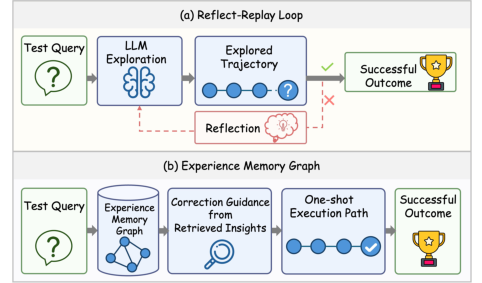
Highlights the limitations of existing self-correction mechanisms that EMG aims to improve upon.
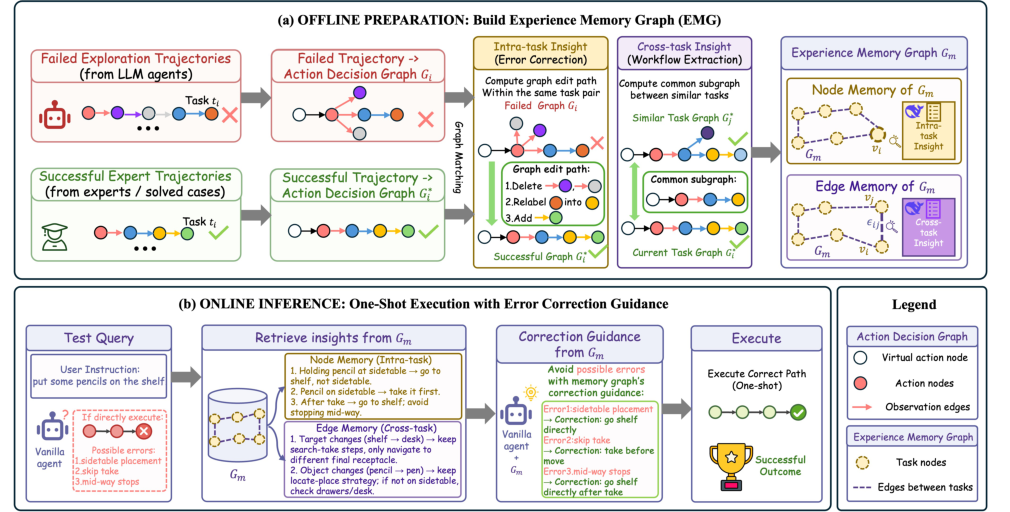
Provides a visual representation of the EMG process, illustrating how structured experience memory is constructed and utilized.
Frequently Asked Questions
This paper introduces a new method for helping AI agents learn from their mistakes more effectively. Instead of relying on trial-and-error, the proposed system uses a structured approach to remember and correct errors, leading to better performance in complex tasks.
The introduction discusses the evolution of Large Language Models (LLMs) into autonomous agents capable of decision-making and planning. It highlights the challenges faced by these agents in long-horizon tasks, particularly the compounding.
The method section describes the EMG framework, detailing its three stages: preparing training trajectories, constructing a memory graph, and retrieving relevant memory at test time to guide agents without iterative loops.
Yes. PDFDigest can turn this paper into a structured explanation, key takeaways, visual summaries, and a narrated video when available.