Agent-Based Output Drift Detection for: Evidence from Decision Support System
This paper discusses a new way to monitor the performance of AI systems used in breast cancer treatment across different hospitals. It highlights the importance of detecting when these systems start to perform poorly due to changes in patient data or technology.
Content & Liability Disclaimer
This article and its accompanying video are automated summaries derived from Agent-Based Output Drift Detection for Breast Cancer Response Prediction in a Multisite Clinical Decision Support System by Xavier Rafael-Palou, Jose Munuera, Ana Jimenez-Pastor, Richard Osuala, Karim Lekadir, Oliver Díaz. The original research was conducted solely by the paper's authors; PDFdigest did not conduct any of the research and makes no claims of ownership over the underlying scientific work.
The video narration is generated by artificial intelligence and references the paper's authors for attribution. The video is not narrated by any of the paper's authors. This content may contain inaccuracies, omissions, or misinterpretations of the original research. First-person language (e.g., "we found", "our results") reflects the original authors' voice, not PDFdigest's. Always read the original paper for accurate, verified information before making any decisions based on this content.
This content is provided "as is" without any warranties, express or implied. Simulated systems OÜ, its officers, directors, employees, and agents shall not be liable for any direct, indirect, incidental, special, consequential, or punitive damages arising from your use of, reliance on, or access to this content, including but not limited to errors, omissions, or misinterpretations of the original research. This disclaimer applies to the fullest extent permitted by applicable law.
- 1 AI systems can lose accuracy when used in different hospitals.
- 2 Monitoring these systems continuously can help identify problems early.
- 3 Using local monitoring agents is more effective than centralized systems.
Introduction
The introduction discusses the challenges of deploying machine learning models in clinical settings, particularly the issue of model drift due to dynamic clinical environments. It highlights the limitations of centralized monitoring systems and the potential of agent-based systems for localized drift detection.
Materials and Methods
This section outlines the design of the agent-based drift monitoring framework, detailing the conceptual design of monitoring agents and the simulation setup for output drift detection.
Results
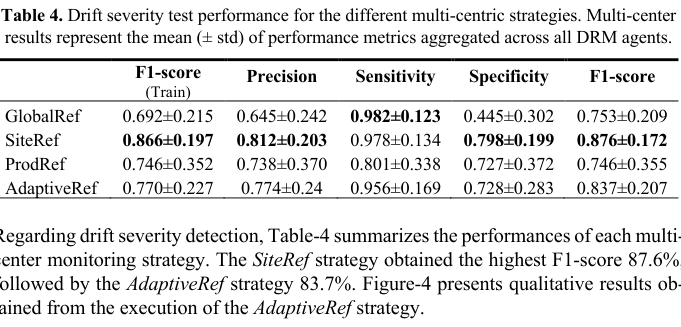
Presents the findings from the simulation, showing that multi-center monitoring schemes significantly outperform centralized monitoring, with specific improvements in F1-scores for drift detection and severity classification.
How PDFdigest Helps You Understand Research
Instant Paper Analysis
Get structured summaries and key findings from dense PDFs in seconds.
Visual Explanations
Turn complex methods, figures, and results into clearer visual breakdowns.
AI-Powered Q&A
Ask focused questions and get answers grounded in the paper.
Drift Monitoring Agent
Describes the functionality of the Drift Monitoring (DRM) agent, which continuously monitors predictive models at individual clinical centers. It details the agent’s modular design and the four architectural steps involved in its operation.
Output Drift Detection Simulation
Illustrates the application of the DRM agent framework through a controlled simulation that assesses unsupervised output drift in a multi-site clinical environment, focusing on site-specific monitoring.
Source Paper Figures and Captions
![Initialization: A global reference distribution Pglobal is constructed from the model's output probabilities on a representative evaluation dataset. This distribution serves as the initial reference for all data centers. ─ Histogram-based Distribution Estimation: Both the global reference and the empirical data observed at the center are transformed into discrete probability distributions using histograms with a fixed number of bins K over a predefined range (i.e, [0,1]). This discretization facilitates distribution comparison using non-parametric statistical tests. ─ Progressive Blending of References: As more data becomes available from a specific center, the method constructs an empirical distribution Pcenter from recent model output probabilities. A blended reference distribution Pref is then computed as a convex combination of the global and center-specific distributions:](https://pdfdigest.com/wp-content/uploads/nala/output/paper_IbxRxfmk18vyrr-9_figure_02.png)
Frequently Asked Questions
This paper discusses a new way to monitor the performance of AI systems used in breast cancer treatment across different hospitals. It highlights the importance of detecting when these systems start to perform poorly due to changes in patient data or technology.
The introduction discusses the challenges of deploying machine learning models in clinical settings, particularly the issue of model drift due to dynamic clinical environments. It highlights the limitations of centralized monitoring systems.
This section outlines the design of the agent-based drift monitoring framework, detailing the conceptual design of monitoring agents and the simulation setup for output drift detection.
Yes. PDFDigest can turn this paper into a structured explanation, key takeaways, visual summaries, and a narrated video when available.