Subject-Independent Brain-Computer Interfaces with Open-Set Subject Recognition
This paper presents a new approach to improve brain-computer interfaces (BCIs) by reducing the need for individual calibration. It introduces a method that learns from multiple subjects to better recognize brain signals from new users.
Content & Liability Disclaimer
This article and its accompanying video are automated summaries derived from Subject-Independent Brain-Computer Interfaces with Open-Set Subject Recognition by Dong-Kyun Han, Geun-Deok Jang, Dong-Young Kim. The original research was conducted solely by the paper's authors; PDFdigest did not conduct any of the research and makes no claims of ownership over the underlying scientific work.
The video narration is generated by artificial intelligence and references the paper's authors for attribution. The video is not narrated by any of the paper's authors. This content may contain inaccuracies, omissions, or misinterpretations of the original research. First-person language (e.g., "we found", "our results") reflects the original authors' voice, not PDFdigest's. Always read the original paper for accurate, verified information before making any decisions based on this content.
This content is provided "as is" without any warranties, express or implied. Simulated systems OÜ, its officers, directors, employees, and agents shall not be liable for any direct, indirect, incidental, special, consequential, or punitive damages arising from your use of, reliance on, or access to this content, including but not limited to errors, omissions, or misinterpretations of the original research. This disclaimer applies to the fullest extent permitted by applicable law.
- 1 The main objective is to lower both the closed-set classification risk associated with labeled known data as well as the open space risk associated with unknown data at the same time .
- 2 It is challenging to analyze EEGs because they vary over time and between subjects due to psychological or physiolog-20xx IEEE.
- 3 We also use OSR methods to classify tasks based on semantic features that are derived from the semantic encoder.
- 4 To summarize, ARPL clf +ARPL ossr achieved the highest performance in 53 subjects, and GCPL clf + GCPL ossr showed the highest performance in the other cases.
Introduction
The brain-computer interface (BCI) interprets the intention of the user to communicate with external devices by analyzing brain signals – . Among the various methods for measuring brain signals – , a well-established and widely used brain signal is electroencephalography (EEG), which is non-invasive and has a high temporal resolution , .
The following paradigms are commonly used for EEG-based BCI: motor imagery (MI) – , event-related potential (ERP) – , and steady-state visual potential (SSVEP) .
Permission from IEEE must be obtained for all other uses, in any current or future media, including reprinting/republishing this material for advertising or promotional purposes, creating new collective works, for resale or redistribution to servers or lists, or reuse of any copyrighted component of this work in other works.
Despite the fact that existing closed-set methods (i.e. softmax) are good at distinguishing classes, their ability to distinguish between known and unknown classes is limited.
Research Question
The main objective is to lower both the closed-set classification risk associated with labeled known data as well as the open space risk associated with unknown data at the same time .
Methodology
In , this issue was addressed by jointly training an auxiliary network that performs an open-set recognition (OSR) task to learn subject-specific style features and to impart invariance between instances of the same subject. In this study, we validated the effectiveness of the OSR task for learning subject-specific style features in a prototypebased domain generalization framework based on.
Study Design
OSSR task utilizes the subject labels to impose crossinstance style (subject-specific information) invariance and to learn subject discriminative features, rather than remove user information.
Using the OSR method as an auxiliary task to classify subjects reduces the open space risk of potentially unknown subjects and trains a more generalized model.
How PDFdigest Helps You Understand Research
Instant Paper Analysis
Get structured summaries and key findings from dense PDFs in seconds.
Visual Explanations
Turn complex methods, figures, and results into clearer visual breakdowns.
AI-Powered Q&A
Ask focused questions and get answers grounded in the paper.
Results & Findings
It is challenging to analyze EEGs because they vary over time and between subjects due to psychological or physiolog-20xx IEEE. In addition to collecting subjectspecific data and tuning the model, calibration takes approximately 20-30 minutes – .
- It is challenging to analyze EEGs because they vary over time and between subjects due to psychological or physiolog-20xx IEEE.
- In addition to collecting subjectspecific data and tuning the model, calibration takes approximately 20-30 minutes – .
- We also use OSR methods to classify tasks based on semantic features that are derived from the semantic encoder.
- In this study, we compare various combinations of OSSR frameworks using the convolutional prototype learning (CPL)-based OSR used in and the following prototype learning-based OSR methodologies.
- In contrast to traditional CNNs, prototype learning does not use a softmax layer but instead learns prototypes based on a data set.
It is challenging to analyze EEGs because they vary over time and between subjects due to psychological or physiolog-20xx IEEE.
We also use OSR methods to classify tasks based on semantic features that are derived from the semantic encoder.
Practical Applications
It is possible, however, that in a transfer learning process, data from other subjects may have negative effects. In light of this, it may be beneficial to learn subject-specific features simultaneously, i.e., to give the network the ability to distinguish which individuals a sample belongs to.
OSR aims to provide a system capable of identifying known and unknown classes for real-world scenarios in which unknown classes might be encountered.
It is possible, however, that in a transfer learning process, data from other subjects may have negative effects.
I. Introduction
The introduction discusses the significance of BCIs and the challenges posed by EEG variability, which necessitates subject-specific calibration. It highlights the need for generalized BCI models that can operate independently of individual subject data.
A. Prototype Learning for EEG Decoding
The section details the prototype learning methods used in the experiments, comparing various OSSR frameworks and methodologies such as Generalized Convolutional Prototype Learning (GCPL), Reciprocal Points Learning (RPL), and Adversarial Reciprocal Points Learning (ARPL).
Source Paper Figures and Captions
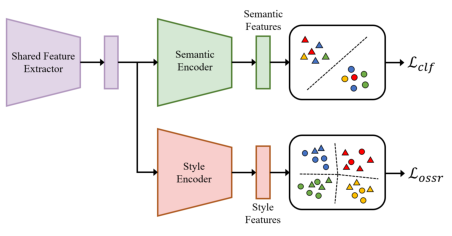
Illustrates the architecture and flow of the OSSR framework, highlighting the roles of the style and semantic encoders.
Frequently Asked Questions
The main objective is to lower both the closed-set classification risk associated with labeled known data as well as the open space risk associated with unknown data at the same time . Despite the fact that existing closed-set methods (i.e. softmax) are.
In , this issue was addressed by jointly training an auxiliary network that performs an open-set recognition (OSR) task to learn subject-specific style features and to impart invariance between instances of the same subject. It should be noted that the OSSR framework’s.
It is challenging to analyze EEGs because they vary over time and between subjects due to psychological or physiolog-20xx IEEE. We also use OSR methods to classify tasks based on semantic features that are derived from the semantic encoder.
It is possible, however, that in a transfer learning process, data from other subjects may have negative effects. In light of this, it may be beneficial to learn subject-specific features simultaneously, i.e., to give the network the ability to distinguish which individuals.
Despite the fact that existing closed-set methods (i.e. softmax) are good at distinguishing classes, their ability to distinguish between known and unknown classes is limited.
This paper presents a new approach to improve brain-computer interfaces (BCIs) by reducing the need for individual calibration. It introduces a method that learns from multiple subjects to better recognize brain signals from new users.