An investigation into the impact of deep learning model choice on sex and race bias in cardiac MR segmentation
This paper examines how different AI models can show bias based on sex and race when analyzing heart images. It highlights the importance of choosing the right model to ensure fair treatment in medical imaging.
Use the local video fallback
Content & Liability Disclaimer
This article and its accompanying video are automated summaries derived from An investigation into the impact of deep learning model choice on sex and race bias in cardiac MR segmentation by Tiarna Lee, Esther Puyol-Antón, Bram Ruijsink, Keana Aitcheson, Miaojing Shi, Andrew P King. The original research was conducted solely by the paper's authors; PDFdigest did not conduct any of the research and makes no claims of ownership over the underlying scientific work.
The video narration is generated by artificial intelligence and references the paper's authors for attribution. The video is not narrated by any of the paper's authors. This content may contain inaccuracies, omissions, or misinterpretations of the original research. First-person language (e.g., "we found", "our results") reflects the original authors' voice, not PDFdigest's. Always read the original paper for accurate, verified information before making any decisions based on this content.
This content is provided "as is" without any warranties, express or implied. Simulated systems OÜ, its officers, directors, employees, and agents shall not be liable for any direct, indirect, incidental, special, consequential, or punitive damages arising from your use of, reliance on, or access to this content, including but not limited to errors, omissions, or misinterpretations of the original research. This disclaimer applies to the fullest extent permitted by applicable law.
- 1 AI in medical imaging can be biased based on the data it is trained on.
- 2 Different AI models can exhibit varying levels of bias.
- 3 Choosing the right model is crucial for fair outcomes in medical applications.
Introduction
The introduction discusses the increasing use of AI in medical imaging and the importance of fairness in these algorithms. It highlights the potential for bias due to imbalanced training datasets and the lack of research on how model architecture affects bias.
Methods
The methods section outlines the experimental design, including dataset sampling based on sex and race, and the controlled matching of subjects by age. It describes the training and testing setup for the models used.
Materials
The study utilized cardiac magnetic resonance images from the UK Biobank, detailing the demographic characteristics of the subjects involved, including age, weight, height, and body mass index, along with the manual segmentation process performed by experts.
How PDFdigest Helps You Understand Research
Instant Paper Analysis
Get structured summaries and key findings from dense PDFs in seconds.
Visual Explanations
Turn complex methods, figures, and results into clearer visual breakdowns.
AI-Powered Q&A
Ask focused questions and get answers grounded in the paper.
Model architecture and implementation
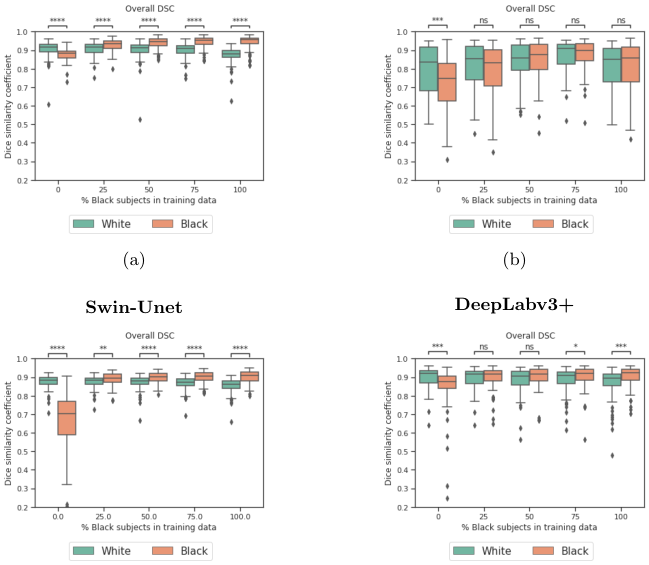
This section details the four segmentation models used in the experiments: U-Net, nnU-Net, Swin-Unet, and DeepLabv3+. It describes their architectures, training parameters, and the data augmentation methods applied.
Source Paper Figures and Captions
![A1 , ...D 100 A1 ] and D A2 = [D 100 A2 , D 75 A2 , ...D 0 A2 ] where A 1 and A 2 are the protected groups and the superscripts indicate the percentage of the protected group in the training set. Based upon D A1 and D A2 , the following metrics were calculated:](https://pdfdigest.com/wp-content/uploads/nala/output/paper_2LJE2-FQ2P_KuTiV_figure_01.png)
Frequently Asked Questions
This paper examines how different AI models can show bias based on sex and race when analyzing heart images. It highlights the importance of choosing the right model to ensure fair treatment in medical imaging.
The introduction discusses the increasing use of AI in medical imaging and the importance of fairness in these algorithms. It highlights the potential for bias due to imbalanced training datasets and the.
The methods section outlines the experimental design, including dataset sampling based on sex and race, and the controlled matching of subjects by age. It describes the training and testing setup for the.
Yes. PDFDigest can turn this paper into a structured explanation, key takeaways, visual summaries, and a narrated video when available.