Optimized Crystallographic Graph Generation for Material Science
This paper presents a new tool for generating graphs that represent crystalline materials, which are important for discovering new materials for applications like solar energy. The tool is designed to work quickly and efficiently using advanced computing techniques.
Use the local video fallback
Content & Liability Disclaimer
This article and its accompanying video are automated summaries derived from Optimized Crystallographic Graph Generation for Material Science by Astrid Klipfel, Yaël Frégier, Adlane Sayede, Zied Bouraoui. The original research was conducted solely by the paper's authors; PDFdigest did not conduct any of the research and makes no claims of ownership over the underlying scientific work.
The video narration is generated by artificial intelligence and references the paper's authors for attribution. The video is not narrated by any of the paper's authors. This content may contain inaccuracies, omissions, or misinterpretations of the original research. First-person language (e.g., "we found", "our results") reflects the original authors' voice, not PDFdigest's. Always read the original paper for accurate, verified information before making any decisions based on this content.
This content is provided "as is" without any warranties, express or implied. Simulated systems OÜ, its officers, directors, employees, and agents shall not be liable for any direct, indirect, incidental, special, consequential, or punitive damages arising from your use of, reliance on, or access to this content, including but not limited to errors, omissions, or misinterpretations of the original research. This disclaimer applies to the fullest extent permitted by applicable law.
- 1 Building a generative model with a dynamic graph is hard to achieve on a periodic structure compared to organic molecules.
- 2 We conducted experiments on the Materials project dataset to evaluate the performance of our tool.
- 3 Graph generation is performed by exploring the direct repetition of a cell, starting by evaluating the adjacent cell and extending the search area until we find all the edges.
- 4 It can also be used to produce hydrocarbons from CO2 to help reduce the carbon footprint of human activities.
Introduction
High-throughput screening based on machine learning models is largely employed to obtain materials with desired properties in the fundamental challenge of new materials discovery in material sciences. Crystalline material generation has recently received considerable attention.
We are interested in generating new crystal materials for developing new solar panels with a band gap enabling hydrolyse.
This helps to solve problems related to clean energy production and storage, which is one of the major challenges facing our society.
Organic molecules are composed of wide carbon chains with a limited variety of atoms, while crystal materials are three-dimensional periodic structures composed of a wide variety of chemical bonds and atoms.
Methodology
Our graph generation method is built upon two main parts: a searching algorithm and an ordered stack. We compare the generation time of one batch with various KNN settings and batch sizes to check the time complexity of our method.
Study Design
Results & Findings
It can also be used to produce hydrocarbons from CO2 to help reduce the carbon footprint of human activities. The periodic structure of crystals makes graph processing difficult when training a generative model, particularly in a massively parallel environment, unlike the straightforward generation of graph-based representations of organic molecules.
- It can also be used to produce hydrocarbons from CO2 to help reduce the carbon footprint of human activities.
- The periodic structure of crystals makes graph processing difficult when training a generative model, particularly in a massively parallel environment, unlike the straightforward generation of graph-based.
- Building a generative model with a dynamic graph is hard to achieve on a periodic structure compared to organic molecules.
- We empirically show the benefits of using our tool.
- Graph generation is performed by exploring the direct repetition of a cell, starting by evaluating the adjacent cell and extending the search area until we find.
Building a generative model with a dynamic graph is hard to achieve on a periodic structure compared to organic molecules.
We conducted experiments on the Materials project dataset to evaluate the performance of our tool.
How PDFdigest Helps You Understand Research
Instant Paper Analysis
Get structured summaries and key findings from dense PDFs in seconds.
Visual Explanations
Turn complex methods, figures, and results into clearer visual breakdowns.
AI-Powered Q&A
Ask focused questions and get answers grounded in the paper.
Practical Applications
Generative models may update the geometry of a chemical structure during forward propagation. Possible graphs should be generated in milliseconds to be usable in practice during the training process.
is an infinite set of triplet that represents all possible materials with n atoms.
The projections may not be injective.
Crystallographic Graph Generation
This section defines crystalline structures as clouds of atoms with periodic repetition patterns. It explains the complexity of representing these structures graphically due to their three-dimensional nature and local environments.
Crystallographic Graph
The section describes the definition of a graph associated with crystal materials as an oriented graph, detailing the representation of edges and nodes. It references previous works and formal definitions related to crystalline structures.
Generation Process
The generation process adapts to the periodic nature of crystals by exploring cell repetitions in a torus space. It outlines the searching algorithm and ordered stack used to efficiently generate graphs while managing RAM usage.
Source Paper Figures and Captions
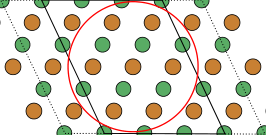
Illustrates the oriented graph structure used to represent crystalline materials.
Frequently Asked Questions
High-throughput screening based on machine learning models is largely employed to obtain materials with desired properties in the fundamental challenge of new materials discovery in material sciences. This helps to solve problems related to clean energy production and storage, which is one.
Our graph generation method is built upon two main parts: a searching algorithm and an ordered stack. We compare the generation time of one batch with various KNN settings and batch sizes to check the time complexity of our method.
Building a generative model with a dynamic graph is hard to achieve on a periodic structure compared to organic molecules. We conducted experiments on the Materials project dataset to evaluate the performance of our tool.
Generative models may update the geometry of a chemical structure during forward propagation. Possible graphs should be generated in milliseconds to be usable in practice during the training process.
Organic molecules are composed of wide carbon chains with a limited variety of atoms, while crystal materials are three-dimensional periodic structures composed of a wide variety of chemical bonds and atoms.
This paper presents a new tool for generating graphs that represent crystalline materials, which are important for discovering new materials for applications like solar energy. The tool is designed to work quickly and efficiently using advanced computing techniques.