Network of Evolvable Neural Units:: Evidence from Learn Synaptic Level
This paper presents a new approach to creating artificial neural networks that mimic the way real neurons work. By evolving individual components of these networks, the authors aim to create systems that can learn and adapt more like biological brains.
Content & Liability Disclaimer
This article and its accompanying video are automated summaries derived from Network of Evolvable Neural Units: Evolving to Learn at a Synaptic Level by Paul Bertens, Seong-Whan Lee. The original research was conducted solely by the paper's authors; PDFdigest did not conduct any of the research and makes no claims of ownership over the underlying scientific work.
The video narration is generated by artificial intelligence and references the paper's authors for attribution. The video is not narrated by any of the paper's authors. This content may contain inaccuracies, omissions, or misinterpretations of the original research. First-person language (e.g., "we found", "our results") reflects the original authors' voice, not PDFdigest's. Always read the original paper for accurate, verified information before making any decisions based on this content.
This content is provided "as is" without any warranties, express or implied. Simulated systems OÜ, its officers, directors, employees, and agents shall not be liable for any direct, indirect, incidental, special, consequential, or punitive damages arising from your use of, reliance on, or access to this content, including but not limited to errors, omissions, or misinterpretations of the original research. This disclaimer applies to the fullest extent permitted by applicable law.
- 1 Artificial neural networks can be improved by modeling them after biological processes.
- 2 Evolving individual neuron and synapse models can lead to better learning capabilities.
- 3 The proposed system can learn to solve tasks independently, similar to how animals learn.
Introduction
The introduction discusses the complexity of neural processing and the limitations of existing mathematical models in capturing the diverse behaviors of neurons and synapses. It highlights the need for a more nuanced understanding of individual neuron dynamics and their contributions to overall network behavior.
Objective
The objective is to evolve a new type of Neural Network where each neuron and synapse is modeled by an Evolvable Neural Unit (ENU). This approach aims to reduce the number of parameters through shared weights while allowing for diverse neuronal behaviors through evolved functions.
Contributions
The paper outlines key contributions, including the introduction of ENUs, their ability to approximate neural dynamics, the construction of a network of ENUs with shared parameters, and the demonstration of evolving networks capable of reinforcement learning.
How PDFdigest Helps You Understand Research
Instant Paper Analysis
Get structured summaries and key findings from dense PDFs in seconds.
Visual Explanations
Turn complex methods, figures, and results into clearer visual breakdowns.
AI-Powered Q&A
Ask focused questions and get answers grounded in the paper.
Evolvable Neural Units (ENUs)
ENUs are described as a basis for modeling neural behavior using Gated Recurrent Units (GRUs) with additional gating mechanisms. These units allow for efficient evolution and combination in larger networks, enabling complex processing of information.
Network of ENUs
The section details how multiple ENUs can be combined into a network, sharing parameters while maintaining unique internal states. This architecture allows for dynamic synaptic plasticity and the evolution of reinforcement learning behaviors.
Source Paper Figures and Captions
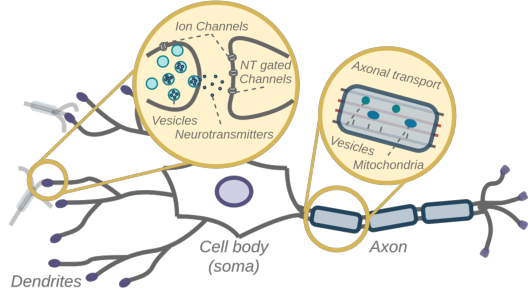
Illustrates the functional components of a neuron and their roles in information processing.
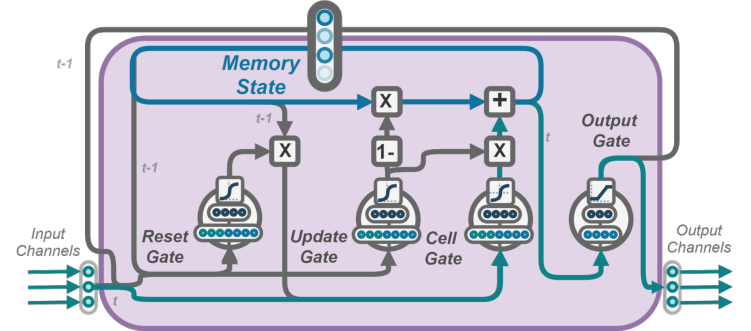
Depicts the structure and gating mechanisms of ENUs, highlighting their ability to store dynamic parameters.
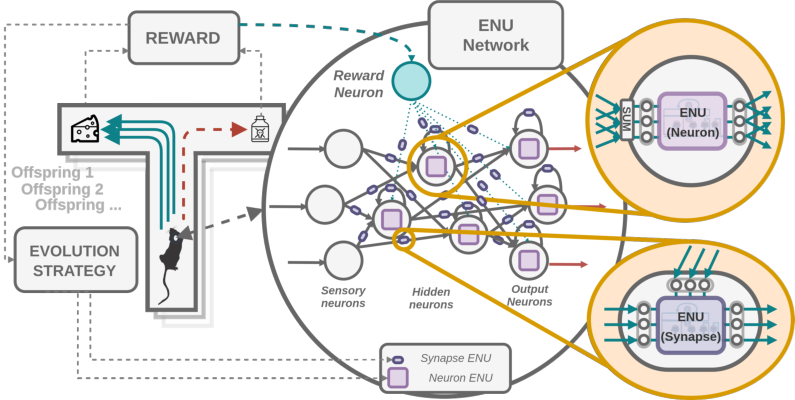
Shows how multiple ENUs are interconnected, emphasizing the shared parameters and unique internal states for complex learning.
Frequently Asked Questions
This paper presents a new approach to creating artificial neural networks that mimic the way real neurons work. By evolving individual components of these networks, the authors aim to create systems that can learn and adapt more like biological brains.
The introduction discusses the complexity of neural processing and the limitations of existing mathematical models in capturing the diverse behaviors of neurons and synapses. It highlights the need for a more nuanced.
Artificial neural networks can be improved by modeling them after biological processes. Evolving individual neuron and synapse models can lead to better learning capabilities. The proposed system can learn to solve tasks independently, similar to how animals learn.
Yes. PDFDigest can turn this paper into a structured explanation, key takeaways, visual summaries, and a narrated video when available.