Multi-dimensional Neural Decoding: Evidence from Representations
This paper discusses a new approach to brain-computer interfaces (BCIs) that allows for better control by decoding multiple movements at once, rather than just one at a time. This is important for creating more natural and effective interactions with technology.
Content & Liability Disclaimer
This article and its accompanying video are automated summaries derived from Multi-dimensional Neural Decoding with Orthogonal Representations for Brain-Computer Interfaces by Kaixi Tian, Shengjia Zhao, Yuhan Zhang, Shan Yu. The original research was conducted solely by the paper's authors; PDFdigest did not conduct any of the research and makes no claims of ownership over the underlying scientific work.
The video narration is generated by artificial intelligence and references the paper's authors for attribution. The video is not narrated by any of the paper's authors. This content may contain inaccuracies, omissions, or misinterpretations of the original research. First-person language (e.g., "we found", "our results") reflects the original authors' voice, not PDFdigest's. Always read the original paper for accurate, verified information before making any decisions based on this content.
This content is provided "as is" without any warranties, express or implied. Simulated systems OÜ, its officers, directors, employees, and agents shall not be liable for any direct, indirect, incidental, special, consequential, or punitive damages arising from your use of, reliance on, or access to this content, including but not limited to errors, omissions, or misinterpretations of the original research. This disclaimer applies to the fullest extent permitted by applicable law.
- 1 Studies in rodents and non-human primates demonstrate that the brain can form schema-like representational patterns that remain consistent across sessions and subjects.
- 2 Impact of Module Combinations We first evaluate the impact of different module combinations on performance.
- 3 First, the impact of training days (Appendix Figure 3 ) shows that more training days lead to better performance, especially pronounced in direction tasks, demonstrating that the model can effectively utilize more training data to learn robust neural-behavioral mapping relationships.
- 4 Consequently, current BCI systems still struggle to support natural, fluent interactions that require information-rich, high-dimensional neural representations , resulting in slow decoding responses and poor generalization in real-world scenarios .
Introduction
Brain-computer interfaces (BCIs) represent a transformative technology for restoring motor function in patients with neural injuries, providing opportunities for decoding neural signals and translating them into actionable commands. However, traditional BCI systems have focused on single-output decoding tasks, extracting individual motor variables from motor cortex .
Natural motor control involves coordinated multi-dimensional information processing, where the brain simultaneously encodes multi-dimensional representations within the same cortical populations .
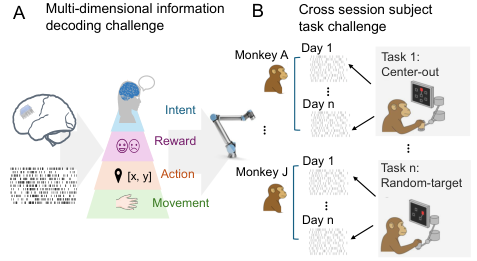
MND faces two core challenges, as illustrated in Figure 1 .
First, it remains unclear whether sufficient multidimensional information across different hierarchical levels can be extracted from limited implanted brain regions.
Methodology
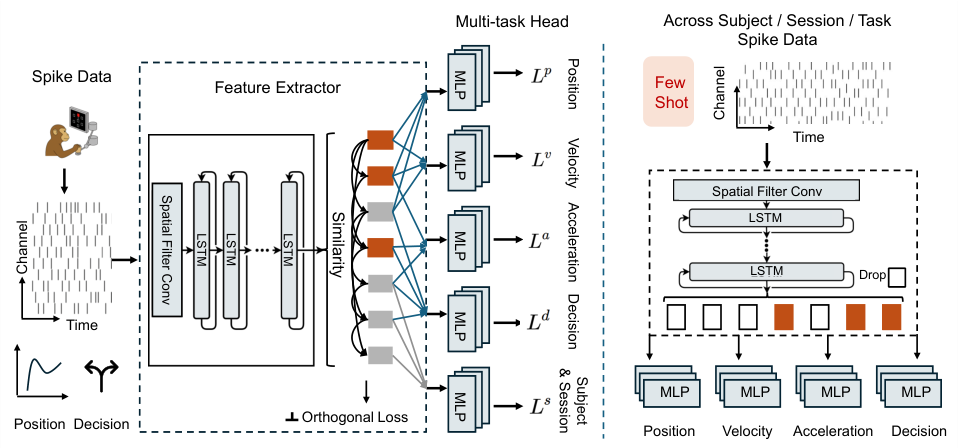
We propose Multi-dimensional Neural Decoding (MND) as a novel task formulation that simultaneously extracts multiple correlated motor variables from shared neural population activity. Unlike traditional single-task approaches, MND formulation encounters the complex interactions that arise when decoding correlated motor dimensions from shared cortical representations.
Study Design
This task formulation not only captures the biological reality of cortical motor encoding but also meets the growing demand for high-bandwidth BCI control .
When extending to multi-dimensional scenarios, severe cross-task interference exists among different dimensions, where extraction of one type of information adversely affects the decoding accuracy of other dimensions icz et al. 2025; Wimalasena, Miller, and Pandarinath 2020), existing methods exhibit poor adaptability across experimental sessions, subjects, and paradigm variations, often requiring extensive retraining when facing new.
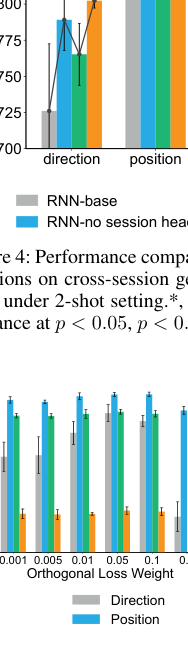
Under the more restrictive 2-shot setting, performance improvements are more pronounced, validating the method’s effectiveness under extremely limited sample conditions.
Results & Findings
Consequently, current BCI systems still struggle to support natural, fluent interactions that require information-rich, high-dimensional neural representations , resulting in slow decoding responses and poor generalization in real-world scenarios . Studies in rodents and non-human primates demonstrate that the brain can form schema-like representational patterns that remain consistent across sessions and subjects.
- Consequently, current BCI systems still struggle to support natural, fluent interactions that require information-rich, high-dimensional neural representations , resulting in slow decoding responses and poor generalization.
- Studies in rodents and non-human primates demonstrate that the brain can form schema-like representational patterns that remain consistent across sessions and subjects.
- To validate the effectiveness of our approach, we employed macaque motor cortex neural datasets from two different paradigms: center-out reaching and random target tasks .
- However, these methods typically address single decoding objectives and face significant challenges when simultaneously extracting multiple behavioral variables from the same neural population.
- Neural decoding stability across sessions, subjects, and paradigms poses major challenges for practical BCI deployment, as neural activity changes significantly due to electrode displacement and tissue.
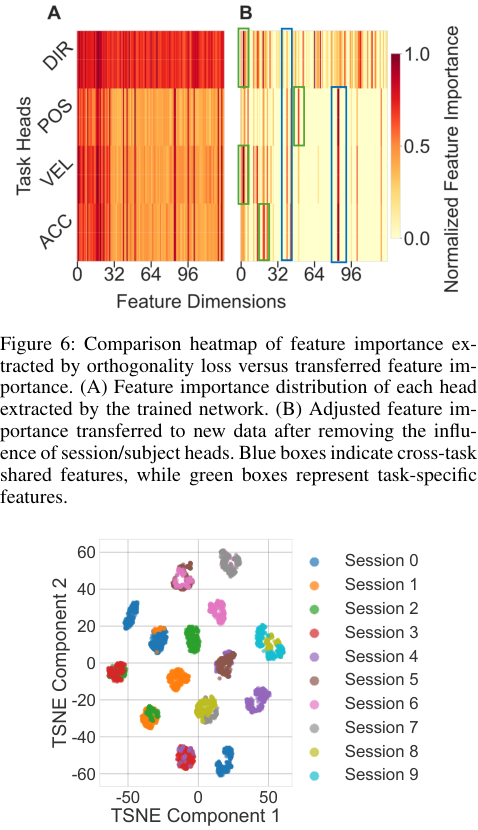
Experiments on macaque motor cortex data validate the effectiveness of OrthoSchema, particularly under limited data conditions (K=2), with visualization revealing effective orthogonal disentanglement and schema-based transfer.
Studies in rodents and non-human primates demonstrate that the brain can form schema-like representational patterns that remain consistent across sessions and subjects.
How PDFdigest Helps You Understand Research
Instant Paper Analysis
Get structured summaries and key findings from dense PDFs in seconds.
Visual Explanations
Turn complex methods, figures, and results into clearer visual breakdowns.
AI-Powered Q&A
Ask focused questions and get answers grounded in the paper.
Practical Applications
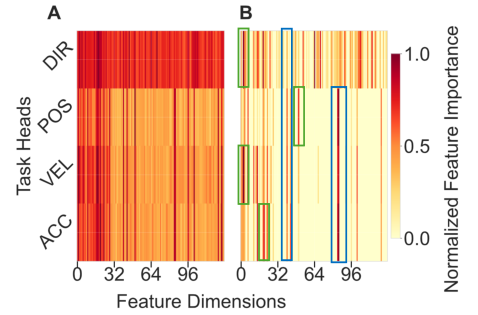
These findings inspire two insights for algorithm design: orthogonal subspace organization may offer a promising approach to mitigate feature coupling problems in multi-dimensional decoding, while schema-like stable representation could provide a theoretical foundation for more efficient transfer learning strategies.
Multi-dimensional Information Decoding
The demand for richer interaction capabilities in BCIs has led to the emergence of multi-dimensional information decoding as a central challenge. Existing methods face cross-dimensional interference, and while some multi-task learning approaches attempt to address task conflicts, they do not fully leverage the potential for orthogonal encodings in neural populations.
Cross-session/subject/paradigm Adaptation
Stability in neural decoding across sessions, subjects, and paradigms is critical for practical BCI deployment. The proposed OrthoSchema framework integrates orthogonality constraints and selective schema reuse to enhance multi-dimensional decoding stability.
Source Paper Figures and Captions
Frequently Asked Questions
LSTM networks have been applied to motion trajectory decoding , while convolutional neural networks have enhanced spatial feature extraction . However, neuroscience research suggests that neural population can form mutually orthogonal encodings in output subspaces , encouraging features to be approximately orthogonal.
MND has been applied to EEG-based decoding, including Bayesian multi-task models and deep neural networks with multi-head outputs , demonstrating cross-dimensional interference challenges. where H is the set of BCI task heads and weight h,i is the weight connecting the i-th feature.
Studies in rodents and non-human primates demonstrate that the brain can form schema-like representational patterns that remain consistent across sessions and subjects. Neural decoding stability across sessions, subjects, and paradigms poses major challenges for practical BCI deployment, as neural activity changes significantly.
These findings inspire two insights for algorithm design: orthogonal subspace organization may offer a promising approach to mitigate feature coupling problems in multi-dimensional decoding, while schema-like stable representation could provide a theoretical foundation for more efficient transfer learning strategies.
Under the more restrictive 2-shot setting, performance improvements are more pronounced, validating the method’s effectiveness under extremely limited sample conditions. Experiments on macaque motor cortex data validate the effectiveness of OrthoSchema, particularly under limited data conditions (K=2), with visualization revealing effective orthogonal.
This paper discusses a new approach to brain-computer interfaces (BCIs) that allows for better control by decoding multiple movements at once, rather than just one at a time. This is important for creating more natural and effective interactions with technology.