Lighthouse : Sample-Efficient Circuit: Evidence from RL
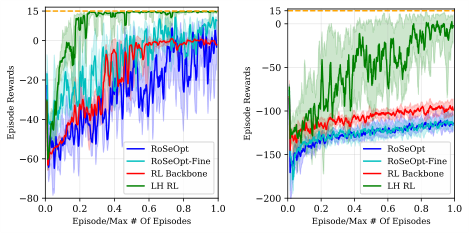
This paper presents a new method for optimizing analog circuits using reinforcement learning. The method improves efficiency by starting from successful configurations, making it faster and more effective than traditional approaches.
Content & Liability Disclaimer
This article and its accompanying video are automated summaries derived from Lighthouse RL: Sample-Efficient Circuit Optimization via Strategic Reset Points by Mustafa Emre Gürsoy, Stefan Uhlich, Ryoga Matsuo, Yağız Gençer, Arun Venkitaraman, Chia-Yu Hsieh, Andrea Bonetti, Eisaku Ohbuchi, Lorenzo Servadei. The original research was conducted solely by the paper's authors; PDFdigest did not conduct any of the research and makes no claims of ownership over the underlying scientific work.
The video narration is generated by artificial intelligence and references the paper's authors for attribution. The video is not narrated by any of the paper's authors. This content may contain inaccuracies, omissions, or misinterpretations of the original research. First-person language (e.g., "we found", "our results") reflects the original authors' voice, not PDFdigest's. Always read the original paper for accurate, verified information before making any decisions based on this content.
This content is provided "as is" without any warranties, express or implied. Simulated systems OÜ, its officers, directors, employees, and agents shall not be liable for any direct, indirect, incidental, special, consequential, or punitive damages arising from your use of, reliance on, or access to this content, including but not limited to errors, omissions, or misinterpretations of the original research. This disclaimer applies to the fullest extent permitted by applicable law.
- 1 Lighthouse RL improves circuit optimization efficiency.
- 2 It uses successful past configurations to guide new attempts.
- 3 The method is particularly useful for complex optimization problems.
Introduction
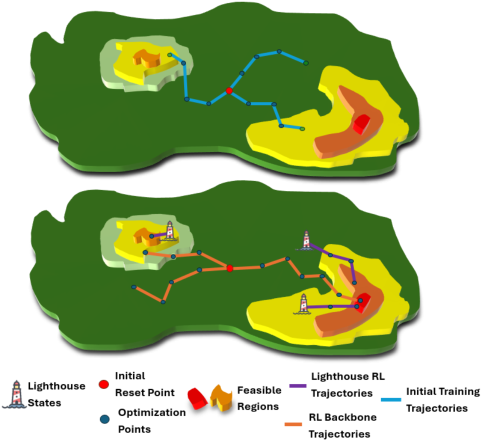
Analog circuit sizing optimization faces challenges due to complex parameter-performance relationships. Traditional methods require re-optimization for each new target, leading to inefficiencies. Lighthouse RL introduces a strategic reset strategy that uses high-performing configurations to guide exploration, improving sample efficiency and generalization.
Background and Previous Work
Circuit sizing optimization has evolved from traditional methods to machine learning approaches. While existing methods like Bayesian Optimization and Evolutionary Strategies have shown effectiveness, they struggle with sample efficiency. Recent RL approaches have improved adaptability, but still face challenges that Lighthouse RL aims to address.
Reinforcement Learning
Reinforcement learning enables agents to learn optimal decision-making through interaction with the environment. The framework is defined as a Markov Decision Process (MDP), where the agent learns a policy to maximize expected cumulative rewards.
How PDFdigest Helps You Understand Research
Instant Paper Analysis
Get structured summaries and key findings from dense PDFs in seconds.
Visual Explanations
Turn complex methods, figures, and results into clearer visual breakdowns.
AI-Powered Q&A
Ask focused questions and get answers grounded in the paper.
Soft Actor-Critic
Soft Actor-Critic (SAC) is an off-policy algorithm that optimizes expected return and policy entropy for continuous control tasks. It employs multiple neural networks to estimate returns and maximize exploration, making it effective for complex problems.
Problem Formulation
The multi-objective circuit sizing task is formulated as a feasibility problem, where the goal is to find a feasible solution that meets target objectives. The RL agent operates in a continuous action space, with a reward function designed to encourage meeting these objectives.
Limitations and Cautions
A useful limitation and caution is that this article summarizes the available paper text and extracted evidence; readers should consult the source paper before treating any interpretation as definitive.
The paper’s conclusions may depend on its source selection, definitions, assumptions, and the scope of its analysis, so follow-up reading is important.
Source Paper Figures and Captions
Frequently Asked Questions
This paper presents a new method for optimizing analog circuits using reinforcement learning. The method improves efficiency by starting from successful configurations, making it faster and more effective than traditional approaches.
Analog circuit sizing optimization faces challenges due to complex parameter-performance relationships. Traditional methods require re-optimization for each new target, leading to inefficiencies. Lighthouse RL introduces a strategic reset strategy that uses high-performing.
Lighthouse RL improves circuit optimization efficiency. It uses successful past configurations to guide new attempts. The method is particularly useful for complex optimization problems.
Yes. PDFDigest can turn this paper into a structured explanation, key takeaways, visual summaries, and a narrated video when available.