Impoola: The Power of Average Pooling: Evidence from Deep Reinforcement
This paper discusses a new approach to improving deep learning models used in teaching computers to play games by changing how they process images. The authors found that a simpler method of summarizing image data leads to better performance than more complex.
Content & Liability Disclaimer
This article and its accompanying video are automated summaries derived from Impoola: The Power of Average Pooling for Image-Based Deep Reinforcement Learning by Raphael Trumpp, Ansgar Schäfftlein, Mirco Theile, Marco Caccamo. The original research was conducted solely by the paper's authors; PDFdigest did not conduct any of the research and makes no claims of ownership over the underlying scientific work.
The video narration is generated by artificial intelligence and references the paper's authors for attribution. The video is not narrated by any of the paper's authors. This content may contain inaccuracies, omissions, or misinterpretations of the original research. First-person language (e.g., "we found", "our results") reflects the original authors' voice, not PDFdigest's. Always read the original paper for accurate, verified information before making any decisions based on this content.
This content is provided "as is" without any warranties, express or implied. Simulated systems OÜ, its officers, directors, employees, and agents shall not be liable for any direct, indirect, incidental, special, consequential, or punitive damages arising from your use of, reliance on, or access to this content, including but not limited to errors, omissions, or misinterpretations of the original research. This disclaimer applies to the fullest extent permitted by applicable law.
- 1 Another line of work has emphasized the impact of improved network design in particular to scale fully connected networks in regular DRL.
- 2 A number of invariance-based methods have been shown to facilitate generalization for Procgen environments, ranging from auxiliary losses to data augmentation .
- 3 The generalized advantage estimate (GAE) is the common choice to estimate A(s, a).
- 4 This change has a vast influence on the model architecture, as it reduces feature maps to single entries.
Introduction
Recent works on deep reinforcement learning (DRL) have revealed that apart from algorithmic improvements, considerable performance increases can come from the network architecture and training approach of the used deep neural networks (DNNs). There is high interest in finding methods for network scaling in image-based DRL in recent studies .
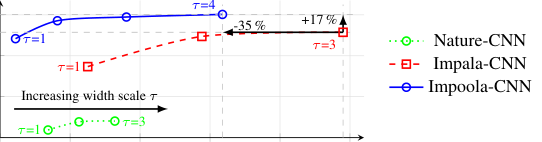
Most of these works use the aforementioned Impala-CNN as the image encoder, typically scaling the network’s width by increasing the output channels per Conv2d layer by a factor τ .
Similar design improvements for image-based DRL are of high practical appeal, primarily due to the prominence of end-to-end learning in robotic applications .
This approach cannot be transferred to Procgen as the backgrounds are not unicolor.
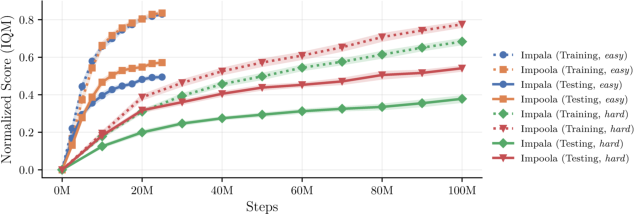
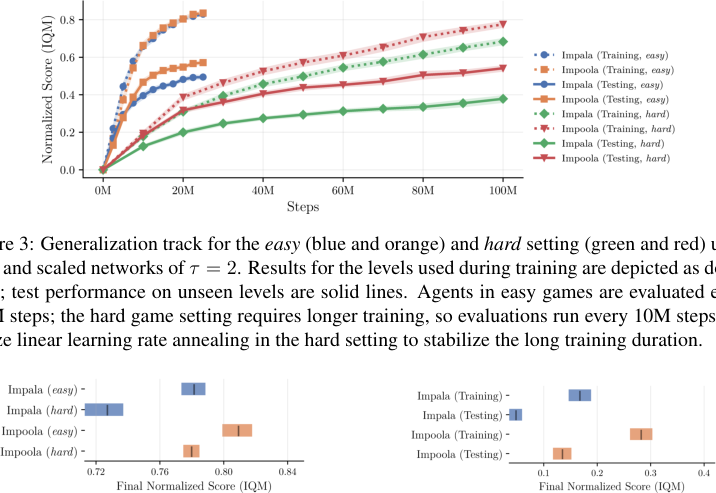
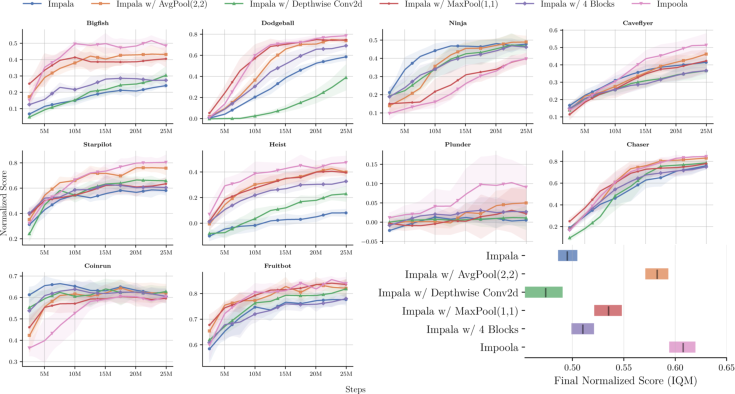
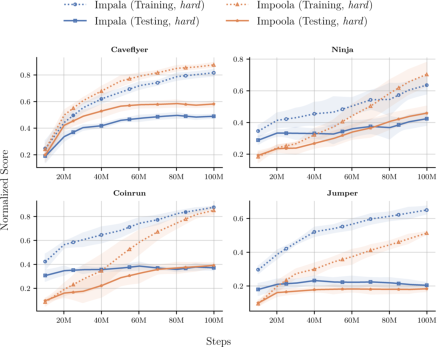
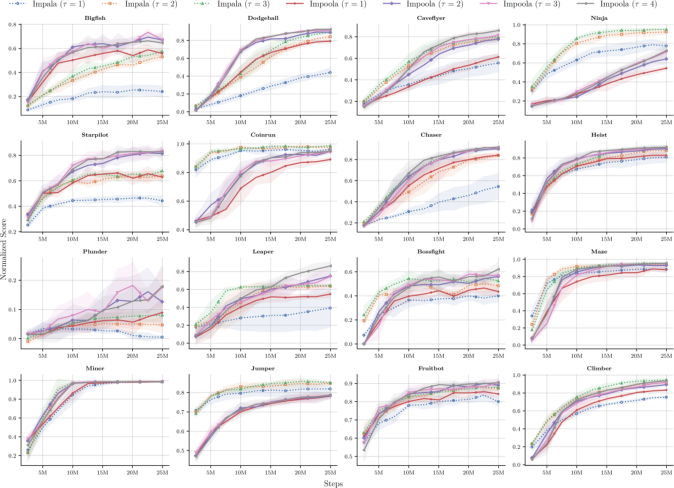
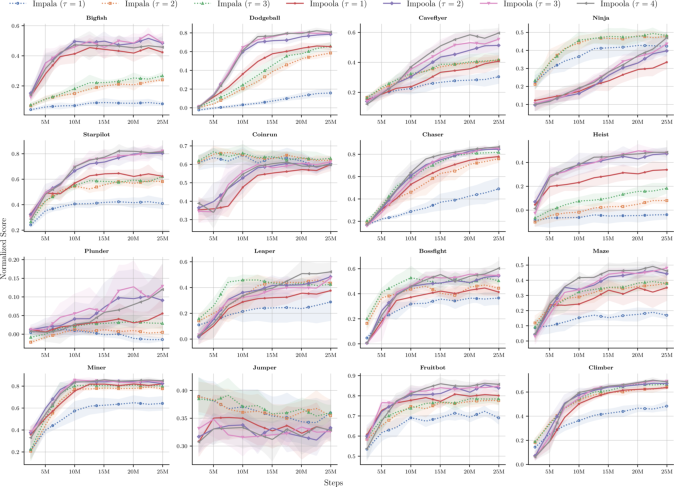
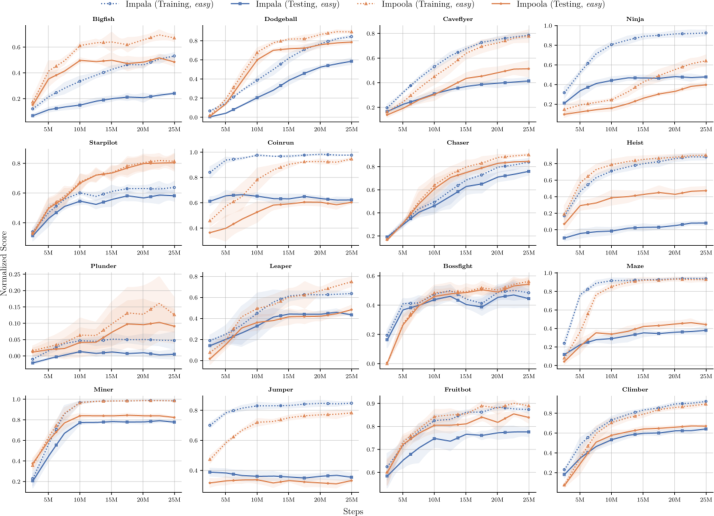
In the easy setting, the performance of Impala-CNN on training levels trails the proposed Impoola-CNN only by a limited margin.
Methodology
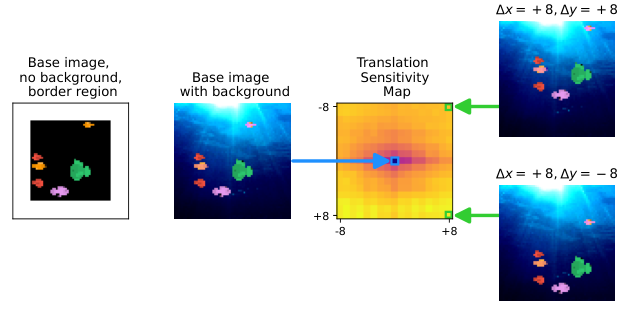
• Our analysis investigates the effect of the GAP layer on the network dynamics, identifying its decreased translation sensitivity as a characteristic quality of Impoola-CNN. Further analysis by Sokar et al. identifies the tokenization of the feature maps for SoftMoEs, rather than the use of multiple experts, to drive the performance gain found in Obando-Ceron et al. .
Study Design
Actor-Critic Methods: In addition to a critic network, e.g., V (s; ϕ) that estimates the state value, the action policy is defined as a dedicated actor network that can be directly optimized towards an optimization goal. PPO is an on-policy DRL method, where the weights θ are updated with respect to the advantage function A(s.
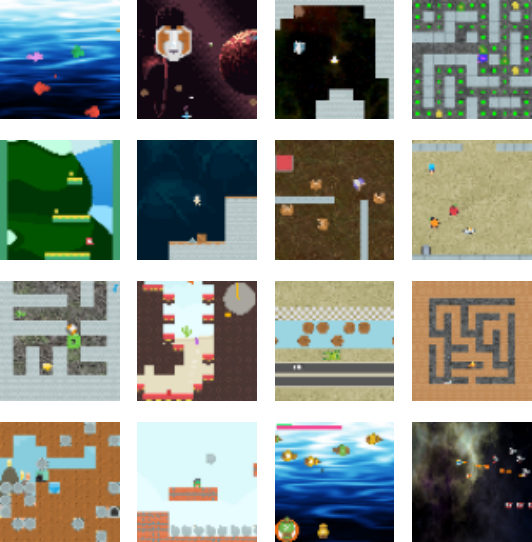
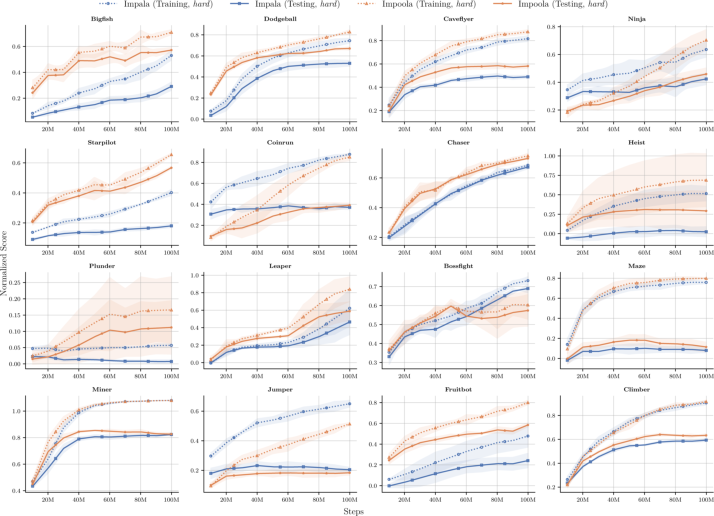
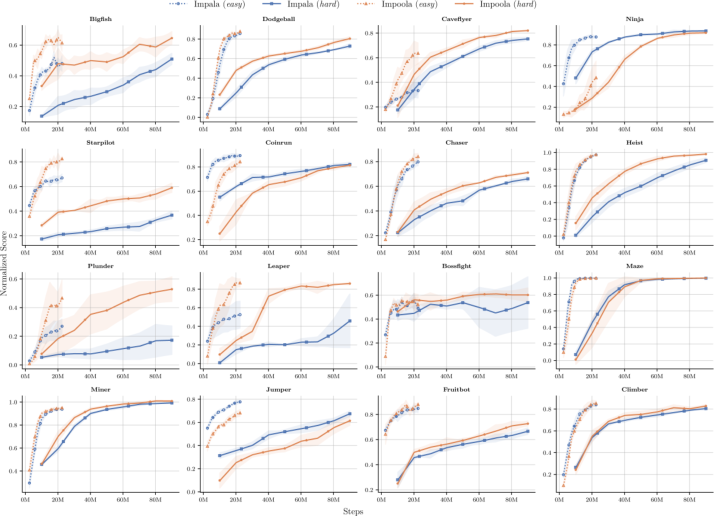
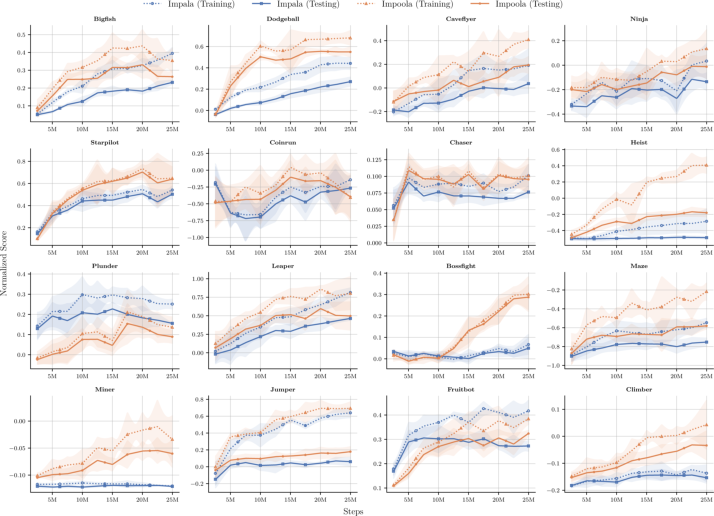
Experiment Design: We base our analysis on the Procgen Benchmark .
Results & Findings
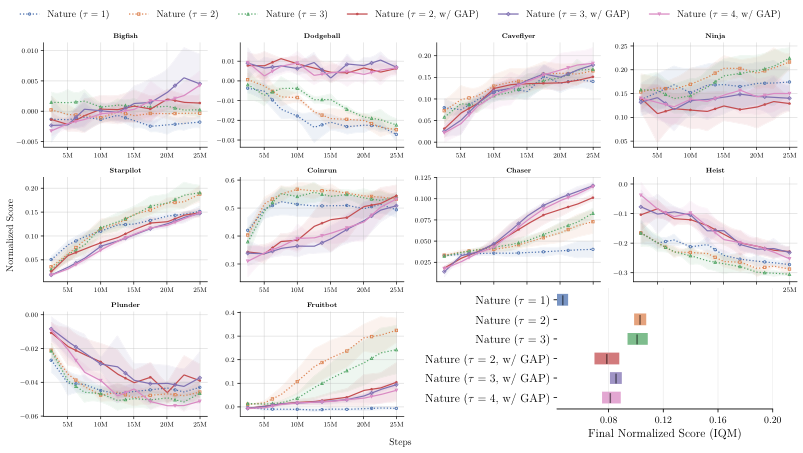
Notably, the Impala-CNN model , a 15-layer convolutional neural network (CNN) with residual connections, outperforms the previously widely used Nature-CNN foot_0 as image encoder for image-based DRL substantially . However, raising the parameter count of DNNs in DRL does not obey scaling laws for better performance as found in other areas in deep learning (DL) , e.g., scaling ResNets to up to 152 layers improves performance for image classification .
- Notably, the Impala-CNN model , a 15-layer convolutional neural network (CNN) with residual connections, outperforms the previously widely used Nature-CNN foot_0 as image encoder for image-based.
- However, raising the parameter count of DNNs in DRL does not obey scaling laws for better performance as found in other areas in deep learning (DL).
- Another line of work has emphasized the impact of improved network design in particular to scale fully connected networks in regular DRL.
- Nature-CNN Impala-CNN Impoola-CNN Figure 1 : Impoola-CNN shows higher generalization over the full Procgen Benchmark than the Nature-CNN and Impala-CNN image encoders when scaling the network.
- The presented results are obtained by evaluating the PPO agent on testing levels after 25M training steps.
For future work, we plan to conduct further experiments outside the Procgen Benchmark.
Another line of work has emphasized the impact of improved network design in particular to scale fully connected networks in regular DRL.
How PDFdigest Helps You Understand Research
Instant Paper Analysis
Get structured summaries and key findings from dense PDFs in seconds.
Visual Explanations
Turn complex methods, figures, and results into clearer visual breakdowns.
AI-Powered Q&A
Ask focused questions and get answers grounded in the paper.
Practical Applications
Overfitting in DRL may be associated with a loss of network plasticity and generalization is theoretically closely related to invariances . We reason that positional information may only be a helpful inductive bias early in training for agent-centered games.
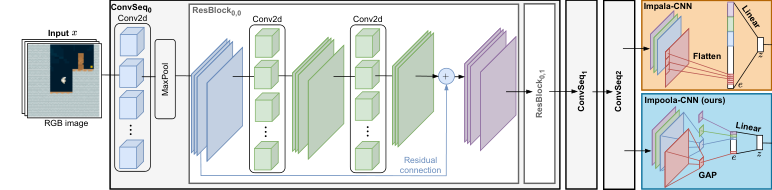
Our advancement is based on the introduction of a GAP layer to the Impala-CNN, which has a two-fold implication.
Deep Reinforcement Learning
This section outlines the fundamentals of deep reinforcement learning, including the Markov decision process, Q-Network methods, and actor-critic methods, providing a foundation for understanding the algorithms used in the study.
Convolutional Neural Networks
The section describes the architecture of Impala-CNN, detailing its components and the role of pooling layers. It explains how global average pooling can reduce translation sensitivity and simplify network architecture.
Source Paper Figures and Captions


Frequently Asked Questions
Similar design improvements for image-based DRL are of high practical appeal, primarily due to the prominence of end-to-end learning in robotic applications . Translation Invariance: A strong inductive bias in computer vision is to incorporate translation invariance, i.e., invariance to the shifts.
Further analysis by Sokar et al. identifies the tokenization of the feature maps for SoftMoEs, rather than the use of multiple experts, to drive the performance gain found in Obando-Ceron et al. . It is evident that the gradual magnitude pruning method.
Another line of work has emphasized the impact of improved network design in particular to scale fully connected networks in regular DRL. A number of invariance-based methods have been shown to facilitate generalization for Procgen environments, ranging from auxiliary losses to data.
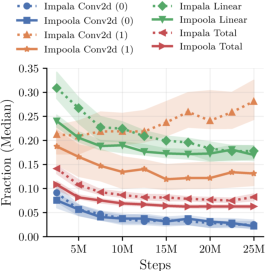
Notably, this layer also has a very high fraction of the network’s overall weights placed due to the high-dimensional embedding created by the Flatten layer. Overfitting in DRL may be associated with a loss of network plasticity and generalization is theoretically closely.
For future work, we plan to conduct further experiments outside the Procgen Benchmark. This approach cannot be transferred to Procgen as the backgrounds are not unicolor.
This paper discusses a new approach to improving deep learning models used in teaching computers to play games by changing how they process images. The authors found that a simpler method of summarizing image data leads to better performance than more complex.