HEAD-RELATED IMPULSE RESPONSE-BASED SPATIAL AUDITORY BRAIN-COMPUTER INTERFACE †
This study explores a new way to help people with severe disabilities communicate using sound instead of sight. It tests a method that uses special audio cues to help users select letters and words.
Use the local video fallback
Content & Liability Disclaimer
This article and its accompanying video are automated summaries derived from HEAD-RELATED IMPULSE RESPONSE-BASED SPATIAL AUDITORY BRAIN-COMPUTER INTERFACE † by Chisaki Nakaizumi, Toshie Matsui, Koichi Mori, Shoji Makino, Tomasz M Rutkowski. The original research was conducted solely by the paper's authors; PDFdigest did not conduct any of the research and makes no claims of ownership over the underlying scientific work.
The video narration is generated by artificial intelligence and references the paper's authors for attribution. The video is not narrated by any of the paper's authors. This content may contain inaccuracies, omissions, or misinterpretations of the original research. First-person language (e.g., "we found", "our results") reflects the original authors' voice, not PDFdigest's. Always read the original paper for accurate, verified information before making any decisions based on this content.
This content is provided "as is" without any warranties, express or implied. Simulated systems OÜ, its officers, directors, employees, and agents shall not be liable for any direct, indirect, incidental, special, consequential, or punitive damages arising from your use of, reliance on, or access to this content, including but not limited to errors, omissions, or misinterpretations of the original research. This disclaimer applies to the fullest extent permitted by applicable law.
- 1 Auditory BCIs can assist individuals who cannot use visual methods due to severe disabilities.
- 2 The study shows promising results with high accuracy in recognizing sounds.
- 3 Using headphones with spatial audio cues may be a better alternative to traditional loudspeaker setups.
Introduction
The introduction discusses the potential of auditory BCIs for individuals with severe disabilities, particularly those unable to use visual modalities. It outlines the research goal of developing a spatial auditory BCI using HRIR for improved sound spatialization and compares it to previous methods.
Methods
The methods section details the experimental setup, including participant demographics, ethical considerations, and the auditory stimuli used. It describes the EEG signal acquisition process and the specific parameters for the auditory stimuli presented to participants.
Results and Discussion
This section presents the findings from the psychophysical and EEG experiments, highlighting high accuracy rates and P300 response latencies. It discusses the implications of the results, including comparisons with previous BCI methods and the potential for further improvements.
How PDFdigest Helps You Understand Research
Instant Paper Analysis
Get structured summaries and key findings from dense PDFs in seconds.
Visual Explanations
Turn complex methods, figures, and results into clearer visual breakdowns.
AI-Powered Q&A
Ask focused questions and get answers grounded in the paper.
Conclusions
The conclusions summarize the findings, noting the confirmation of P300 responses and the need for further training to improve accuracy. It emphasizes the potential of HRIR-based stimuli while acknowledging the challenges compared to visual BCIs.
Source Paper Figures and Captions
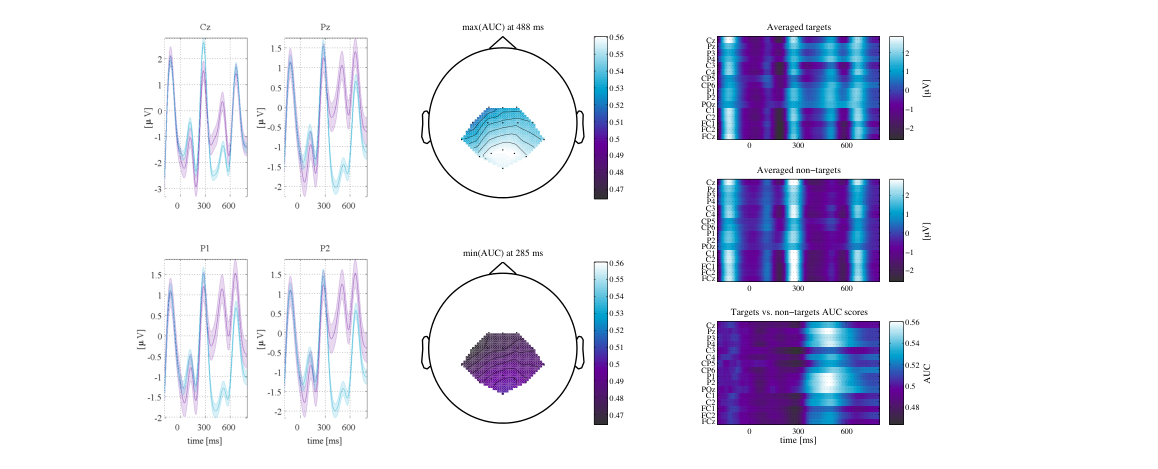
Illustrates the effectiveness of the auditory stimuli in eliciting P300 responses.
Frequently Asked Questions
This study explores a new way to help people with severe disabilities communicate using sound instead of sight. It tests a method that uses special audio cues to help users select letters and words.
The introduction discusses the potential of auditory BCIs for individuals with severe disabilities, particularly those unable to use visual modalities. It outlines the research goal of developing a spatial auditory BCI using.
The methods section details the experimental setup, including participant demographics, ethical considerations, and the auditory stimuli used. It describes the EEG signal acquisition process and the specific parameters for the auditory stimuli.
Yes. PDFDigest can turn this paper into a structured explanation, key takeaways, visual summaries, and a narrated video when available.