Generalised Bellman recurrence and: Evidence from Dualities Sequential
This paper explores how the Bellman equation, a key concept in decision-making, can be understood through three important conditions. It shows how these conditions relate to each other and lead to useful insights in various fields like reinforcement learning and control.
Content & Liability Disclaimer
This article and its accompanying video are automated summaries derived from Generalised Bellman recurrence and three dualities in sequential decision-making by Fernando E Rosas, David Hyland, Daniel Polani. The original research was conducted solely by the paper's authors; PDFdigest did not conduct any of the research and makes no claims of ownership over the underlying scientific work.
The video narration is generated by artificial intelligence and references the paper's authors for attribution. The video is not narrated by any of the paper's authors. This content may contain inaccuracies, omissions, or misinterpretations of the original research. First-person language (e.g., "we found", "our results") reflects the original authors' voice, not PDFdigest's. Always read the original paper for accurate, verified information before making any decisions based on this content.
This content is provided "as is" without any warranties, express or implied. Simulated systems OÜ, its officers, directors, employees, and agents shall not be liable for any direct, indirect, incidental, special, consequential, or punitive damages arising from your use of, reliance on, or access to this content, including but not limited to errors, omissions, or misinterpretations of the original research. This disclaimer applies to the fullest extent permitted by applicable law.
- 1 The Bellman equation is central to optimal decision-making.
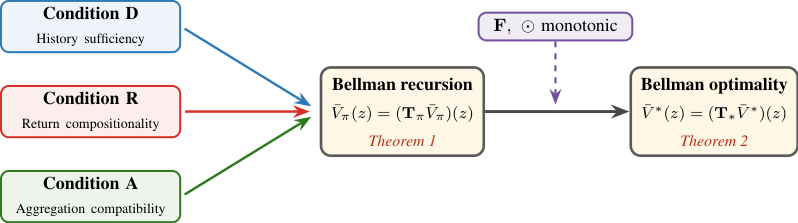
- 2 Three conditions are necessary for the Bellman equation to hold.
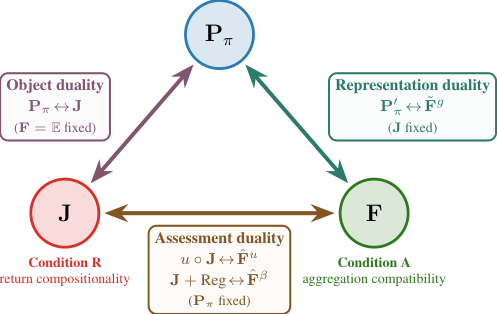
- 3 These conditions reveal important relationships between probability, returns, and uncertainty.
Introduction
The introduction discusses the significance of Bellman’s principle of optimality in reinforcement learning and outlines the three conditions necessary for this principle to hold, leading to the derivation of the Bellman equations.
Methods
The article should be read as a source-grounded explanation of the paper’s argument, evidence, and analysis rather than as a new independent experiment. The summary is grounded in the paper text and the extracted evidence used by PDFDigest.
PDFDigest preserves the distinction between the paper’s own claims, its cited evidence, and plain-language explanation for readers.
A general framework for sequential decision problems
This section formalizes the decision-making framework, defining optimal policies and the role of trajectories, returns, and aggregation in sequential decision problems.
How PDFdigest Helps You Understand Research
Instant Paper Analysis
Get structured summaries and key findings from dense PDFs in seconds.
Visual Explanations
Turn complex methods, figures, and results into clearer visual breakdowns.
AI-Powered Q&A
Ask focused questions and get answers grounded in the paper.
Three conditions for Bellman recursion
The section details the three conditions (D, R, A) necessary for the optimization problem to admit a Bellman recursion, explaining their implications for the structure of decision-making.
Condition D (history sufficiency)
Condition D states that the dynamics must decompose through sufficient statistics, allowing the transition probabilities to depend only on a sufficient statistic derived from the history.
Condition R (return compositionality)
Condition R requires that returns can be decomposed recursively, indicating that the return functional can be expressed in terms of local return functions and an associative operator.
Limitations and Cautions
A useful limitation and caution is that this article summarizes the available paper text and extracted evidence; readers should consult the source paper before treating any interpretation as definitive.
The paper’s conclusions may depend on its source selection, definitions, assumptions, and the scope of its analysis, so follow-up reading is important.
Source Paper Figures and Captions
![, with d[g(1 -p)] = -g ′ (1 -p) dp, g ′ (1 -p) dp.](https://pdfdigest.com/wp-content/uploads/nala/output/paper_ixPJwXJPkPP61LAn_figure_03.png)
![That is, the fact that Fg[c + Z] = c + Fg[Z], which holds because g • Pπ is normalised. 8 The tail-integral formula says E[Y ] = ∞ 0 P(Y > x) dx = ∞ 0 S Y (x) dx with S Y (x) = P(Y > x).](https://pdfdigest.com/wp-content/uploads/nala/output/paper_ixPJwXJPkPP61LAn_figure_04.png)
Frequently Asked Questions
This paper explores how the Bellman equation, a key concept in decision-making, can be understood through three important conditions. It shows how these conditions relate to each other and lead to useful insights in various fields like reinforcement learning and control.
The introduction discusses the significance of Bellman’s principle of optimality in reinforcement learning and outlines the three conditions necessary for this principle to hold, leading to the derivation of the Bellman equations.
The article should be read as a source-grounded explanation of the paper’s argument, evidence, and analysis rather than as a new independent experiment. The summary is grounded in the paper text and the extracted evidence used.
Yes. PDFDigest can turn this paper into a structured explanation, key takeaways, visual summaries, and a narrated video when available.