Neuroprosthetic Motor Brings Event-based Neural Decoding for into Focus
This paper discusses a new method for controlling prosthetic limbs using brain signals. The method is designed to be efficient and responsive, making it suitable for real-time use.
Content & Liability Disclaimer
This article and its accompanying video are automated summaries derived from Event-based Neural Decoding for Neuroprosthetic Motor Control by Khaleelulla Khan Nazeer, Sirine Arfa, Matthias Jobst, Richard George, Christian Mayr. The original research was conducted solely by the paper's authors; PDFdigest did not conduct any of the research and makes no claims of ownership over the underlying scientific work.
The video narration is generated by artificial intelligence and references the paper's authors for attribution. The video is not narrated by any of the paper's authors. This content may contain inaccuracies, omissions, or misinterpretations of the original research. First-person language (e.g., "we found", "our results") reflects the original authors' voice, not PDFdigest's. Always read the original paper for accurate, verified information before making any decisions based on this content.
This content is provided "as is" without any warranties, express or implied. Simulated systems OÜ, its officers, directors, employees, and agents shall not be liable for any direct, indirect, incidental, special, consequential, or punitive damages arising from your use of, reliance on, or access to this content, including but not limited to errors, omissions, or misinterpretations of the original research. This disclaimer applies to the fullest extent permitted by applicable law.
- 1 The output of the EGRU is then passed through a linear head to produce the final output. y is the sparse output of the EGRU layer that's fed back into the model as recurrent input.
- 2 It computes the Euclidean distance between the agent's current position and the target, then uses a sigmoid function to softly indicate whether the target has been reached (with a sharpness parameter controlling the transition).
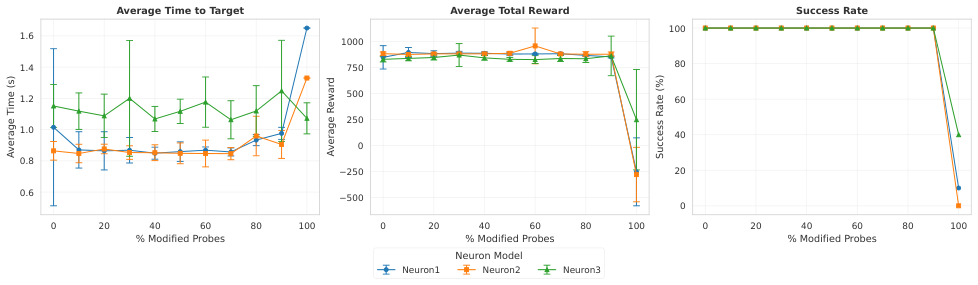
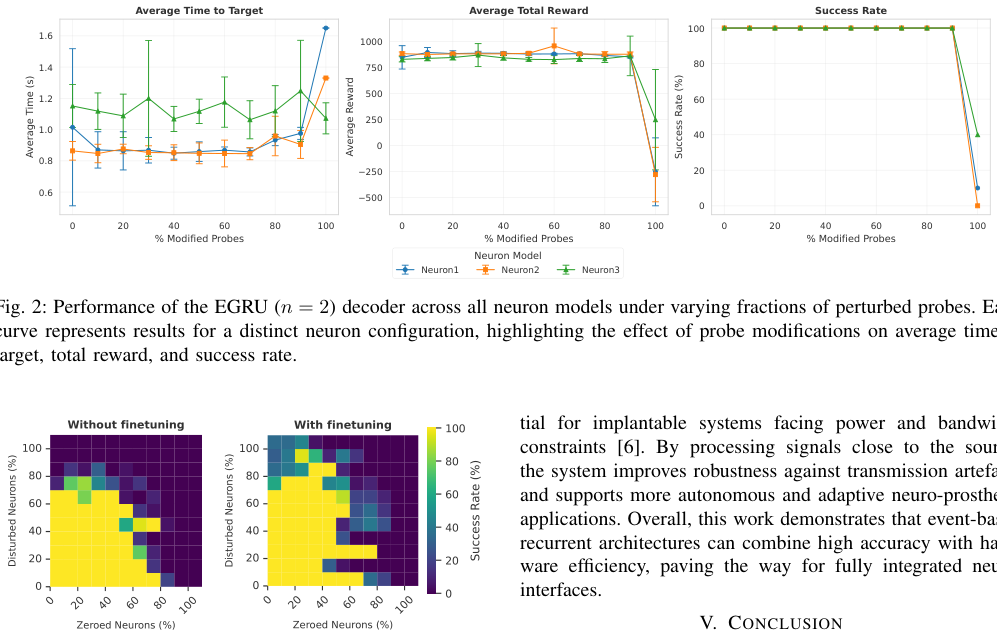
- 3 To evaluate robustness under degraded recording conditions, we introduced controlled perturbations before evaluation.
- 4 To evaluate our EGRU-based neural decoder, we conducted a series of experiments designed to assess performance, robustness, and efficiency under varying conditions.
Introduction
The development of intra-cortical Brain-Machine Interfaces has accelerated in recent years, aiming to restore functional independence to individuals affected by paralysis and neurodegenerative diseases. Building on this foundation, the 2025 competition introduces an even more demanding scenario: closed-loop neural decoding.
Here, algorithms must adapt and perform in real time, mirroring clinical neuro-prosthetic applications.
An Online Prosthesis Simulator (OPS) gen-Partially funded by the German Research Foundation (DFG, Deutsche Forschungsgemeinschaft) as part of Germany’s Excellence Strategy -EXC 2050/1 -Project ID 390696704 -Cluster of Excellence “Centre for Tactile Internet with Human-in-the-Loop” (CeTI) of TU Dresden, German Federal Ministry of Education and Research (BMBF), funding reference 16ME0729K, joint project “EVENTS” and the.
Spiking neural networks (SNNs) mimic the brain’s sparse, asynchronous signals and are promising in resource-limited settings.
Methodology
Participants were evaluated using the Neurobench suite on non-human primate datasets and ranked by decoding accuracy and computational efficiency . The challenge consists of two tracks centered on a closed-loop center-out task where a virtual cursor must move from a central starting point to a randomly positioned target in a twodimensional plane.
Study Design
2) On-Device-Efficient Decoder Design: This approach achieves high task performance with only 2 EGRU units (2K parameters), demonstrating strong accuracyefficiency trade-offs for implantable applications.
We designed the reward function to provide a smooth, differentiable signal for reaching a target in a continuous control task.
Results & Findings
To advance this field, the 2024 IEEE Bio-CAS Grand Challenge established a benchmark emphasizing neural decoders that combine high prediction accuracy with strict resource constraints inherent to implantable systems. erates neural activity from 96 directionally sensitive neurons in response to desired acceleration vectors, and decoders must infer velocity commands from this synthetic data.
- To advance this field, the 2024 IEEE Bio-CAS Grand Challenge established a benchmark emphasizing neural decoders that combine high prediction accuracy with strict resource constraints inherent.
- erates neural activity from 96 directionally sensitive neurons in response to desired acceleration vectors, and decoders must infer velocity commands from this synthetic data.
- They can learn control policies with low-latency, asynchronous communication, but deep SNNs still lag behind dense DNNs in accuracy.
- In the present work, we adopt the EGRU for neural decoding.
- In the pre-training stage, the model learns from synthetic trajectories generated offline followed by RL-based fine-tuning in a closed-loop environment.
The output of the EGRU is then passed through a linear head to produce the final output. y is the sparse output of the EGRU layer that’s fed back into the model as recurrent input.
It computes the Euclidean distance between the agent’s current position and the target, then uses a sigmoid function to softly indicate whether the target has been reached (with a sharpness parameter controlling the transition).
How PDFdigest Helps You Understand Research
Instant Paper Analysis
Get structured summaries and key findings from dense PDFs in seconds.
Visual Explanations
Turn complex methods, figures, and results into clearer visual breakdowns.
AI-Powered Q&A
Ask focused questions and get answers grounded in the paper.
I. Introduction
The introduction discusses the advancements in intra-cortical Brain-Machine Interfaces aimed at restoring independence for individuals with paralysis. It highlights the challenges of neural decoders in terms of prediction accuracy and resource constraints, particularly in closed-loop systems.
A. Model Architecture
The model architecture consists of a linear layer projecting input spikes to a feature space, followed by an EGRU layer that processes the data. The architecture is designed for low computational footprint while maintaining performance.
3) Robustness to Chronic Neural Signal Degradation
This section evaluates the model’s resilience to chronic neural signal degradation, including signal dropout and tuning drift, demonstrating its robustness in realistic scenarios.
Source Paper Figures and Captions
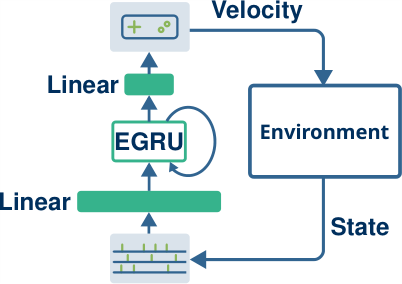
Illustrates the structure and flow of data through the neural decoder, highlighting the efficiency of the EGRU layer.
Frequently Asked Questions
The development of intra-cortical Brain-Machine Interfaces has accelerated in recent years, aiming to restore functional independence to individuals affected by paralysis and neurodegenerative diseases. Performance is evaluated by time-to-target, the ability to maintain the cursor within the target area, and a low.
Participants were evaluated using the Neurobench suite on non-human primate datasets and ranked by decoding accuracy and computational efficiency . The challenge consists of two tracks centered on a closed-loop center-out task where a virtual cursor must move from a central starting.
The output of the EGRU is then passed through a linear head to produce the final output. y is the sparse output of the EGRU layer that’s fed back into the model as recurrent input. It computes the Euclidean distance between the.
Spiking neural networks (SNNs) mimic the brain’s sparse, asynchronous signals and are promising in resource-limited settings.
This paper discusses a new method for controlling prosthetic limbs using brain signals. The method is designed to be efficient and responsive, making it suitable for real-time use.
Yes. PDFDigest can turn this paper into a structured explanation, key takeaways, visual summaries, and a narrated video when available.