AI-Driven Clinical Decision Support System for Enhanced Diabetes Diagnosis and Management
This study presents a new AI system designed to help doctors diagnose and manage type 2 diabetes more effectively. It combines expert knowledge with advanced technology to improve accuracy in identifying diabetes and prediabetes.
Content & Liability Disclaimer
This article and its accompanying video are automated summaries derived from AI-Driven Clinical Decision Support System for Enhanced Diabetes Diagnosis and Management by Mujeeb Ur Rehman, Imran Rehan, Sohail Khalid. The original research was conducted solely by the paper's authors; PDFdigest did not conduct any of the research and makes no claims of ownership over the underlying scientific work.
The video narration is generated by artificial intelligence and references the paper's authors for attribution. The video is not narrated by any of the paper's authors. This content may contain inaccuracies, omissions, or misinterpretations of the original research. First-person language (e.g., "we found", "our results") reflects the original authors' voice, not PDFdigest's. Always read the original paper for accurate, verified information before making any decisions based on this content.
This content is provided "as is" without any warranties, express or implied. Simulated systems OÜ, its officers, directors, employees, and agents shall not be liable for any direct, indirect, incidental, special, consequential, or punitive damages arising from your use of, reliance on, or access to this content, including but not limited to errors, omissions, or misinterpretations of the original research. This disclaimer applies to the fullest extent permitted by applicable law.
- 1 Further exploration is needed to investigate how the system can integrate with other medical technologies to create a comprehensive AI-driven healthcare ecosystem.
- 2 T He study of medical diagnoses is essential in the healthcare sector to enhance the clinical outcomes.
- 3 It is anticipated that the number of individuals with diabetes will sharply increase to 592 million by 2035 .
- 4 The World Health Organization (WHO) has classified diabetes mellitus (DM) as a serious concern owing to its sharp increase in prevalence.
Introduction
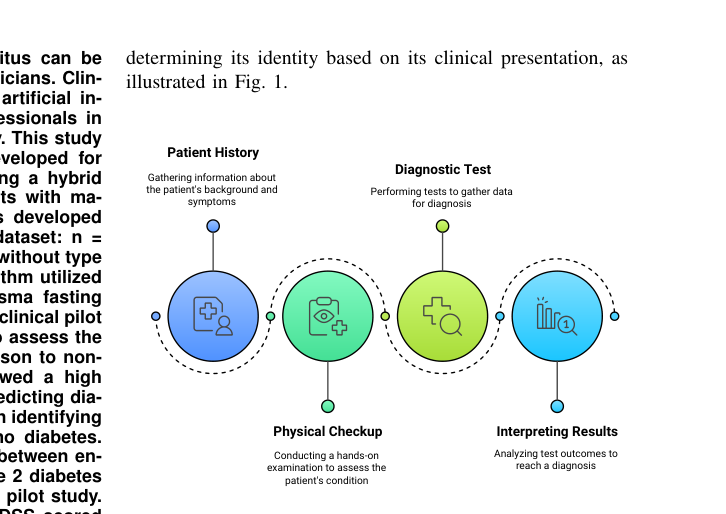
The pathological process, or systematic study of a disease, involves identifying diseases based on clinical experts’ interpretations of signs and symptoms . Assessing the pathology of a disease requires a diagnosis , which is the process of Mujeeb Ur Rehman is with the School of Computer Science and Informatics, De Montfort University, Leicester, UK.
Imran rehan is with the department of physics, Islamia College Peshawar, Pakistan.
Sohail Khalid is with the Computer Science Department, University of Management and Technology, Lahore, Pakistan (e-mail: sohail.khalid@umt.edu.pk).
When a person has type 2 diabetes, their body develops insulin resistance because the pancreas is unable to generate enough insulin to fulfil their needs.
Research Question
Further exploration is needed to investigate how the system can integrate with other medical technologies to create a comprehensive AI-driven healthcare ecosystem.
Methodology
A white-box AI-driven decision system is primarily built using supervised algorithms such as the decision tree algorithm, and incorporates associations and visibility among rules for the analysis of accumulated data. The missing values were handled using the imputation method as.
Study Design
The dataset was subjected to several machine learning methods, including Decision Tree (DT), Random Forest, J48, Chi-squared Automatic Interaction Detection (CHAID), and Classification and Regression Tree (CART).
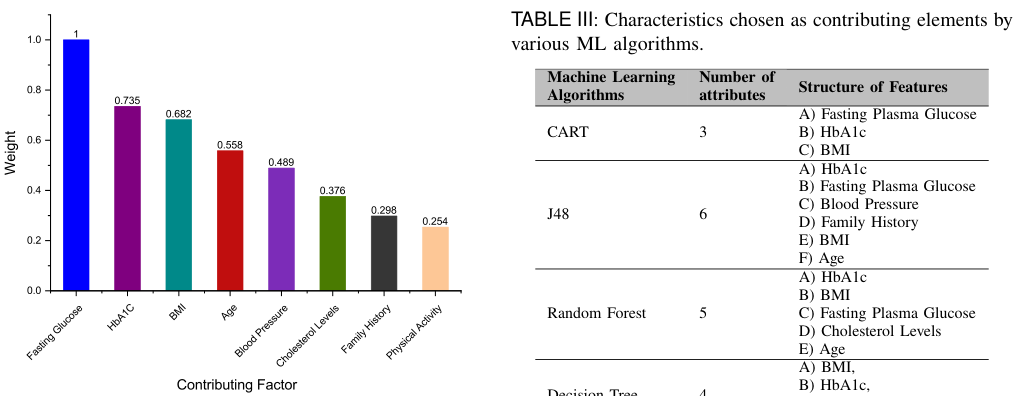
1 0.735 0.682 0.558 0.489 0.376 0.298 0.254 F a s ti n g G lu c o s e H b A 1 C B M I A g e B lo o d P r e s s u r e C h o le s te r o l L e v.
How PDFdigest Helps You Understand Research
Instant Paper Analysis
Get structured summaries and key findings from dense PDFs in seconds.
Visual Explanations
Turn complex methods, figures, and results into clearer visual breakdowns.
AI-Powered Q&A
Ask focused questions and get answers grounded in the paper.
Results & Findings
T He study of medical diagnoses is essential in the healthcare sector to enhance the clinical outcomes. A disease is a condition or set of conditions that results in pain and suffering, illness, malfunction, or ultimately, death .
- T He study of medical diagnoses is essential in the healthcare sector to enhance the clinical outcomes.
- A disease is a condition or set of conditions that results in pain and suffering, illness, malfunction, or ultimately, death .
- Diabetes can cause several health problems that affect numerous body parts.
- It is anticipated that the number of individuals with diabetes will sharply increase to 592 million by 2035 .
- The World Health Organization (WHO) has classified diabetes mellitus (DM) as a serious concern owing to its sharp increase in prevalence.
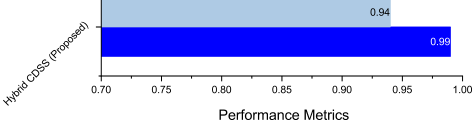
These findings suggest that the hybrid CDSS can be a valuable tool for physicians, particularly in situations where specialized expertise is limited.
T He study of medical diagnoses is essential in the healthcare sector to enhance the clinical outcomes.
Practical Applications
Increased thirst and urination are common early signs of diabetes; additionally, they may lose weight even when their appetite is high . However, oral medication or insulin injections may be necessary for type 2 diabetes depending on its severity , , .
Four outcomes were possible: verified diabetes, prediabetes, at risk, and no diabetes.
During CKM construction, doctors may overlook certain qualities or paths of attributes.
I. Introduction
The introduction discusses the importance of accurate medical diagnoses in healthcare, particularly for chronic illnesses like diabetes. It highlights the challenges faced by primary care physicians in diagnosing type 2 diabetes and the increasing prevalence of the disease globally.
Ii. Ai-Cdss Algorithms For Diabetes
This section outlines the methodology of the AI-CDSS developed for diabetes diagnosis, which combines machine learning insights with expert knowledge. It details the data collection and preprocessing steps involved in the system’s development.
Source Paper Figures and Captions
Frequently Asked Questions
Analyzing test outcomes to reach a diagnosis Diabetes is a serious chronic illness that affects glucose metabolism, and can have major consequences if left untreated. Further exploration is needed to investigate how the system can integrate with other medical technologies to create.
The dataset was subjected to several machine learning methods, including Decision Tree (DT), Random Forest, J48, Chi-squared Automatic Interaction Detection (CHAID), and Classification and Regression Tree (CART). From January 2023 to December 2024, 1,298 participants with and without diabetes were included in.
T He study of medical diagnoses is essential in the healthcare sector to enhance the clinical outcomes. It is anticipated that the number of individuals with diabetes will sharply increase to 592 million by 2035 .
Increased thirst and urination are common early signs of diabetes; additionally, they may lose weight even when their appetite is high . For the recommended course of treatment for breast cancer, WFO showed a 93 % concordance rate; however, it was unable.
For the recommended course of treatment for breast cancer, WFO showed a 93 % concordance rate; however, it was unable to provide the recommended methods used to reach the ultimate clinical conclusion. These findings suggest that the hybrid CDSS can be a.
This study presents a new AI system designed to help doctors diagnose and manage type 2 diabetes more effectively. It combines expert knowledge with advanced technology to improve accuracy in identifying diabetes and prediabetes.