ABiMed: An intelligent and visual clinical decision support system for medication reviews and polypharmacy management
ABiMed is a new system designed to help pharmacists and doctors work together to manage patients who take many medications. It makes the process easier and more efficient by automatically gathering patient information and presenting it in a clear way.
Content & Liability Disclaimer
This article and its accompanying video are automated summaries derived from ABiMed: An intelligent and visual clinical decision support system for medication reviews and polypharmacy management by Abdelmalek Mouazer, Romain Léguillon, Nada Boudegzdame, Thibaud Levrard, Yoann Le Bars, Christian Simon, Brigitte Séroussi, Julien Grosjean, Romain Lelong, Catherine Letord, Stéfan Darmoni, Matthieu Schuers, Karima Sedki, Sophie Dubois, Hector Falcoff, Rosy Tsopra, Jean-Baptiste Lamy. The original research was conducted solely by the paper's authors; PDFdigest did not conduct any of the research and makes no claims of ownership over the underlying scientific work.
The video narration is generated by artificial intelligence and references the paper's authors for attribution. The video is not narrated by any of the paper's authors. This content may contain inaccuracies, omissions, or misinterpretations of the original research. First-person language (e.g., "we found", "our results") reflects the original authors' voice, not PDFdigest's. Always read the original paper for accurate, verified information before making any decisions based on this content.
This content is provided "as is" without any warranties, express or implied. Simulated systems OÜ, its officers, directors, employees, and agents shall not be liable for any direct, indirect, incidental, special, consequential, or punitive damages arising from your use of, reliance on, or access to this content, including but not limited to errors, omissions, or misinterpretations of the original research. This disclaimer applies to the fullest extent permitted by applicable law.
- 1 However, our aim is to be compatible with existing data flows and to encourage software publishers to endorse our approach.
- 2 On the contrary, the objective of this paper is to describe the ABiMed CDSS, including data exchange, ontological rule-based system, and original visual interfaces, and to focus on qualitative evaluations on the software aiming at testing how desirable are the functionalities we propose.
- 3 Pharmacists have to assess the interactions and adverse effects of 5-20 drugs, to identify inappropriate or missing drugs and to write the synthesis.
- 4 Clinical decision support systems (CDSSs) have been shown to be efficient in facilitating clinician work, increasing guidelines adherence, and improving healthcare .
Introduction
Elderly often receive polypharmacy, i.e. five drugs or more. Polypharmacy is both a public health, economic and ecologic issue.
Each new drug administered in polypharmacy increases the risk of adverse events by 12-18% .
The pharmacist assesses the treatment, and writes a synthesis with preconizations for the GP.
Additionally, comments were added to a rule when the execution of the rule cannot be fully automatized.
In future work, we would like to explore the use of argumentation as a way to structure communication between the pharmacist and the GP.
Research Question
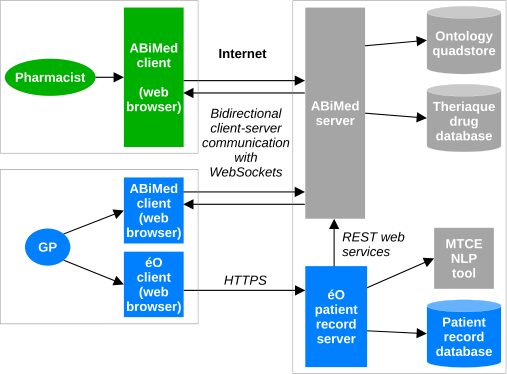
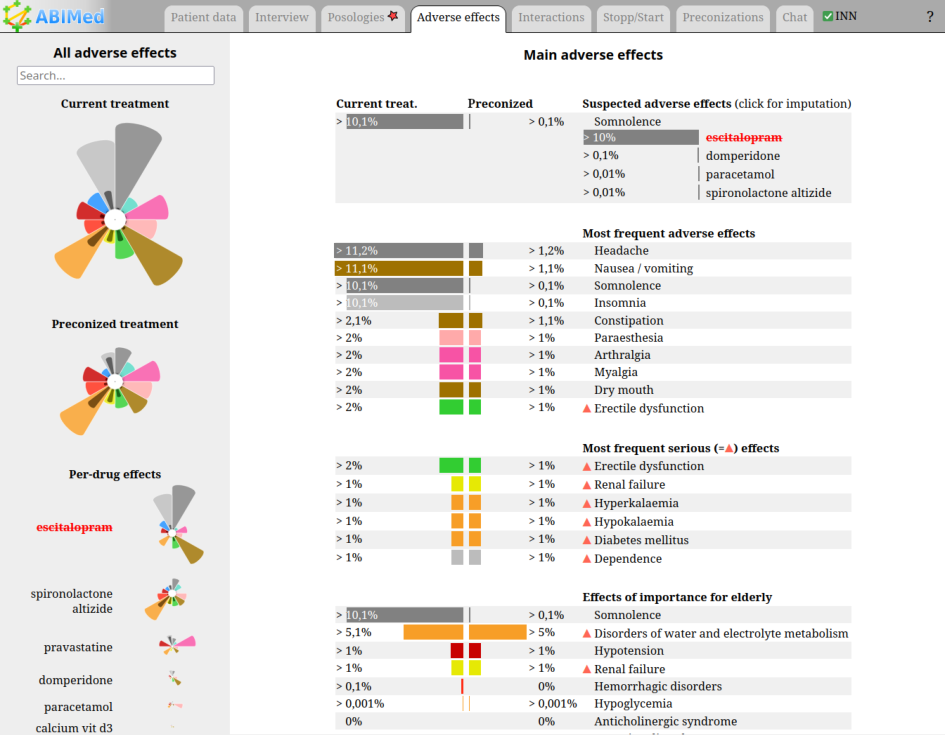
On the contrary, the objective of this paper is to describe the ABiMed CDSS, including data exchange, ontological rule-based system, and original visual interfaces, and to focus on qualitative evaluations on the software aiming at testing how desirable are the functionalities we propose. However, our aim is to be compatible with existing data flows and to encourage software publishers to endorse our approach.
Methodology
However, few pharmacists are engaged in MR, because they lack the appropriate knowledge in geriatrics, they fear the reaction of GPs, and MR is a tedious task. This may turn MR as a more collaborative task, increasing the involvement of the GP.
Study Design
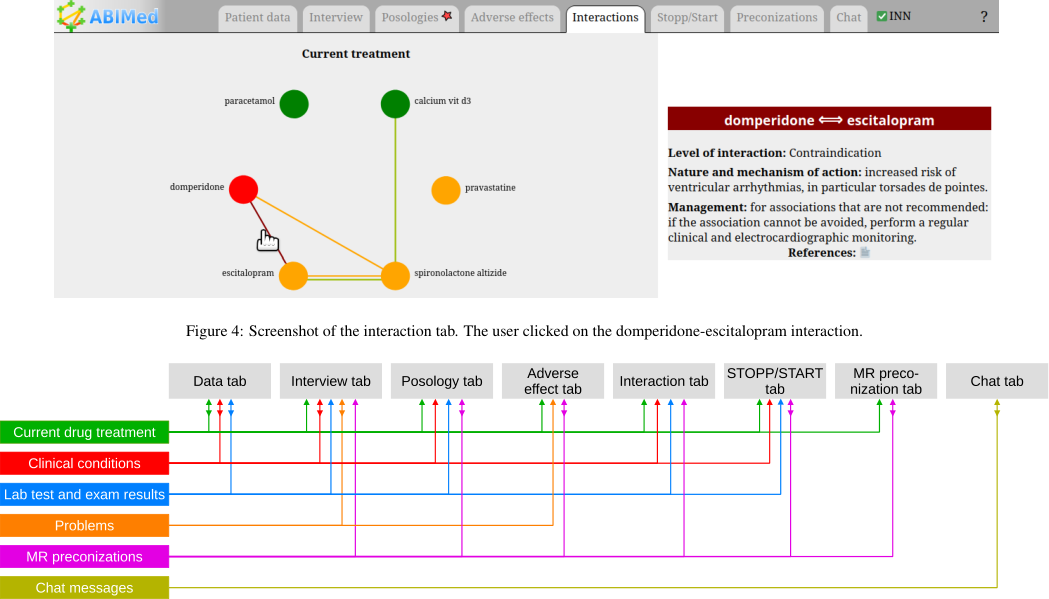
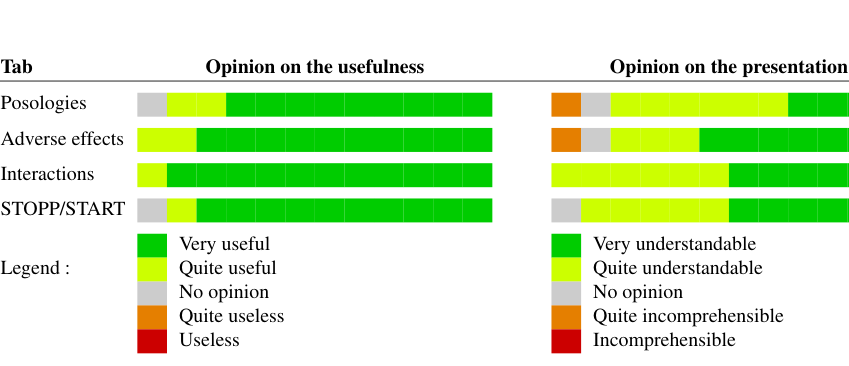
The prototype and its interfaces were presented, and participants’ opinions were collected.
ABiMed was presented during the workshop, and then the participants were divided in small groups and asked to use ABiMed themselves, for analyzing a clinical case.
How PDFdigest Helps You Understand Research
Instant Paper Analysis
Get structured summaries and key findings from dense PDFs in seconds.
Visual Explanations
Turn complex methods, figures, and results into clearer visual breakdowns.
AI-Powered Q&A
Ask focused questions and get answers grounded in the paper.
Results & Findings
Evidence shows it is a major problem in many countries, including Canada , Sweden and France . One solution for reducing polypharmacy is medication review (MR), “a structured interview with the patient, carried out by the pharmacist in collaboration with the general practitioner (GP) with the aim of optimizing patient care” .
- Evidence shows it is a major problem in many countries, including Canada , Sweden and France .
- One solution for reducing polypharmacy is medication review (MR), “a structured interview with the patient, carried out by the pharmacist in collaboration with the general practitioner.
- Evidence shows that MR significantly reduces polypharmacy and saves money, without lowering the quality of care , and can save 273 C per patient-year .
- MR may also have a positive ecological impact, by reducing the consumption of drugs .
- Pharmacists have to assess the interactions and adverse effects of 5-20 drugs, to identify inappropriate or missing drugs and to write the synthesis.
Many problems were: (1) of very low severity, e.g. the absence of handling of the “escape” key to close dialog boxes, (2) not directly related to the decision support activity, e.g. the absence of a “password lost” functionality, or (3).
However, it requires temporal data, which may be difficult to obtain, especially for the pharmacist (e.g. when extracting drug treatment from health insurance reimbursement, only the drug delivered in the last months are present, thus the initial prescription date cannot.
Practical Applications
Other drugs may see their dose changed, and drugs may also be added, e.g. to control adverse events. For example, one may replace a drug involved in a serious interaction by another drug, involved in even more serious interactions.
The standard we selected may not be the most recent ones, but are the most used today in France.
To overcome this difficulty, it was made possible to exploit HeTOP’s inter-terminological semantic network by internally using more generic terminologies such as the controlled vocabulary thesaurus Medical Subject Headings (MeSH).
While it might have been more obvious to work with an editor of pharmacy management software, the amount of clinical data available in such software is very limited.
Background
Polypharmacy, defined as the use of five or more medications, poses significant public health and economic challenges. Medication reviews conducted by pharmacists aim to optimize drug treatments and reduce unnecessary prescriptions. Despite the availability of clinical guidelines, the implementation of medication reviews remains limited due to the complexity and time required.
General principles
The system is built on principles that include intelligent implementation of clinical guidelines, automatic data extraction, comparative treatment analysis, and cooperative usage between healthcare professionals to enhance the medication review process.
Source Paper Figures and Captions
Frequently Asked Questions
On the contrary, the objective of this paper is to describe the ABiMed CDSS, including data exchange, ontological rule-based system, and original visual interfaces, and to focus on qualitative evaluations on the software aiming at testing how desirable are the functionalities we.
However, few pharmacists are engaged in MR, because they lack the appropriate knowledge in geriatrics, they fear the reaction of GPs, and MR is a tedious task. ABiMed was presented during the workshop, and then the participants were divided in small groups.
Pharmacists have to assess the interactions and adverse effects of 5-20 drugs, to identify inappropriate or missing drugs and to write the synthesis. Clinical decision support systems (CDSSs) have been shown to be efficient in facilitating clinician work, increasing guidelines adherence, and.
To overcome this difficulty, it was made possible to exploit HeTOP’s inter-terminological semantic network by internally using more generic terminologies such as the controlled vocabulary thesaurus Medical Subject Headings (MeSH). When a checkbox is checked, a drop-down combo list appears, allowing to.
Many problems were: (1) of very low severity, e.g. the absence of handling of the “escape” key to close dialog boxes, (2) not directly related to the decision support activity, e.g. the absence of a “password lost” functionality, or (3) not problematic.
ABiMed is a new system designed to help pharmacists and doctors work together to manage patients who take many medications. It makes the process easier and more efficient by automatically gathering patient information and presenting it in a clear way.