A Misclassification Network-Based: Evidence from Comparative Genomic
This paper introduces a new method for analyzing genome sequences that focuses on understanding errors in classification. By studying how genomes are misclassified, researchers can gain insights into their relationships and improve classification methods.
Content & Liability Disclaimer
This article and its accompanying video are automated summaries derived from A MISCLASSIFICATION NETWORK-BASED METHOD FOR COMPARATIVE GENOMIC ANALYSIS by Wan He, Tina Eliassi-Rad, Samuel V Scarpino. The original research was conducted solely by the paper's authors; PDFdigest did not conduct any of the research and makes no claims of ownership over the underlying scientific work.
The video narration is generated by artificial intelligence and references the paper's authors for attribution. The video is not narrated by any of the paper's authors. This content may contain inaccuracies, omissions, or misinterpretations of the original research. First-person language (e.g., "we found", "our results") reflects the original authors' voice, not PDFdigest's. Always read the original paper for accurate, verified information before making any decisions based on this content.
This content is provided "as is" without any warranties, express or implied. Simulated systems OÜ, its officers, directors, employees, and agents shall not be liable for any direct, indirect, incidental, special, consequential, or punitive damages arising from your use of, reliance on, or access to this content, including but not limited to errors, omissions, or misinterpretations of the original research. This disclaimer applies to the fullest extent permitted by applicable law.
- 1 The objective function for classifier training is to minimize the total misclassification cost:.
- 2 The discriminative filters used to compare the genome ensembles are learned by an arbitrary AI model using genome feature information.
- 3 Under this AI-based misclassification network framework, we rely on the judgement of the machine to determine how close a pair of genome ensembles are by computing an indistinguishability score, based on the empirical misclassification likelihood.
- 4 To demonstrate the utility of the GNMA, we utilized 551,230 labeled whole genome SARS-CoV-2 sequences, where each label denotes the specific region in which the sequence was collected.
Introduction
As a consequence, such AI-based genome comparative methods can likely be enhanced by studying drivers of misclassification. Instead of viewing this epistemic challenge as a weakness, we see an opportunity to derive insights from studying how genomes are misclassified by AI models.
By acknowledging and utilizing the pairwise relationships among the misclassified data, our framework generates additional insights into the underlying processes giving rise to the misclassified genomic data.
Comparative genomics: Comparative genomics enhances our understanding of the functional and/or evolutionary significance of genetic variation by analyzing sequences from different individuals and/or species .
Research Question
The objective function for classifier training is to minimize the total misclassification cost:.
Methodology
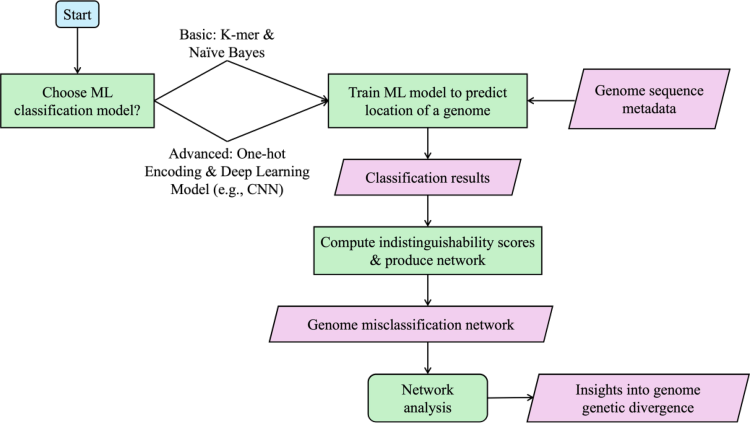
Here, we introduce the Genome Misclassification Network Analysis (GMNA), a genome association analysis framework that extends beyond classification accuracy to extract knowledge from the pairwise relationships among misclassified data. This framework further allows us to integrate network-science-based approaches into downstream analysis of the drivers of misclassification.
Study Design
Genome Misclassification Network Analysis: Here, we introduce an alignment-free framework for comparative analysis, which we call the Genome Misclassification Network Analysis (GMNA).
Without manual feature engineering or explicitly specifying a feature selection scheme for the genome classification task, the AI model automatically learns the features that optimize performance.
How PDFdigest Helps You Understand Research
Instant Paper Analysis
Get structured summaries and key findings from dense PDFs in seconds.
Visual Explanations
Turn complex methods, figures, and results into clearer visual breakdowns.
AI-Powered Q&A
Ask focused questions and get answers grounded in the paper.
Results & Findings
Artificial Intelligence (AI) based approaches, e.g., models using deep learning architectures, have demonstrated remarkable accuracy in classifying genome sequencing data according to metadata such as geographic sampling location , drug resistance , taxonomic grouping , and various other phenotypes of interest . Despite the impressive performance of these models, they typically rely on the widely held assumption in machine learning/AI that classification accuracy best reflects model performance .
- Artificial Intelligence (AI) based approaches, e.g., models using deep learning architectures, have demonstrated remarkable accuracy in classifying genome sequencing data according to metadata such as geographic.
- Despite the impressive performance of these models, they typically rely on the widely held assumption in machine learning/AI that classification accuracy best reflects model performance .
- The reason-ing is that, while ML/AI approaches typically assume errors are driven by random noise inherent in the data, i.e., aleatoric uncertainty, in many biological settings.
- Nevertheless, even finding an approximately optimal solution can be computationally infeasible when dealing with even moderate numbers of moderately sized sequences .
- Alternatively, graph-based alignment methods have improved the efficiency and accuracy of aligning whole-genomes, particularly in the highly polymorphic genomic regions.
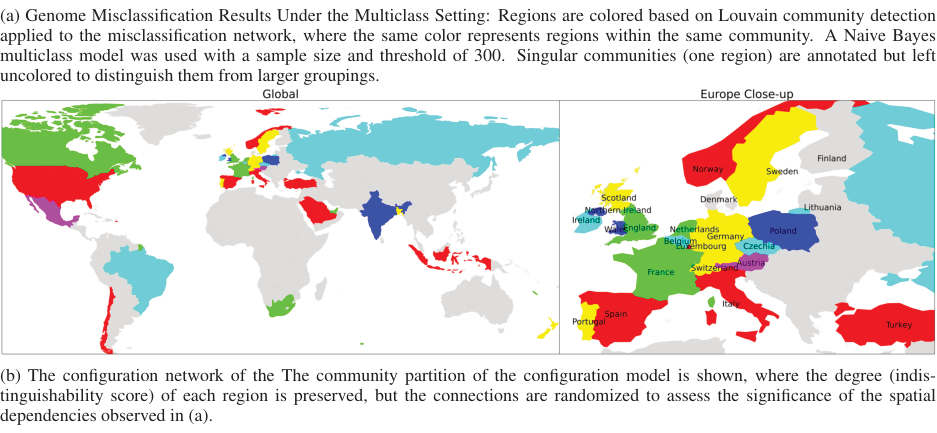
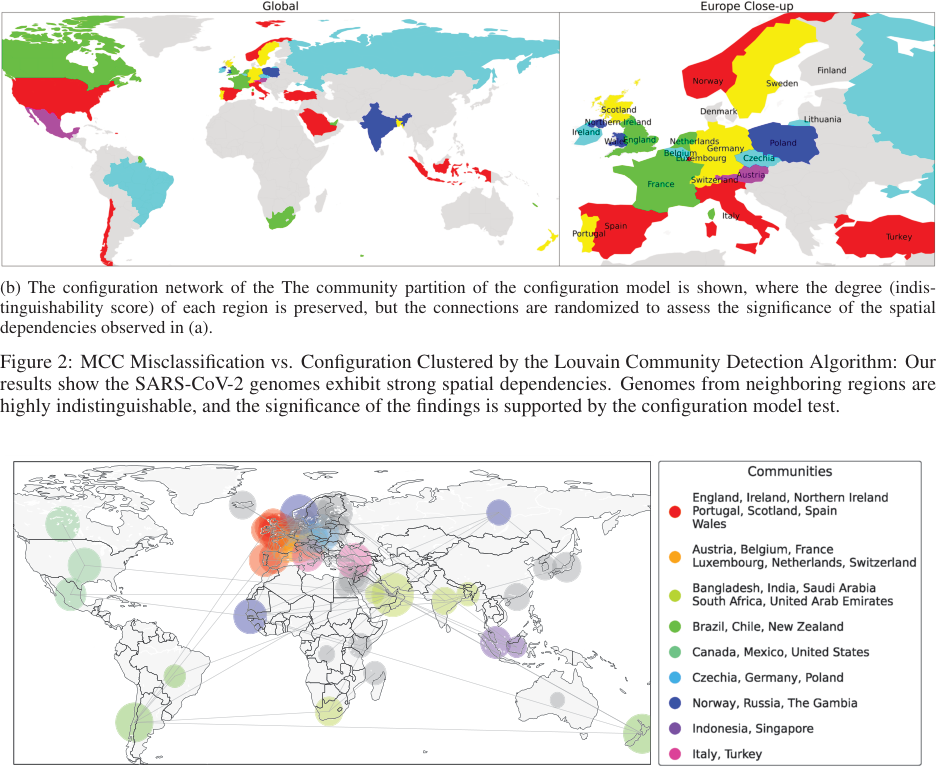
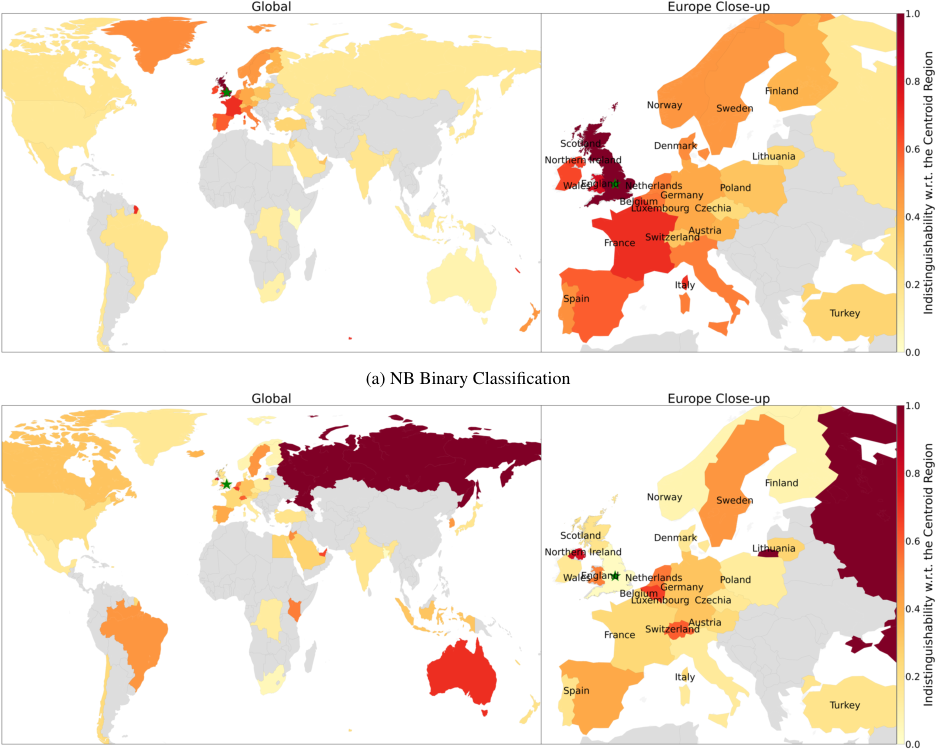
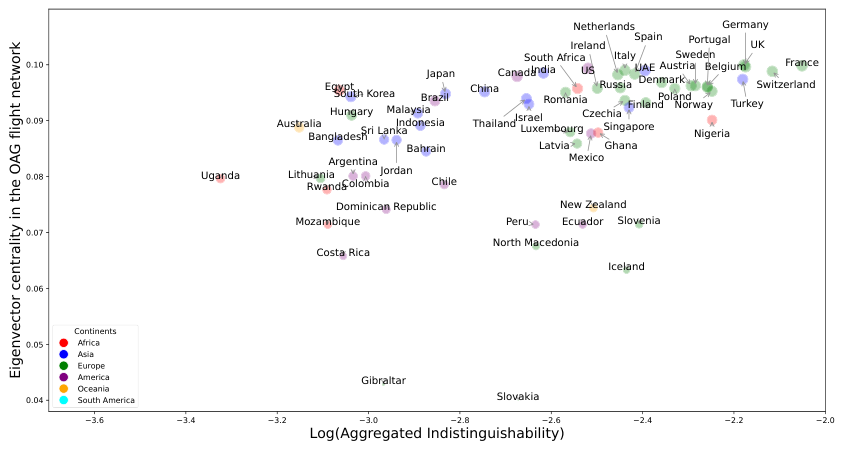
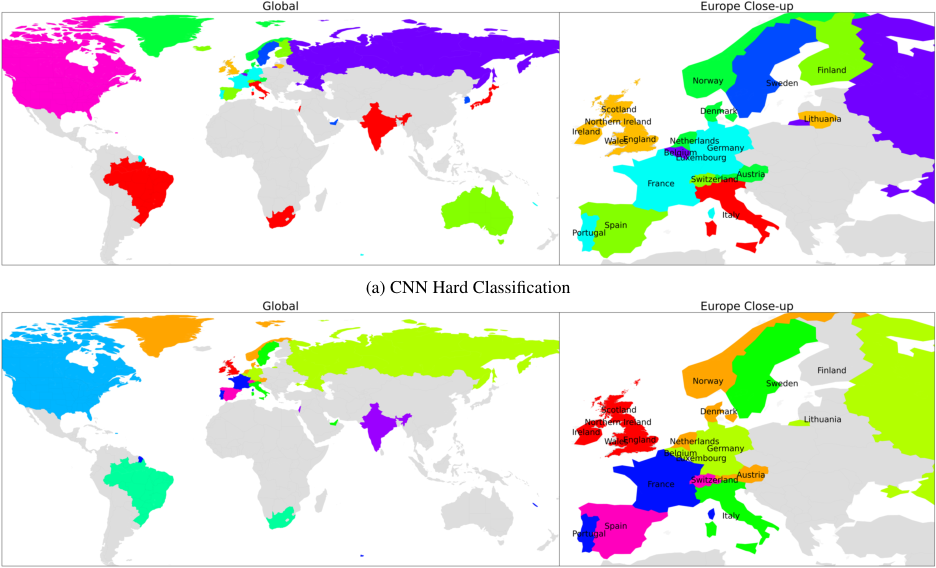
• Using more than 500,000 SARS-CoV-2 genomes, we demonstrate that GMNA can uncover geographic associations between genome sequences with limited computational resources.
Although the misclassified instances produced by a higher-performance classifier intuitively suggest stronger classwise associations, an overly accurate binary classifier that generates few misclassified instances offers limited insights into the genome associations.
Practical Applications
We believe the use of the GMNA may provide meaningful insights beyond traditional accuracybased approaches across the broader field of comparative genomics and for non-genetic data coming from varying application domains. Finally, we discuss how our GMNA may be applied to datasets labeled with multiple features.
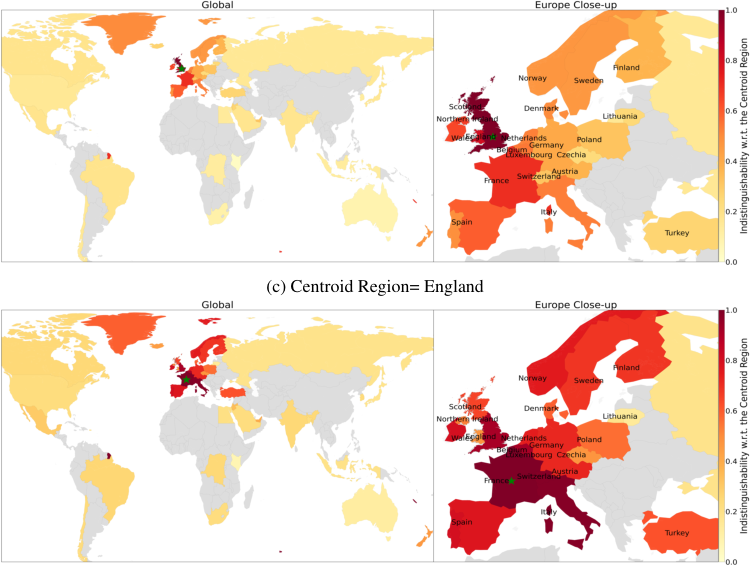
Finally, the genome ensemble association between the centroid and the remaining regions could be computed as,.
Connection to TPV and PPV The True Positive Value (TPV) and Positive Predictive Value (PPV) for region r i could be written as:.
We showed using more than 500,000 SARS-CoV-2 genomes that by employing GMNA, associations between sequences and geographic sampling location could be uncovered with limited computation resources.
Contributions
The contributions section outlines the key innovations of GMNA, including its alignment-free framework, the concept of indistinguishability for measuring genome associations, and its adaptability to various AI models. It highlights the framework’s efficiency in uncovering geographic associations in genomic data.
Misclassification Network Construction
This section details the construction of the misclassification network, defining the problem of mapping genome sequences to location labels and establishing the empirical probabilities of misclassification between regions.
Source Paper Figures and Captions
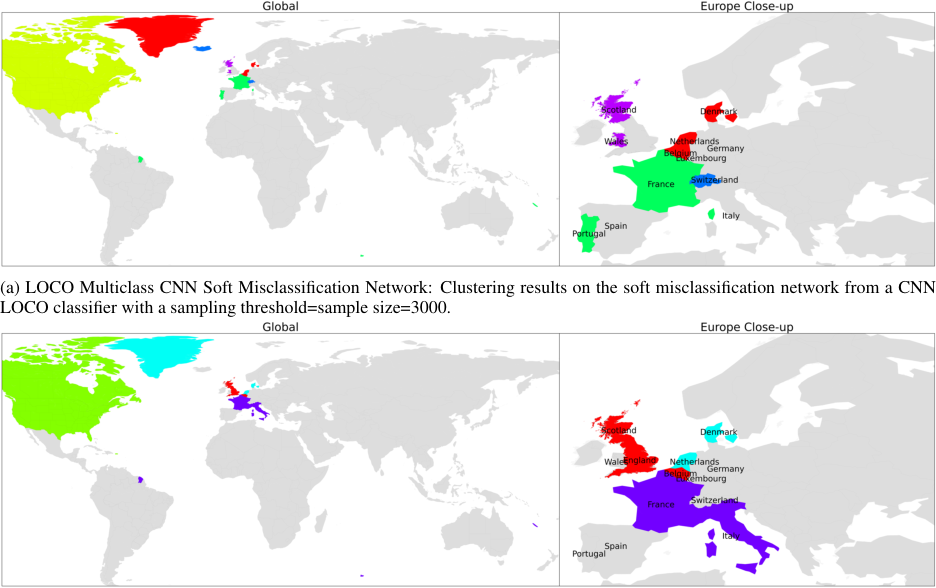
Frequently Asked Questions
Instead of viewing this epistemic challenge as a weakness, we see an opportunity to derive insights from studying how genomes are misclassified by AI models. The objective function for classifier training is to minimize the total misclassification cost:.
• We identify the pairwise association between the target outcome and the predicted outcome, which is then utilized to design a data-driven framework that can incorporate any arbitrary AI model for use in comparative genome analysis. The misclassified instances outputted from the.
The discriminative filters used to compare the genome ensembles are learned by an arbitrary AI model using genome feature information. Under this AI-based misclassification network framework, we rely on the judgement of the machine to determine how close a pair of genome.
Unlike alignment-based methods, alignment-free comparative approaches in genomics typically rely on statistics derived from K-mer words to capture key features without the need for sequence alignment and are therefore efficient for large-scale genome comparisons. The padded sequences are then one-hot encoded to.
• Using more than 500,000 SARS-CoV-2 genomes, we demonstrate that GMNA can uncover geographic associations between genome sequences with limited computational resources. Although the misclassified instances produced by a higher-performance classifier intuitively suggest stronger classwise associations, an overly accurate binary classifier that.
This paper introduces a new method for analyzing genome sequences that focuses on understanding errors in classification. By studying how genomes are misclassified, researchers can gain insights into their relationships and improve classification methods.