AI Rater Discrimination Depends on Scoring Protocol in Complex Clinical Decision-Making
This paper examines how AI systems, specifically large language models, evaluate clinical decisions in diabetes treatment. It highlights the differences in scoring based on the evaluation method used.
Use the local video fallback
Content & Liability Disclaimer
This article and its accompanying video are automated summaries derived from AI Rater Discrimination Depends on Scoring Protocol in Complex Clinical Decision-Making by Sangwon Baek, Yeon Kyu, Hur, Kyunga Kim. The original research was conducted solely by the paper's authors; PDFdigest did not conduct any of the research and makes no claims of ownership over the underlying scientific work.
The video narration is generated by artificial intelligence and references the paper's authors for attribution. The video is not narrated by any of the paper's authors. This content may contain inaccuracies, omissions, or misinterpretations of the original research. First-person language (e.g., "we found", "our results") reflects the original authors' voice, not PDFdigest's. Always read the original paper for accurate, verified information before making any decisions based on this content.
This content is provided "as is" without any warranties, express or implied. Simulated systems OÜ, its officers, directors, employees, and agents shall not be liable for any direct, indirect, incidental, special, consequential, or punitive damages arising from your use of, reliance on, or access to this content, including but not limited to errors, omissions, or misinterpretations of the original research. This disclaimer applies to the fullest extent permitted by applicable law.
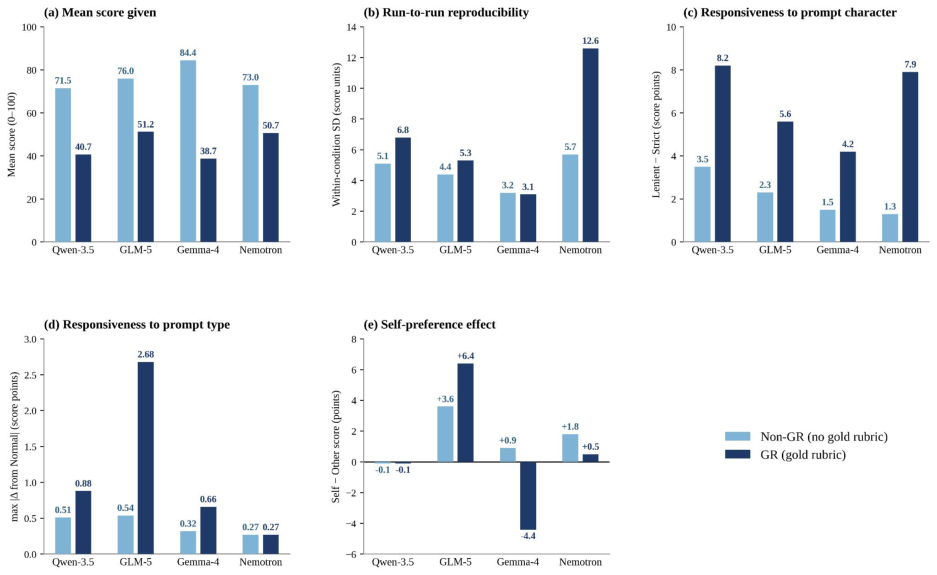
- 1 These findings indicate that a rater model cannot be assumed to score its own outputs neutrally.
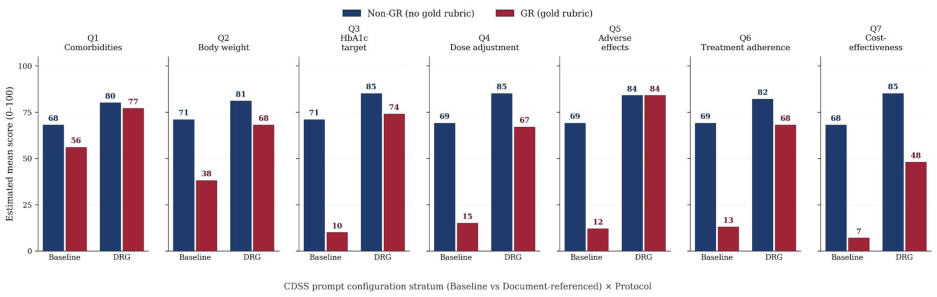
- 2 The DRG prompt is designed to produce higher-quality outputs than the Baseline prompt, so the AI rater's ability to distinguish quality differences can be tested against a known contrast.
- 3 First, this study reports quantitative comparisons of AI rater scores across scoring protocols but does not examine the internal reasoning processes underlying the observed patterns; understanding rater-side mechanisms is left to future work.
- 4 Each model is publicly released under the following license; the Hugging Face Hub identifiers below refer to the NVFP4 quantized variants distributed by NVIDIA and used in deployment (see §D.2 on inference precision).
Introduction
Clinical AI evaluation has begun to incorporate large language models (LLMs) as AI raters that assign scores to clinical outputs produced by other AI systems at scale. This shift reflects two limits of human-based evaluation that have persisted across clinical domains.
Human expert raters disagree with one another on the same case, producing interobserver variability documented in systematic reviews .
Large-scale clinical benchmarks such as MedHELM and HealthBench have already adopted LLM juries as scoring mechanisms, signaling that AI rater-based evaluation is increasingly shaping how clinical AI systems are assessed.
Methodology
To perform this characterization in clinical AI evaluation, we conducted a factorial study of how AI raters behave across a range of evaluation conditions in type 2 diabetes (T2D) pharmacotherapy, a clinical task that involves complex decision-making over multiple drug classes. The evaluation task scores AI-generated treatment recommendations for adult patients with T2D at 12-month outpatient follow-up .
Study Design
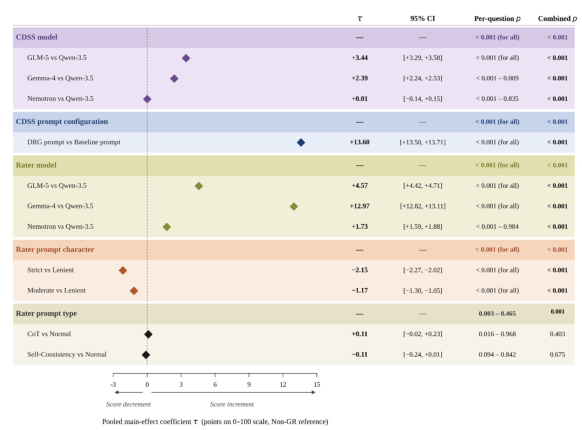
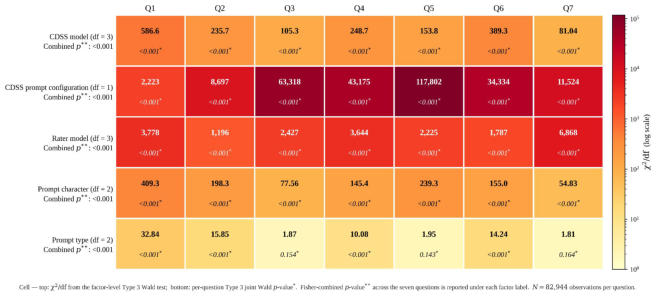
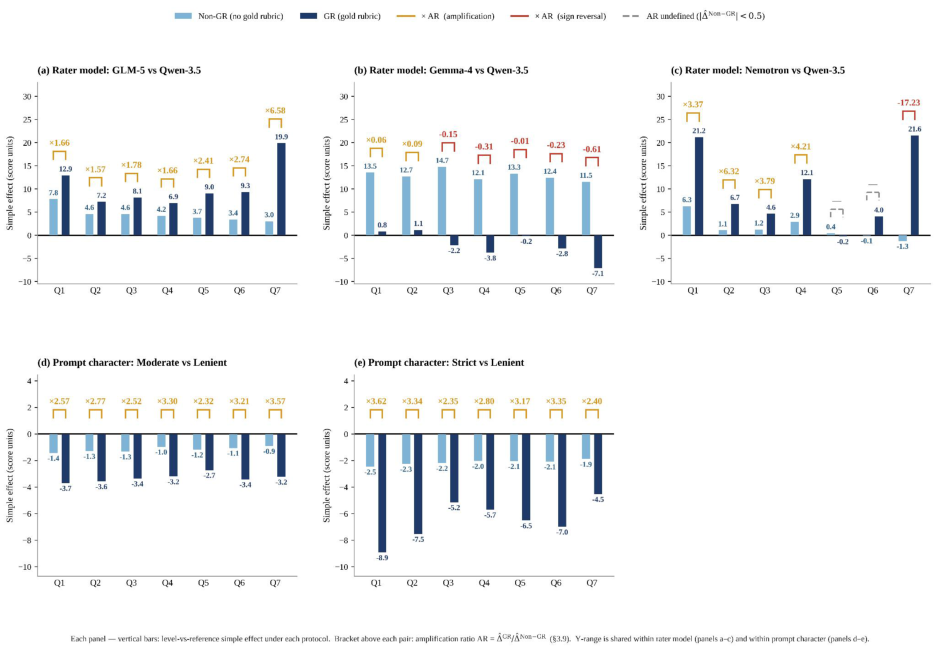
Per-level contrasts are summarized across the seven questions by inverse-variance weighting, and per-question p-values are combined by Fisher’s method .
Second, the experimental task is restricted to adult T2D pharmacotherapy at 12-month outpatient follow-up; how the protocol effect translates to clinical tasks with different decision structures remains an open question.
Results & Findings
Expert review also struggles to keep pace with the volume of AI-generated clinical outputs, and the fatigue that accompanies extended review correlates with measurable increases in clinical error . Meeting this responsibility requires more than demonstrating that AI raters produce reasonablelooking scores.
- Expert review also struggles to keep pace with the volume of AI-generated clinical outputs, and the fatigue that accompanies extended review correlates with measurable increases in.
- Meeting this responsibility requires more than demonstrating that AI raters produce reasonablelooking scores.
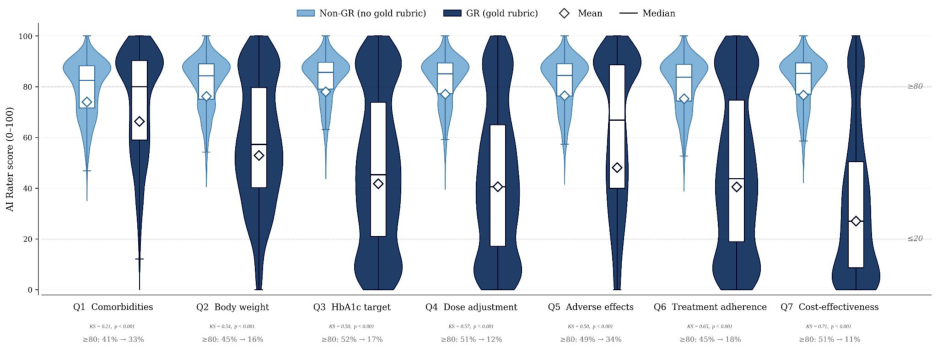
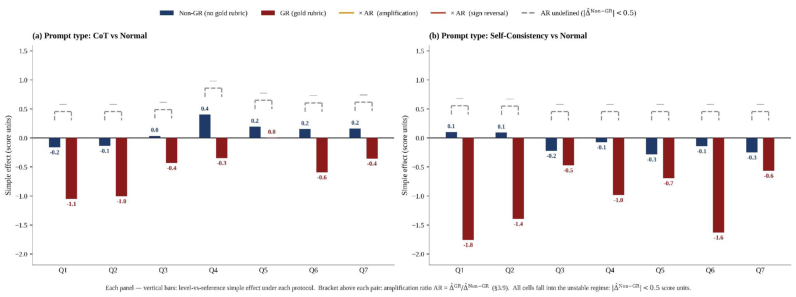
- With this protocol contrast as the primary axis, we systematically vary clinical decision support system (CDSS) model, CDSS prompt configuration, rater model, prompt character, and prompt.
- • We characterize how AI rater scoring behavior differs between the GR and Non-GR protocols across the seven evaluation questions (Q1-Q7), quantifying the difference in score.
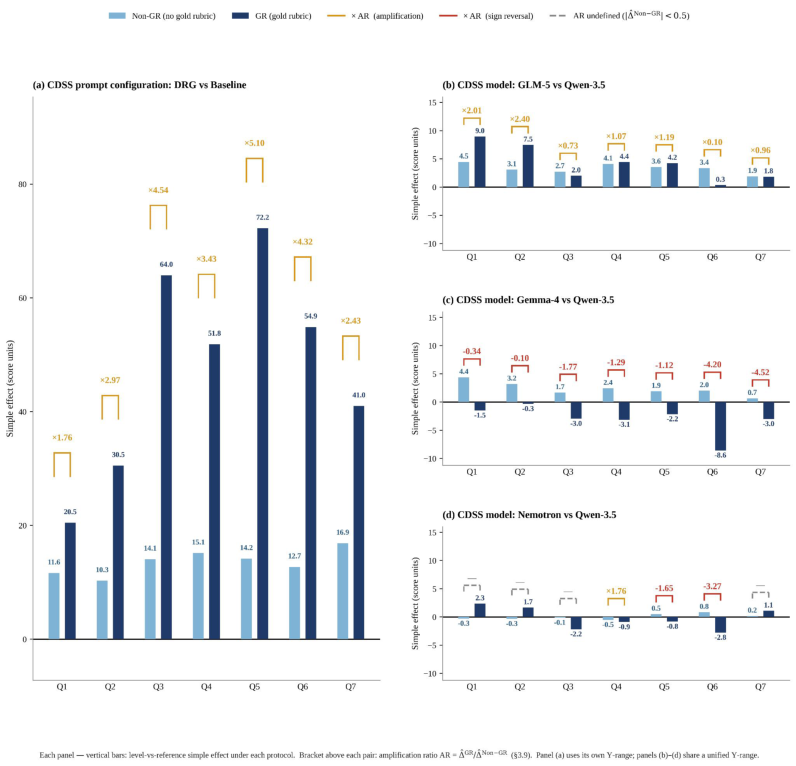
- • We quantify whether the two protocols produce different score gaps between higher-quality and lower-quality CDSS outputs, characterizing how the choice of protocol affects the AI.
These findings indicate that a rater model cannot be assumed to score its own outputs neutrally.
First, this study reports quantitative comparisons of AI rater scores across scoring protocols but does not examine the internal reasoning processes underlying the observed patterns; understanding rater-side mechanisms is left to future work.
How PDFdigest Helps You Understand Research
Instant Paper Analysis
Get structured summaries and key findings from dense PDFs in seconds.
Visual Explanations
Turn complex methods, figures, and results into clearer visual breakdowns.
AI-Powered Q&A
Ask focused questions and get answers grounded in the paper.
Practical Applications
AI rater adoption may bring substantial value by enabling systematic, large-scale evaluation, but this benefit must come with a corresponding responsibility: AI raters should function as reliable evaluators if they are to be used for assessing clinical tools. The extraction prompts and intermediate outputs are not released; the reference documents are described structurally in §E.4 and may be requested from the corresponding author.
The expanded GR-side variability in the patient and run components may reflect the rubric exposing patient-specific decision elements that the rater evaluates separately for each patient and at each run, but it may equivalently reflect the narrower Non-GR score band described in §4.1: when AI raters concentrate Non-GR scores within the 70-80 range regardless of.
LLM-as-a-judge in clinical evaluation
The section explores the application of LLMs in clinical evaluations, noting the differences in scoring patterns between AI raters and human evaluators, and identifying gaps in current research.
Limitations and Cautions
A useful limitation and caution is that this article summarizes the available paper text and extracted evidence; readers should consult the source paper before treating any interpretation as definitive.
The paper’s conclusions may depend on its source selection, definitions, assumptions, and the scope of its analysis, so follow-up reading is important.
Source Paper Figures and Captions
Frequently Asked Questions
Clinical AI evaluation has begun to incorporate large language models (LLMs) as AI raters that assign scores to clinical outputs produced by other AI systems at scale. Zhu et al. applied variance decomposition to general-domain evaluation and reported that systematic judge bias.
Second, the experimental task is restricted to adult T2D pharmacotherapy at 12-month outpatient follow-up; how the protocol effect translates to clinical tasks with different decision structures remains an open question. The role-and-scope and quality-assurance blocks are held in stable positions across all.
These findings indicate that a rater model cannot be assumed to score its own outputs neutrally. The DRG prompt is designed to produce higher-quality outputs than the Baseline prompt, so the AI rater’s ability to distinguish quality differences can be tested against.
AI rater adoption may bring substantial value by enabling systematic, large-scale evaluation, but this benefit must come with a corresponding responsibility: AI raters should function as reliable evaluators if they are to be used for assessing clinical tools. GR scoring is therefore.
These findings indicate that a rater model cannot be assumed to score its own outputs neutrally. First, this study reports quantitative comparisons of AI rater scores across scoring protocols but does not examine the internal reasoning processes underlying the observed patterns; understanding.
This paper examines how AI systems, specifically large language models, evaluate clinical decisions in diabetes treatment. It highlights the differences in scoring based on the evaluation method used.