Compression and Localization in Reinforcement Learning for ATARI Games
This paper discusses a new approach to making reinforcement learning models smaller and more efficient, particularly for playing ATARI games.
Content & Liability Disclaimer
This article and its accompanying video are automated summaries derived from Compression and Localization in Reinforcement Learning for ATARI Games by Joel Ruben, Antony Moniz, Barun Patra, Sarthak Garg. The original research was conducted solely by the paper's authors; PDFdigest did not conduct any of the research and makes no claims of ownership over the underlying scientific work.
The video narration is generated by artificial intelligence and references the paper's authors for attribution. The video is not narrated by any of the paper's authors. This content may contain inaccuracies, omissions, or misinterpretations of the original research. First-person language (e.g., "we found", "our results") reflects the original authors' voice, not PDFdigest's. Always read the original paper for accurate, verified information before making any decisions based on this content.
This content is provided "as is" without any warranties, express or implied. Simulated systems OÜ, its officers, directors, employees, and agents shall not be liable for any direct, indirect, incidental, special, consequential, or punitive damages arising from your use of, reliance on, or access to this content, including but not limited to errors, omissions, or misinterpretations of the original research. This disclaimer applies to the fullest extent permitted by applicable law.
- 1 These light-weight networks are significantly harder to directly optimize using the traditional Q-Learning objective.
- 2 An important objective of this work is to investigate the ability to distill the knowledge of an RL agent into a highly compressed student network.
- 3 Expert networks are trained using the vanilla DQN objective and use the architecture proposed by Mnih et al. .
- 4 This is to the best of our knowledge one of the first times model compression has been performed in the setting of a Deep RL agent.
Introduction
Deep Reinforcement Learning (Deep RL) has lately seen increasing applications to real world problems: in robotics (such as by Levine et al. ), real-time bidding (such as by Jin et al. ) and dialog generation (such as by Li et al. ). With increasing real-world applicability, making light-weight Deep RL agents is increasingly important.
While compressing networks has widely been adopted in domains where Deep Learning techniques are often applied, such as computer vision (for example, in Han et al. ), exploring the compression of networks in Deep RL is relatively less explored.
We propose using a formulation similar to Actor-Mimic to distill the knowledge of a trained expert into a student network, which has significantly fewer parameters and a lower computational cost.
Research Question
These light-weight networks are significantly harder to directly optimize using the traditional Q-Learning objective. An important objective of this work is to investigate the ability to distill the knowledge of an RL agent into a highly compressed student network.
Expert networks are trained using the vanilla DQN objective and use the architecture proposed by Mnih et al. .
Methodology
Hinton et al. showed that it might be easier for a small network to learn to mimic the predictions of a large network or an ensemble of networks trained on a task as compared to learning that task from scratch. We employ the same technique as above in our method.
Study Design
Hinton et al. first proposed that it might be easier for smaller networks to mimic the outputs of a bigger network instead of learning the original task from scratch.
How PDFdigest Helps You Understand Research
Instant Paper Analysis
Get structured summaries and key findings from dense PDFs in seconds.
Visual Explanations
Turn complex methods, figures, and results into clearer visual breakdowns.
AI-Powered Q&A
Ask focused questions and get answers grounded in the paper.
Results & Findings
In this work, we aim to perform model compression in the context of a Deep RL agent. We validate this using a test bed commonly used in RL: ATARI games using the ALE environment , and use a Deep Q-Network as our expert model.
- In this work, we aim to perform model compression in the context of a Deep RL agent.
- We validate this using a test bed commonly used in RL: ATARI games using the ALE environment , and use a Deep Q-Network as our expert.
- This is to the best of our knowledge one of the first times model compression has been performed in the setting of a Deep RL agent.
- While one of the ways in which we reduce parameters in our student network involves directly reducing the number of feature maps, we also explore improving.
- In addition to drastically reducing the required number of parameters (now utilizing fewer than 3% of the parameters required by the original expert network), this model.
This is to the best of our knowledge one of the first times model compression has been performed in the setting of a Deep RL agent.
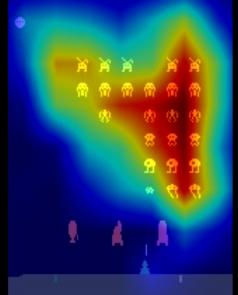
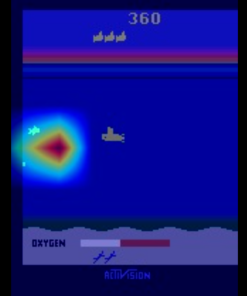
The basic idea behind visual attention is to learn a probability distribution over the features, which can be interpreted as a measure of the relevance of the feature for prediction.
Practical Applications
However applying a global max pool drastically reduces the performance, this drop in performance could not be controlled by knowledge distillation. An interesting line of future work might be to explore the applicability of these techniques and architectures in the context of compression in reinforcement learning.
An interesting line of future work might be to explore the applicability of these techniques and architectures in the context of compression in reinforcement learning.
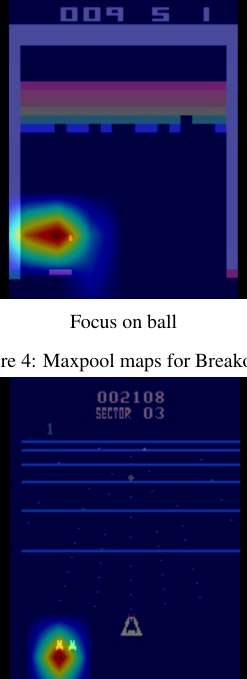
Pooling as an attention proxy
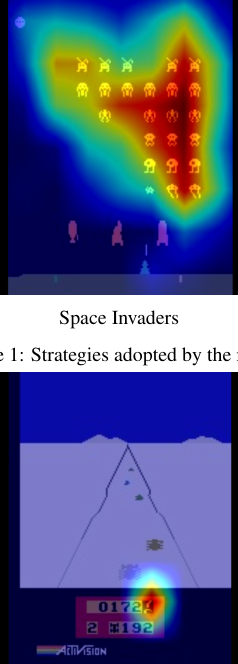
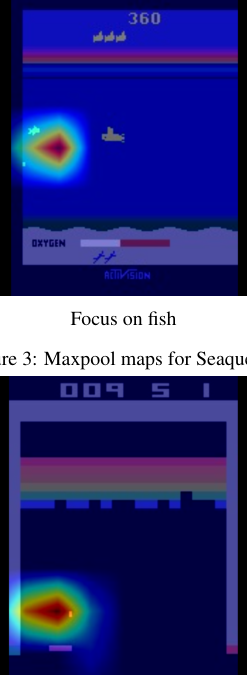
The section discusses the benefits of using global max-pooling as a means to reduce parameters and encourage localization without the need for explicit attention mechanisms. It draws on previous work in weakly supervised learning to support this approach.
Parameter reduction using Actor-Mimic
This section explores the concept of knowledge distillation from a trained expert network to a compressed student network, akin to imitation learning. It describes the method of converting Q values to a probability distribution to facilitate the training of the student network.
Source Paper Figures and Captions
Frequently Asked Questions
These light-weight networks are significantly harder to directly optimize using the traditional Q-Learning objective. An important objective of this work is to investigate the ability to distill the knowledge of an RL agent into a highly compressed student network.
Hinton et al. showed that it might be easier for a small network to learn to mimic the predictions of a large network or an ensemble of networks trained on a task as compared to learning that task from scratch. Hinton et.
This is to the best of our knowledge one of the first times model compression has been performed in the setting of a Deep RL agent. The basic idea behind visual attention is to learn a probability distribution over the features, which.
However applying a global max pool drastically reduces the performance, this drop in performance could not be controlled by knowledge distillation. An interesting line of future work might be to explore the applicability of these techniques and architectures in the context of.
An interesting line of future work might be to explore the applicability of these techniques and architectures in the context of compression in reinforcement learning.
This paper discusses a new approach to making reinforcement learning models smaller and more efficient, particularly for playing ATARI games.