Multi-command Chest Tactile Brain Computer Interface for Small Vehicle Robot Navigation
This study explores how tactile sensations on the chest can be used to control small robots. By sending signals through touch, users can operate vehicles without needing to see or think about movements.
Content & Liability Disclaimer
This article and its accompanying video are automated summaries derived from Multi-command Chest Tactile Brain Computer Interface for Small Vehicle Robot Navigation by Hiromu Mori, Shoji Makino, Tomasz M Rutkowski. The original research was conducted solely by the paper's authors; PDFdigest did not conduct any of the research and makes no claims of ownership over the underlying scientific work.
The video narration is generated by artificial intelligence and references the paper's authors for attribution. The video is not narrated by any of the paper's authors. This content may contain inaccuracies, omissions, or misinterpretations of the original research. First-person language (e.g., "we found", "our results") reflects the original authors' voice, not PDFdigest's. Always read the original paper for accurate, verified information before making any decisions based on this content.
This content is provided "as is" without any warranties, express or implied. Simulated systems OÜ, its officers, directors, employees, and agents shall not be liable for any direct, indirect, incidental, special, consequential, or punitive damages arising from your use of, reliance on, or access to this content, including but not limited to errors, omissions, or misinterpretations of the original research. This disclaimer applies to the fullest extent permitted by applicable law.
- 1 Recently alternative solutions have been proposed to make use of spatial auditory or tactile (somatosensory) modalities [1, 7, 20] to enhance brain-computer interface comfort and increase the information transfer rate (ITR) achieved by users.
- 2 No electromagnetic interference was observed from the vibrotactile transducers operating in higher frequencies comparing to the EEG frequency spectrum.
- 3 The maximum ITR possible for the BCI subjects to achieve in the settings presented were 5.14 bit/min and 69.65 bit/min, for seven averaged and single trial cases respectively.
- 4 The concept reported in this paper further extends the previously reported by the authors in brain somatosensory (tactile) channel to allow targeting of the tactile sensory domain for the operation of robotic equipment such as personal vehicles, life support systems, etc.
Introduction
Contemporary BCIs are typically based on mental visual and motor imagery paradigms, which require extensive user training and good eyesight from the users . The rationale behind the use of the tactile channel is that it is usually far less loaded than auditory or even visual channels in interfacing applications.
The P300 responses are commonly used in BCI approaches and are considered to be the most reliable ERPs with even beginner subjects.
This paper reports improvement of our previously reported finger stimulus tBCI based on P300 responses evoked by tactile stimulus delivered via vibrotactile transducers attached to five positions on the subject’s chest this time.
However, even in its current form, the proposed tBCI can be regarded as a practical solution for LIS patients (locked into their own bodies despite often intact cognitive functioning), who cannot use vision or auditory based interfaces due to sensory.
Methodology
The stimuli were delivered via five channel outputs of an external digital-to-analog signal converter RME Fireface UCX coupled with the two acoustic YAMAHA P4050 power amplifiers (four acoustic frequency channels each). The stimuli were delivered to the subjects’ chest locations via the tactile transducers HiWave HIAX25C10-8/HS operating in the acoustic frequency spectrum of 100 -20, 000 Hz, as depicted in Figure 1 .
Study Design
The captured EEG signals were processed online by BCI2000-based application , using a stepwise linear discriminant analysis (SWLDA) classifier with features drawn from the 0 -650 ms ERP intervals.
The EEG experiment with the paradigm has confirmed that tactile stimuli can be used to operate robotic devices with five commands and with the interfacing rate ranging from 0.64 bit/min to 5.14 bit/min for online case using SWLDA and 4.53 bit/min to 69.95 bit/min in the offline post processing case with linear SVM classifier respectively.
Results & Findings
Recently alternative solutions have been proposed to make use of spatial auditory or tactile (somatosensory) modalities [1, 7, 20] to enhance brain-computer interface comfort and increase the information transfer rate (ITR) achieved by users. The concept reported in this paper further extends the previously reported by the authors in brain somatosensory (tactile) channel to allow targeting of the tactile sensory domain for the operation of robotic equipment such as personal.
- Recently alternative solutions have been proposed to make use of spatial auditory or tactile (somatosensory) modalities [1, 7, 20] to enhance brain-computer interface comfort and increase.
- The concept reported in this paper further extends the previously reported by the authors in brain somatosensory (tactile) channel to allow targeting of the tactile sensory.
- The first report of the successful employment of steady-state somatosensory responses to create a BCI targeted a low frequency vibrotactile stimulus in the range of 20.
- A more recent report proposed using a Braille stimulator with 100 ms static push stimulus delivered to each of six fingers to evoke a somatosensory evoked.
- The P300 response is a positive electroencephalogram event-related potential (ERP) deflection starting at around 300 ms and lasting for 200 -300 ms after an expected stimulus.
Recently alternative solutions have been proposed to make use of spatial auditory or tactile (somatosensory) modalities [1, 7, 20] to enhance brain-computer interface comfort and increase the information transfer rate (ITR) achieved by users.
No electromagnetic interference was observed from the vibrotactile transducers operating in higher frequencies comparing to the EEG frequency spectrum.
How PDFdigest Helps You Understand Research
Instant Paper Analysis
Get structured summaries and key findings from dense PDFs in seconds.
Visual Explanations
Turn complex methods, figures, and results into clearer visual breakdowns.
AI-Powered Q&A
Ask focused questions and get answers grounded in the paper.
Practical Applications
All the participating in the study tBCI subjects scored well above the chance level of 20%, reaching an ITR in the range from 0.64 bit/min to 5.14 bit/min in case of the online BCI experiment with SWLDA classifier, which may be considered to be a good outcome for online vehicular robot driving experiments. The proposed interface could be used for a real-time operation of the robotic vehicle.
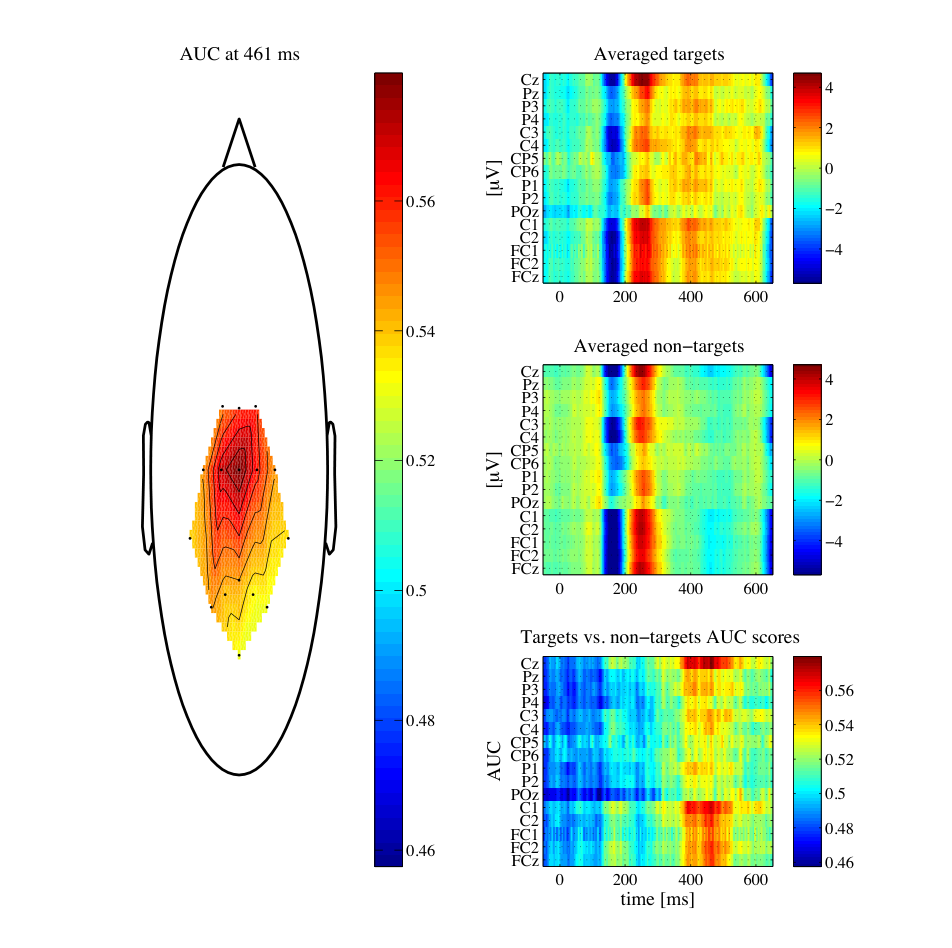
Finally, the bottom panel presents the AUC of target versus non -target responses (again, P300 could easily be identified).
Tactile Stimulus Generation
Details on how tactile stimuli were generated and delivered to the subjects’ chest locations using specific equipment and settings to stimulate sensory receptors.
EEG tBCI Experiment
This section outlines the EEG data collection process, including electrode placement, signal processing methods, and the experimental protocol followed during the trials.
Source Paper Figures and Captions
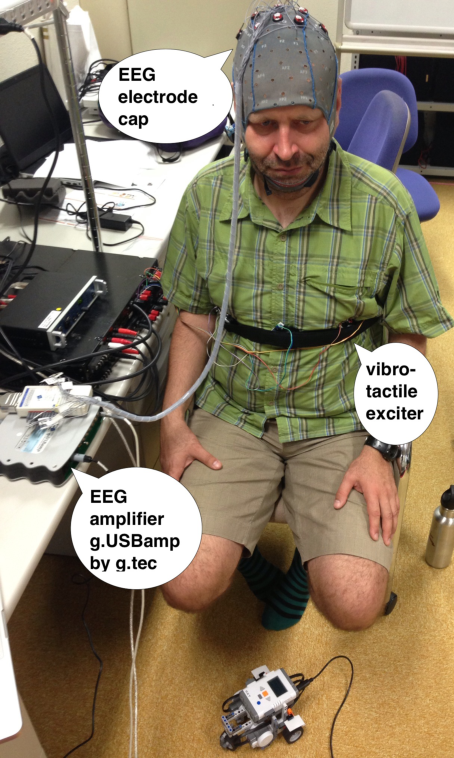
Illustrates the experimental setup and the tactile transducers used.
Shows the locations of EEG electrodes used in the study.
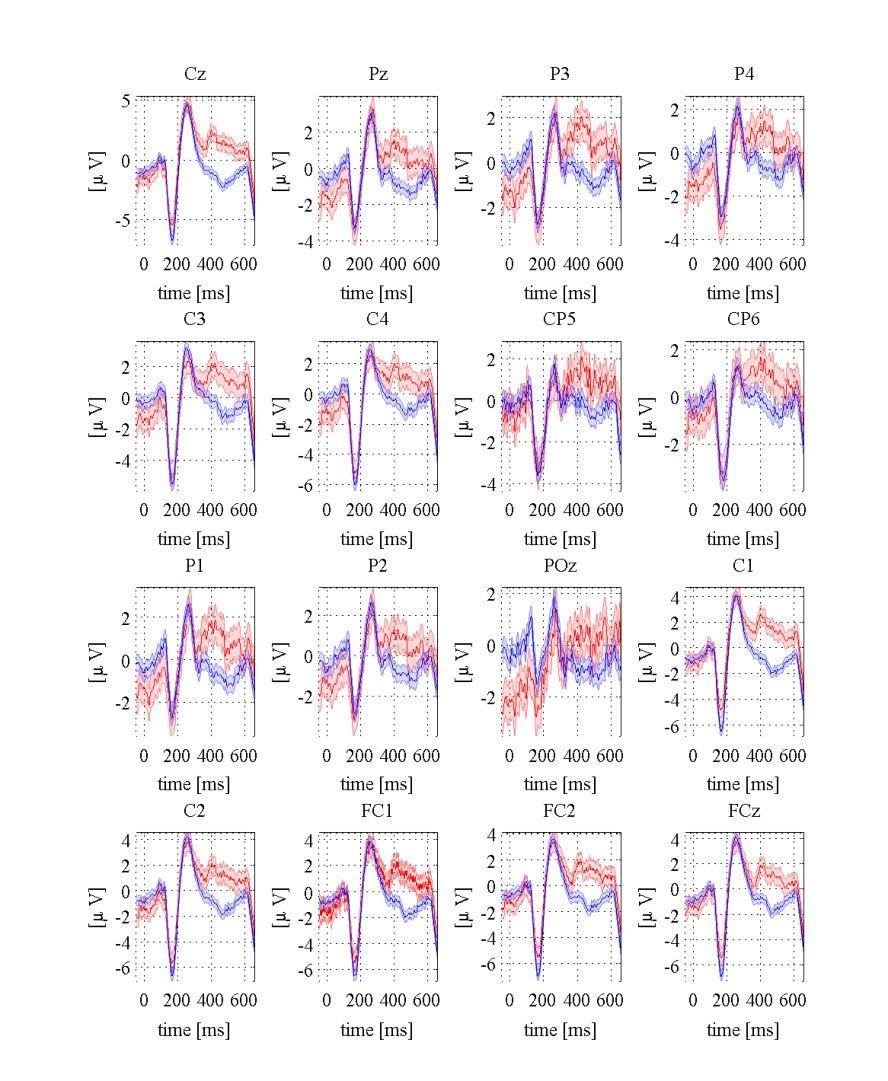
Depicts the P300 responses which are critical for BCI performance evaluation.
Frequently Asked Questions
The P300 responses are commonly used in BCI approaches and are considered to be the most reliable ERPs with even beginner subjects. This paper reports improvement of our previously reported finger stimulus tBCI based on P300 responses evoked by tactile stimulus delivered.
The stimuli were delivered to the subjects’ chest locations via the tactile transducers HiWave HIAX25C10-8/HS operating in the acoustic frequency spectrum of 100 -20, 000 Hz, as depicted in Figure 1 . The third panel presents averaged SEP responses to the non.
Recently alternative solutions have been proposed to make use of spatial auditory or tactile (somatosensory) modalities [1, 7, 20] to enhance brain-computer interface comfort and increase the information transfer rate (ITR) achieved by users. No electromagnetic interference was observed from the vibrotactile.
The proposed interface could be used for a real-time operation of the robotic vehicle. Finally, the bottom panel presents the AUC of target versus non -target responses (again, P300 could easily be identified).
However, even in its current form, the proposed tBCI can be regarded as a practical solution for LIS patients (locked into their own bodies despite often intact cognitive functioning), who cannot use vision or auditory based interfaces due to sensory or other.
This study explores how tactile sensations on the chest can be used to control small robots. By sending signals through touch, users can operate vehicles without needing to see or think about movements.