Deep learning approaches for neural decoding: from CNNs to LSTMs and spikes to fMRI
This paper discusses how deep learning techniques can be used to interpret signals from the brain to understand behavior and cognitive states. It highlights the importance of different neural recording methods and how they can be analyzed using advanced machine learning models.
Content & Liability Disclaimer
This article and its accompanying video are automated summaries derived from Deep learning approaches for neural decoding: from CNNs to LSTMs and spikes to fMRI by Jesse A Livezey, Joshua I Glaser. The original research was conducted solely by the paper's authors; PDFdigest did not conduct any of the research and makes no claims of ownership over the underlying scientific work.
The video narration is generated by artificial intelligence and references the paper's authors for attribution. The video is not narrated by any of the paper's authors. This content may contain inaccuracies, omissions, or misinterpretations of the original research. First-person language (e.g., "we found", "our results") reflects the original authors' voice, not PDFdigest's. Always read the original paper for accurate, verified information before making any decisions based on this content.
This content is provided "as is" without any warranties, express or implied. Simulated systems OÜ, its officers, directors, employees, and agents shall not be liable for any direct, indirect, incidental, special, consequential, or punitive damages arising from your use of, reliance on, or access to this content, including but not limited to errors, omissions, or misinterpretations of the original research. This disclaimer applies to the fullest extent permitted by applicable law.
- 1 Another common goal of neural decoding is to gain a better scientific understanding of the link between neural activity and the outside world.
- 2 Next, depending on the output that is being predicted, the convolutional layers are fed into other types of layers to produce the final output (e.g., into fully connected layers to classify an image).
- 3 Training a neural decoder uses supervised learning, where the network's parameters are learned to predict target outputs based on the inputs.
- 4 GANs are trained to produce images that fool a classifier deep network about whether they are real versus generated images.
Introduction
Using signals from the brain to make predictions about behavior, perception, or cognitive state, i.e., “neural decoding”, is becoming increasingly important within neuroscience and engineering. One common goal of neural decoding is to create brain computer interfaces, where neural signals are used to control an output in real time.
Plus, the representations learned by neural decoders can be probed to better understand the structure of neural computation .
These uses of neural decoding span many different neural recording modalities and span a wide range of behavioral outputs (Fig. 1A ).
Due to the limited temporal resolution, sometimes the temporal continuity of this data is not used for decoding purposes (Fig. 1A ).
One general machine learning approach to efficiently use limited data is transfer learning, in which a neural network trained in one scenario (typically with more data) is used a separate scenario.
Methodology
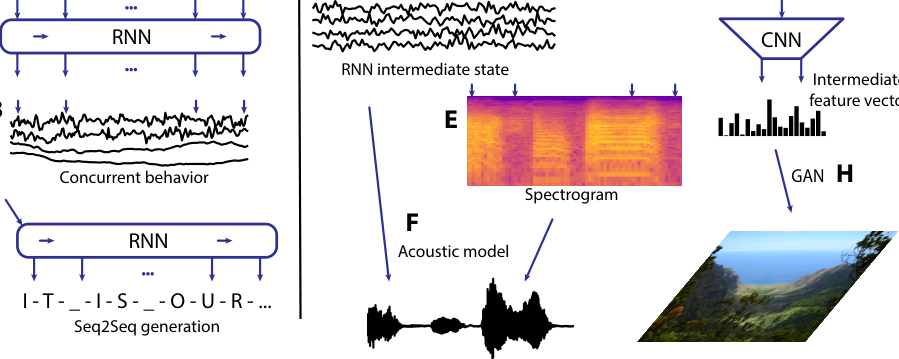
A decoder can be thought of as a function approximator, doing either regression or classification depending on whether the output is a continuous or categorical variable. One common method, generative adversarial networks (GANs) , generate an output, e.g. an image, given a vector of noise as input.
Study Design
Another method is convolutional autoencoders, which are trained to encode an image into a latent state, and then reconstruct a high fidelity version .
EEG is a noninvasive method that records from the surface of the scalp from up to hundreds of spatially distributed channels.
This means that here, a 2×2 filter will be multiplied pixel-wise with all 2×2 blocks to get the values of the next layer in the network. activity), through its absorption of light and with resonance imaging respectively, and their temporal.
Results & Findings
This could allow patients with neurological or motor diseases or injuries to, for example, control a robotic arm or cursor on a screen, or produce speech through a synthesizer. Another common goal of neural decoding is to gain a better scientific understanding of the link between neural activity and the outside world.
- This could allow patients with neurological or motor diseases or injuries to, for example, control a robotic arm or cursor on a screen, or produce speech.
- Another common goal of neural decoding is to gain a better scientific understanding of the link between neural activity and the outside world.
- To provide insight, decoding accuracy can be compared across brain regions, cell types, different types of subjects (e.g., with different diseases or genetics), and different experimental.
- Here, we will review the many uses of deep learning for neural decoding.
- We will emphasize how different deep learning architectures can induce biases that can be beneficial when decoding from different neural recording modalities and when decoding different.
In these scenarios, the decoded outputs will be a function of both neural activity and the prior, so one cannot simply determine what information the brain has about the output.
How PDFdigest Helps You Understand Research
Instant Paper Analysis
Get structured summaries and key findings from dense PDFs in seconds.
Visual Explanations
Turn complex methods, figures, and results into clearer visual breakdowns.
AI-Powered Q&A
Ask focused questions and get answers grounded in the paper.
Practical Applications
However, in future research, it might be advantageous to provide a more raw form of spiking as input, and use deep learning architectures to do feature engineering. For rate coding, the best size and temporal placement of time bins could be automatically determined, and for temporal coding, features related to the precise timing of spikes could be learned.
While it could be possible to develop an end-to-end decoder that works with the videos as input, this may prove challenging given the potential for overfitting with high-dimensional input.
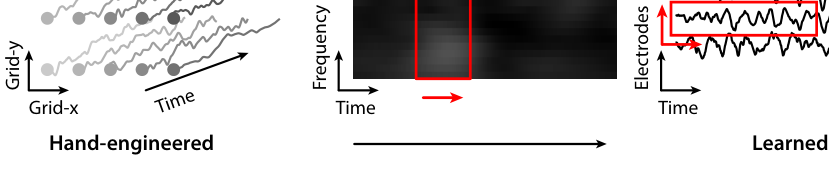
It is also possible to let a deep learning architecture do more of the feature extraction.
Deep learning architectures
Deep learning models consist of simple components and complex architectures. Common architectures for neural decoding include CNNs and RNNs, which are suited for different types of neural data. RNNs are particularly useful for processing sequences of varying lengths, while CNNs can handle structured data formats.
Neural recording modalities
Different neural recording modalities vary in invasiveness and precision. Techniques include invasive recordings of spikes and local field potentials, as well as calcium imaging. Understanding these modalities is essential for selecting appropriate deep learning architectures for decoding.
Feature engineering
Raw neural data is processed to create features for decoding, either through hand-engineering or automatic extraction by deep learning architectures. The choice of features can significantly impact decoding performance, with firing rates commonly used for spikes.
Source Paper Figures and Captions
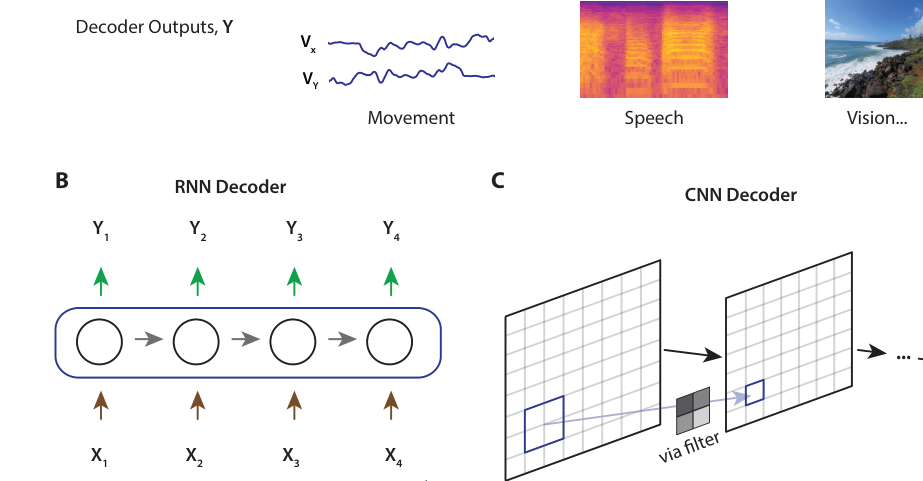
Illustrates the range of neural recording modalities and their applications in decoding behavior and cognitive states.
Demonstrates how RNNs process sequences of inputs over time, highlighting their flexibility in neural decoding.
Shows the process of feature engineering and how deep learning architectures can automate this step.
Frequently Asked Questions
Using signals from the brain to make predictions about behavior, perception, or cognitive state, i.e., “neural decoding”, is becoming increasingly important within neuroscience and engineering. One common goal of neural decoding is to create brain computer interfaces, where neural signals are used.
Another method is convolutional autoencoders, which are trained to encode an image into a latent state, and then reconstruct a high fidelity version . EEG is a noninvasive method that records from the surface of the scalp from up to hundreds of.
Another common goal of neural decoding is to gain a better scientific understanding of the link between neural activity and the outside world. Next, depending on the output that is being predicted, the convolutional layers are fed into other types of layers.
It is also possible to let a deep learning architecture do more of the feature extraction. These methods could be used to attribute what channels, neurons, or time-points are most salient for decoding .
This means that here, a 2×2 filter will be multiplied pixel-wise with all 2×2 blocks to get the values of the next layer in the network. activity), through its absorption of light and with resonance imaging respectively, and their temporal resolution are.
This paper discusses how deep learning techniques can be used to interpret signals from the brain to understand behavior and cognitive states. It highlights the importance of different neural recording methods and how they can be analyzed using advanced machine learning models.