Unleashing the Power of Transformer for Graphs
This paper introduces a new type of Transformer model designed to work better with large graphs, which are often too complex for traditional models.
Content & Liability Disclaimer
This article and its accompanying video are automated summaries derived from Unleashing the Power of Transformer for Graphs by Qiang Zhang. The original research was conducted solely by the paper's authors; PDFdigest did not conduct any of the research and makes no claims of ownership over the underlying scientific work.
The video narration is generated by artificial intelligence and references the paper's authors for attribution. The video is not narrated by any of the paper's authors. This content may contain inaccuracies, omissions, or misinterpretations of the original research. First-person language (e.g., "we found", "our results") reflects the original authors' voice, not PDFdigest's. Always read the original paper for accurate, verified information before making any decisions based on this content.
This content is provided "as is" without any warranties, express or implied. Simulated systems OÜ, its officers, directors, employees, and agents shall not be liable for any direct, indirect, incidental, special, consequential, or punitive damages arising from your use of, reliance on, or access to this content, including but not limited to errors, omissions, or misinterpretations of the original research. This disclaimer applies to the fullest extent permitted by applicable law.
- 1 Hypothesis 2 The distant nodes with similar embeddings to that of the node of interest are important sources to the node of interest.
- 2 Using one-hop neighbors is sufficient to achieve promising performance in most cases.
- 3 The key is learning a semantic encoder to identify useful distant nodes as semantic neighbors.
- 4 Another key design is the semantic operator used to estimate the semantic score between the node of interest and others.
Introduction
Transformer has become one of the most prevalent neural models for natural language processing (NLP) . The self-attention mechanism leveraged by Transformer has already been extended to graph neural network (GNN) models, e.g., GAT and its variants .
Nevertheless, these models only consider the 1-hop neighbors, which violates the original intention of Transformer that attends to the elements at distant positions.
In this regard, they are graph convolutional networks (GCNs) with learnable attention weights for aggregating 1-hop neighborhood.
Different from large-scale knowledge graphs (KGs) or networks, the input graph for the graph property prediction tasks are limited with small sizes (e.g., small molecules).
Even the improvement brought by the two-hop neighbors is very limited .
Research Question
Hypothesis 2 The distant nodes with similar embeddings to that of the node of interest are important sources to the node of interest.
Methodology
The proposed DET is capable of achieving superior performance on various learning tasks oriented to graphs with different sizes: (1) For the graph property prediction task, DET outperforms the best-performing methods on the PCQM4M-LSC and ZINC datasets;. (2) For the node classification task, DET has competitive or better performance than the stateof-the-art attention-based methods, on the Cora, CiteSeer, PubMed and PPI benchmarks ; (3) For the KG completion (a.k.a., entity.
Study Design
We also present in-depth model analysis to provide more insights.
Self-attention-based neural models, such as Transformer, have recently become the de facto choice in NLP tasks, ranging from language modeling and machine translation to question answering and sentiment analysis .
How PDFdigest Helps You Understand Research
Instant Paper Analysis
Get structured summaries and key findings from dense PDFs in seconds.
Visual Explanations
Turn complex methods, figures, and results into clearer visual breakdowns.
AI-Powered Q&A
Ask focused questions and get answers grounded in the paper.
Results & Findings
These works inspire us to explore the possibility of using one universal Transformer architecture as the general backbone to model different sizes of graphs. Is it possible to directly aggregate the embeddings of multi-hop neighbors?
- These works inspire us to explore the possibility of using one universal Transformer architecture as the general backbone to model different sizes of graphs.
- Is it possible to directly aggregate the embeddings of multi-hop neighbors?
- Using one-hop neighbors is sufficient to achieve promising performance in most cases.
- We then model semantic encoding as the dual process, with the semantic encoder as the main attention model and the structural encoder as an assistant model.
- The key is learning a semantic encoder to identify useful distant nodes as semantic neighbors.
This is because the restriction of the model size on the ZINC benchmark severely limited the capability of modeling structural information.
Using one-hop neighbors is sufficient to achieve promising performance in most cases.
Practical Applications
For example, in a citation network, the semantic similarity may be a more effective metric than structural distance when aggregating the neighboring papers for classification. Intuitively, if a node appears as a neighbor of other nodes for many times, the information provided by this node may not be helpful to make the node of interest unique.
It may have its pros and cons compared with the standard dot-product attention layer on different datasets.
This observation suggests that properly combining the output of two encoders may be the best choice.
Self-attention
The self-attention section elaborates on the advantages of self-attention models like Transformer over RNNs, particularly in graph data modeling. It discusses the use of dot-product and linear attention mechanisms in DET for encoding structural and semantic neighbors.
Source Paper Figures and Captions
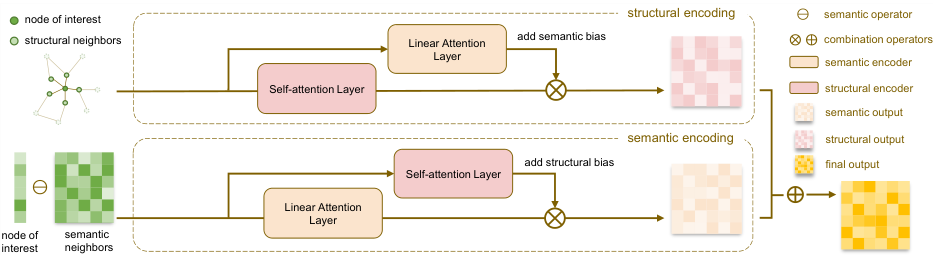
Illustrates how structural and semantic encoders interact to improve performance in graph representation.
Frequently Asked Questions
The self-attention mechanism leveraged by Transformer has already been extended to graph neural network (GNN) models, e.g., GAT and its variants . Hypothesis 2 The distant nodes with similar embeddings to that of the node of interest are important sources to the.
Self-attention-based neural models, such as Transformer, have recently become the de facto choice in NLP tasks, ranging from language modeling and machine translation to question answering and sentiment analysis . In this paper, we propose a self-supervised training method to exploit the.
Using one-hop neighbors is sufficient to achieve promising performance in most cases. The key is learning a semantic encoder to identify useful distant nodes as semantic neighbors.
Therefore, the problem can be converted to find the distant nodes that are as important as the one-hop neighbors. Therefore, it is reasonable to regard the one-hop neighbors as the most informative sources.
Different from large-scale knowledge graphs (KGs) or networks, the input graph for the graph property prediction tasks are limited with small sizes (e.g., small molecules). This is because the restriction of the model size on the ZINC benchmark severely limited the capability.
This paper introduces a new type of Transformer model designed to work better with large graphs, which are often too complex for traditional models.