FairLens: Auditing Black-box Clinical Decision Support Systems
This paper introduces FairLens, a tool designed to help healthcare professionals identify and understand biases in AI systems used for clinical decision-making. It emphasizes the importance of ensuring that these systems are fair and reliable before they are used in patient care.
Content & Liability Disclaimer
This article and its accompanying video are automated summaries derived from FairLens: Auditing Black-box Clinical Decision Support Systems by Cecilia Panigutti, Alan Perotti, Andrè Panisson, Paolo Bajardi, Dino Pedreschi. The original research was conducted solely by the paper's authors; PDFdigest did not conduct any of the research and makes no claims of ownership over the underlying scientific work.
The video narration is generated by artificial intelligence and references the paper's authors for attribution. The video is not narrated by any of the paper's authors. This content may contain inaccuracies, omissions, or misinterpretations of the original research. First-person language (e.g., "we found", "our results") reflects the original authors' voice, not PDFdigest's. Always read the original paper for accurate, verified information before making any decisions based on this content.
This content is provided "as is" without any warranties, express or implied. Simulated systems OÜ, its officers, directors, employees, and agents shall not be liable for any direct, indirect, incidental, special, consequential, or punitive damages arising from your use of, reliance on, or access to this content, including but not limited to errors, omissions, or misinterpretations of the original research. This disclaimer applies to the fullest extent permitted by applicable law.
- 1 In this paper we proposed FairLens, an algorithmic pipeline to inspect clinical DSS and we showed how to use it to spot fairness issues in patients' subgroups, and to further investigate potential over-/under-diagnosed conditions.
- 2 While there is an increasing interest of the AI community to commit to interdisciplinary endeavors to define, investigate and provide guidelines to tackle biases and fairness-related issues , quantitative and systematic auditing for real-world datasets and ML models is still in its infancy.
- 3 In this work, we investigate the potential biases in ML models trained on patients' clinical history represented as diagnostic codes.
- 4 Moreover, we aim at providing a more structured local-to-global explanation of the BB error.
Introduction
This type of structured data allows for a machine-ready representation of the patient’s clinical history and is commonly used in longitudinal ML modeling for phenotyping, multi-morbidity diagnosis classification and sequential clinical events prediction . The implicit assumption behind the use of ICD codes in this kind of ML applications is that these codes are a good proxy for the patient’s actual health status.
However, ICD codes can misrepresent such status because of many potential sources of error in translating the patient’s actual disease into the respective code .
Data quality assessment for the secondary use of health data is of pivotal importance to ease the transition of ML-based DSS from academic prototypes into real-world clinical practice.
Research Question
While there is an increasing interest of the AI community to commit to interdisciplinary endeavors to define, investigate and provide guidelines to tackle biases and fairness-related issues , quantitative and systematic auditing for real-world datasets and ML models is still in its infancy. In this work, we investigate the potential biases in ML models trained on patients’ clinical history represented as diagnostic codes.
In this paper we proposed FairLens, an algorithmic pipeline to inspect clinical DSS and we showed how to use it to spot fairness issues in patients’ subgroups, and to further investigate potential over-/under-diagnosed conditions.
Moreover, we aim at providing a more structured local-to-global explanation of the BB error.
Methodology
We take bias analysis a step further by explaining the reasons behind the bad model’s performance on specific subgroups. We focused our analysis on hospital admissions coded with ICD-9 billing codes and on patients having at least two admissions to the hospital, reducing the number of patients to 43,697 and the number of admission to the hospital to 164,411 (see table 1 is a Recurrent Neural Network (RNN) with Gated.
Study Design
This analysis tells the domain expert that the group with the highest disparity is young (15-25 y.o.) male black patients with Medicaid.
How PDFdigest Helps You Understand Research
Instant Paper Analysis
Get structured summaries and key findings from dense PDFs in seconds.
Visual Explanations
Turn complex methods, figures, and results into clearer visual breakdowns.
AI-Powered Q&A
Ask focused questions and get answers grounded in the paper.
Results & Findings
The growing availability of Electronic Health Records (EHR) and the constantly increasing predictive power of Machine Learning (ML) models are boosting both research advances and the creation of business opportunities to deploy clinical decision support systems (DSS) in healthcare facilities . Since such models are still not equipped to differentiate between correlation and causation, they might leverage spurious correlations and undesired biases to boost their performance.
- The growing availability of Electronic Health Records (EHR) and the constantly increasing predictive power of Machine Learning (ML) models are boosting both research advances and the.
- Since such models are still not equipped to differentiate between correlation and causation, they might leverage spurious correlations and undesired biases to boost their performance.
- In this paper we introduce FairLens, a methodology to discover and explain biases for ML models trained on ICD structured healthcare data.
- FairLens embeds explainability techniques in order to explain the reasons behind model mistakes instead of simply explaining model predictions.
- The presented methodology is designed to be applied to any sequential ML model trained on ICD codes.
Future work will be devoted to test FairLens on different black-box and to include additional disparity scores with the aid of domain experts to increase the tool usability.
The presented methodology is designed to be applied to any sequential ML model trained on ICD codes.
Practical Applications
We also remark that some patients might not occur in any group or occur in more than one, depending on the provided conditions. Alternatively, the domain experts might arbitrarily select one subgroup for further inspection, regardless of their scores, due to the cohort’s known peculiarities or clinical-dependent reasons.
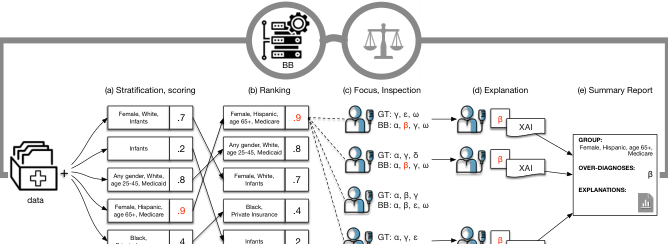
The domain expert can decide to either explore a specific group of interest or to have a comprehensive view of the biases of the DSS on all possible groups.
Each point is a combination of attributes, considering all possible combinations of values FairLens obtains 432 groups.
FairLens: Pipeline
The FairLens methodology is detailed, outlining the process of stratifying patient data based on various attributes and assessing model performance across these groups to identify biases.
Source Paper Figures and Captions
Frequently Asked Questions
While there is an increasing interest of the AI community to commit to interdisciplinary endeavors to define, investigate and provide guidelines to tackle biases and fairness-related issues , quantitative and systematic auditing for real-world datasets and ML models is still in its.
We focused our analysis on hospital admissions coded with ICD-9 billing codes and on patients having at least two admissions to the hospital, reducing the number of patients to 43,697 and the number of admission to the hospital to 164,411 (see table.
The presented methodology is designed to be applied to any sequential ML model trained on ICD codes. We show how a domain expert can use FairLens to audit a multilabel clinical DSS acting as a fictional commercial black-box model.
In our scenario, we want to provide an explanation for a over-or underdiagnosis observed in a group of patients, therefore FairLens binarizes the blackbox labels and it combines the explanations as described in the Explanation and Reporting paragraphs of Section 3. The.
Future work will be devoted to test FairLens on different black-box and to include additional disparity scores with the aid of domain experts to increase the tool usability.
This paper introduces FairLens, a tool designed to help healthcare professionals identify and understand biases in AI systems used for clinical decision-making. It emphasizes the importance of ensuring that these systems are fair and reliable before they are used in patient care.