AQ-PINNs: Attention-Enhanced Quantum Physics-Informed Neural Networks for Carbon-Efficient Climate Modeling
This paper presents a new type of neural network that uses quantum computing to improve climate modeling while being more energy-efficient. It aims to reduce the environmental impact of AI technologies.
Content & Liability Disclaimer
This article and its accompanying video are automated summaries derived from AQ-PINNs: Attention-Enhanced Quantum Physics-Informed Neural Networks for Carbon-Efficient Climate Modeling by Siddhant Dutta, Nouhaila Innan, Sadok Ben Yahia, Muhammad Shafique, J Svkm's Dwarkadas, Sanghvi. The original research was conducted solely by the paper's authors; PDFdigest did not conduct any of the research and makes no claims of ownership over the underlying scientific work.
The video narration is generated by artificial intelligence and references the paper's authors for attribution. The video is not narrated by any of the paper's authors. This content may contain inaccuracies, omissions, or misinterpretations of the original research. First-person language (e.g., "we found", "our results") reflects the original authors' voice, not PDFdigest's. Always read the original paper for accurate, verified information before making any decisions based on this content.
This content is provided "as is" without any warranties, express or implied. Simulated systems OÜ, its officers, directors, employees, and agents shall not be liable for any direct, indirect, incidental, special, consequential, or punitive damages arising from your use of, reliance on, or access to this content, including but not limited to errors, omissions, or misinterpretations of the original research. This disclaimer applies to the fullest extent permitted by applicable law.
- 1 AI technologies are consuming more energy and contributing to carbon emissions.
- 2 The proposed AQ-PINNs model reduces the number of parameters needed for climate modeling, making it more efficient.
- 3 Using quantum computing can help improve the accuracy of climate predictions while lowering the carbon footprint.
Introduction
The introduction discusses the rapid growth of AI and its associated energy consumption and carbon emissions, highlighting the Jevons paradox. It emphasizes the need for Green AI methodologies to mitigate environmental impacts and introduces quantum machine learning as a solution to reduce model parameters and improve efficiency.
Methodology
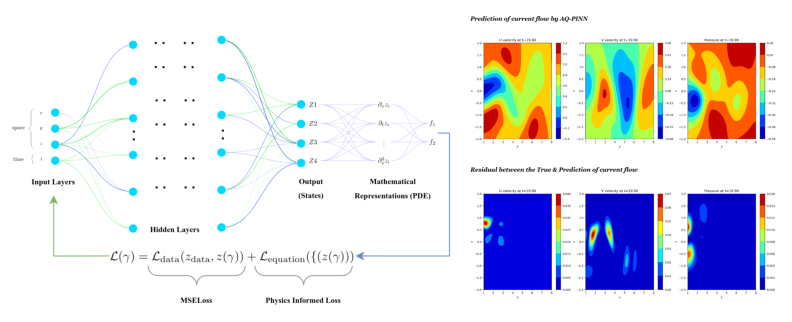
The methodology section outlines the use of computational fluid dynamics (CFD) for climate modeling, detailing the dataset derived from numerical solutions of the Navier-Stokes equations. It describes the structure of the data and the training process for the AQ-PINNs model.
Results
The results demonstrate that AQ-PINNs achieve significant reductions in model parameters while maintaining or improving performance compared to classical models. The section highlights the importance of these reductions for climate modeling and outlines future work to enhance the model’s capabilities.
How PDFdigest Helps You Understand Research
Instant Paper Analysis
Get structured summaries and key findings from dense PDFs in seconds.
Visual Explanations
Turn complex methods, figures, and results into clearer visual breakdowns.
AI-Powered Q&A
Ask focused questions and get answers grounded in the paper.
Architecture
This section explains the architecture of AQ-PINNs, focusing on the integration of physics-informed neural networks with quantum multi-head self-attention mechanisms. It describes how classical data is encoded into quantum states and the computation of attention scores.
Source Paper Figures and Captions
Frequently Asked Questions
This paper presents a new type of neural network that uses quantum computing to improve climate modeling while being more energy-efficient. It aims to reduce the environmental impact of AI technologies.
The introduction discusses the rapid growth of AI and its associated energy consumption and carbon emissions, highlighting the Jevons paradox. It emphasizes the need for Green AI methodologies to mitigate environmental impacts.
The methodology section outlines the use of computational fluid dynamics (CFD) for climate modeling, detailing the dataset derived from numerical solutions of the Navier-Stokes equations. It describes the structure of the data.
Yes. PDFDigest can turn this paper into a structured explanation, key takeaways, visual summaries, and a narrated video when available.