HIVE: Understanding Post-Hallucination Reasoning in Vision Language Models
This paper explores how errors in understanding visual information, known as hallucinations, affect the reasoning of models that combine text and images. It introduces a new tool called HIVE to study these effects.
Content & Liability Disclaimer
This article and its accompanying video are automated summaries derived from HIVE: Understanding Post-Hallucination Reasoning in Vision Language Models by Feng He, Zhenting Wang, Qifan Wang, Qiang Guan, Dongfang Liu, Ruixiang Tang, Qiankun Li. The original research was conducted solely by the paper's authors; PDFdigest did not conduct any of the research and makes no claims of ownership over the underlying scientific work.
The video narration is generated by artificial intelligence and references the paper's authors for attribution. The video is not narrated by any of the paper's authors. This content may contain inaccuracies, omissions, or misinterpretations of the original research. First-person language (e.g., "we found", "our results") reflects the original authors' voice, not PDFdigest's. Always read the original paper for accurate, verified information before making any decisions based on this content.
This content is provided "as is" without any warranties, express or implied. Simulated systems OÜ, its officers, directors, employees, and agents shall not be liable for any direct, indirect, incidental, special, consequential, or punitive damages arising from your use of, reliance on, or access to this content, including but not limited to errors, omissions, or misinterpretations of the original research. This disclaimer applies to the fullest extent permitted by applicable law.
- 1 We conduct a token-level ablation study to test whether hallucinated content is necessary for successful predictions.
- 2 Meanwhile, studies of LLMs show that chain-of-thought reasoning does not strictly follow human causal logic: incorrect intermediate steps can still lead to correct conclusions.
- 3 Yet little attention has been paid to how hallucinated semantics affect the reasoning processes that follow.
- 4 Hallucinations naturally arise when an LLM is asked to produce a free-form caption of any input, regardless of modality.
Introduction
Vision-language models (VLMs) often operate under partial observability . According to community standards, such unverifiable content is considered hallucination.
Consequently, most existing studies focus on detecting or mitigating hallucinations at the moment they appear.
Far less attention has been paid to what happens after hallucinated semantics enter the reasoning process of a VLM, leaving this post-hallucination stage largely unexplored.
All captions are generated from a unified source using the same prompt, temperature, and token budget, ensuring that decoding hyper-parameters cannot confound attribution.
❶ LLMs on text-only tasks: limited or unstable benefits.
Research Question
We conduct a token-level ablation study to test whether hallucinated content is necessary for successful predictions.
Methodology
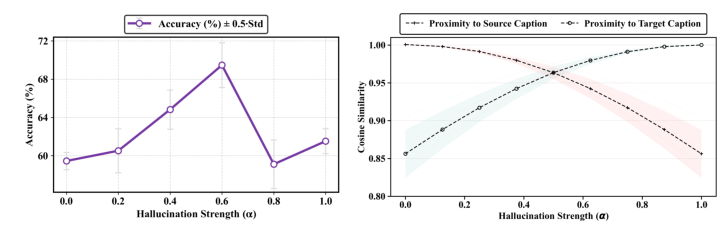
We identify and characterize PHR, a previously overlooked stage in which hallucinated semantics influence downstream reasoning in VLMs across diverse task settings. HIVE organizes caption generation, hallucination discrimination, and downstream evaluation under matched configurations, enabling paired comparisons between faithful and hallucinated captions and allowing us to isolate and quantify the downstream impact across multiple models and task domains. ❸ Mechanistic Analysis of PHR.
Study Design
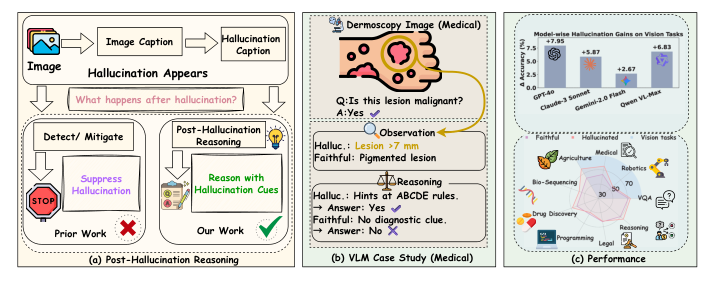
Different from existing methods, we focus on a largely overlooked stage in VLM inference: Post-Hallucination Reasoning (PHR), where hallucinated semantics, once generated and adopted by the model, may influence subsequent reasoning and task predictions.
It examines how hallucinated semantics, once generated and adopted by the model, influence subsequent reasoning and task predictions compared with faithful semantics.
Future work should investigate broader task domains and develop principled mechanisms to better control hallucination induced semantic expansion in multimodal reasoning systems.
How PDFdigest Helps You Understand Research
Instant Paper Analysis
Get structured summaries and key findings from dense PDFs in seconds.
Visual Explanations
Turn complex methods, figures, and results into clearer visual breakdowns.
AI-Powered Q&A
Ask focused questions and get answers grounded in the paper.
Results & Findings
Occlusion, low resolution, and motion blur frequently lead them to produce speculative semantic completions . However, hallucinations arise naturally from incomplete visual evidence rather than isolated system failures .
- Occlusion, low resolution, and motion blur frequently lead them to produce speculative semantic completions .
- However, hallucinations arise naturally from incomplete visual evidence rather than isolated system failures .
- Meanwhile, studies of LLMs show that chain-of-thought reasoning does not strictly follow human causal logic: incorrect intermediate steps can still lead to correct conclusions.
- However, whether such speculative cues help, hinder, or simply perturb reasoning remains unclear.
- We refer to this phenomenon as Post-Hallucination Reasoning (PHR), which describes the reasoning behavior that emerges after hallucinated semantics become part of the model’s inference context.
However, whether such speculative cues help, hinder, or simply perturb reasoning remains unclear.
Meanwhile, studies of LLMs show that chain-of-thought reasoning does not strictly follow human causal logic: incorrect intermediate steps can still lead to correct conclusions.
Practical Applications
This observation suggests that reasoning may continue to evolve in latent space even when intermediate representations are imperfect or partially incorrect. By analogy, hallucinations in VLMs may also interact with downstream reasoning processes.
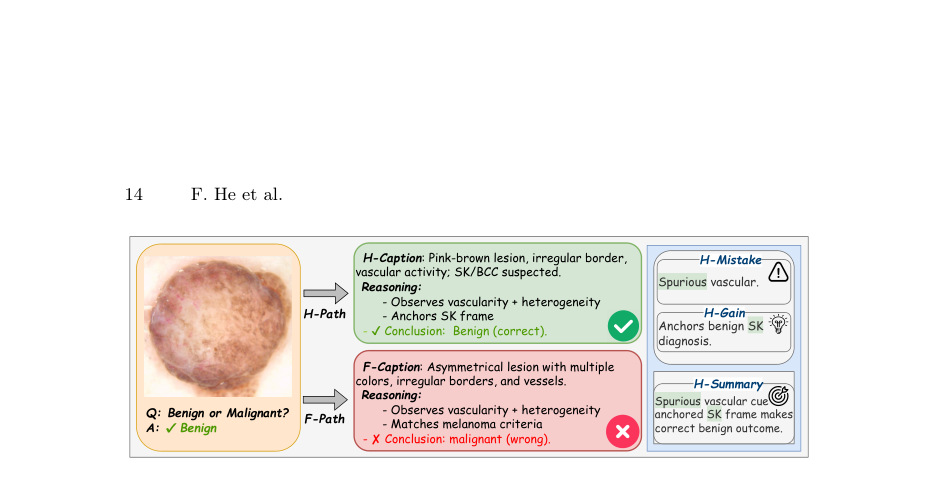
This suggests that hallucinations may occasionally provide speculative semantic anchors that guide inference rather than merely degrading predictions.
Hallucination detection is inherently imperfect, and even human annotators may disagree.
Problem Setup
HIVE is an evaluation infrastructure designed to study PHR in VLMs. It compares the influence of hallucinated semantics on reasoning and predictions against faithful semantics, ensuring fair comparisons and reliable discrimination in the evaluation process.
HIVE Evaluation Pipeline
The HIVE evaluation pipeline consists of three modules: Caption Generator, Caption Discriminator, and Task Solver. This structured approach ensures controlled evaluation across tasks by generating candidate captions, classifying them, and integrating them into task-specific instructions.
Source Paper Figures and Captions
Frequently Asked Questions
Far less attention has been paid to what happens after hallucinated semantics enter the reasoning process of a VLM, leaving this post-hallucination stage largely unexplored. We conduct a token-level ablation study to test whether hallucinated content is necessary for successful predictions.
We select a sample from the ISIC dataset, where the task is to determine whether a skin lesion is benign or malignant. Although this cue is not strictly faithful to the image, it provides a task-aligned semantic trigger that reshapes the reasoning.
Meanwhile, studies of LLMs show that chain-of-thought reasoning does not strictly follow human causal logic: incorrect intermediate steps can still lead to correct conclusions. Yet little attention has been paid to how hallucinated semantics affect the reasoning processes that follow.
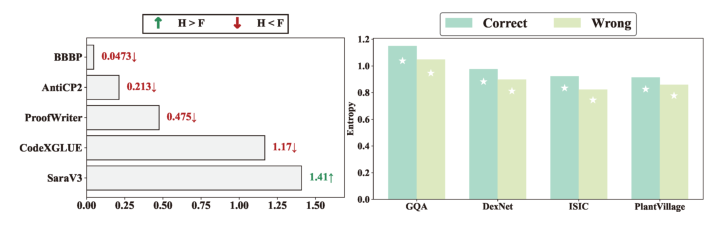
This observation suggests that reasoning may continue to evolve in latent space even when intermediate representations are imperfect or partially incorrect. The overall trends are small and inconsistent, indicating that hallucinated semantics are hard to exploit in rule-based or symbolically constrained tasks.
However, whether such speculative cues help, hinder, or simply perturb reasoning remains unclear. Future work should investigate broader task domains and develop principled mechanisms to better control hallucination induced semantic expansion in multimodal reasoning systems.
This paper explores how errors in understanding visual information, known as hallucinations, affect the reasoning of models that combine text and images. It introduces a new tool called HIVE to study these effects.