Mixture of Cognitive Experts in Large Vision-Language Models
This paper discusses how advanced models that understand both images and text can be improved by using specialized systems that mimic human thinking. It introduces a new framework that helps these models reason better and reduce errors.
Content & Liability Disclaimer
This article and its accompanying video are automated summaries derived from Mixture of Cognitive Experts in Large Vision-Language Models by Robert Wijaya, Ngai-Man Cheung. The original research was conducted solely by the paper's authors; PDFdigest did not conduct any of the research and makes no claims of ownership over the underlying scientific work.
The video narration is generated by artificial intelligence and references the paper's authors for attribution. The video is not narrated by any of the paper's authors. This content may contain inaccuracies, omissions, or misinterpretations of the original research. First-person language (e.g., "we found", "our results") reflects the original authors' voice, not PDFdigest's. Always read the original paper for accurate, verified information before making any decisions based on this content.
This content is provided "as is" without any warranties, express or implied. Simulated systems OÜ, its officers, directors, employees, and agents shall not be liable for any direct, indirect, incidental, special, consequential, or punitive damages arising from your use of, reliance on, or access to this content, including but not limited to errors, omissions, or misinterpretations of the original research. This disclaimer applies to the fullest extent permitted by applicable law.
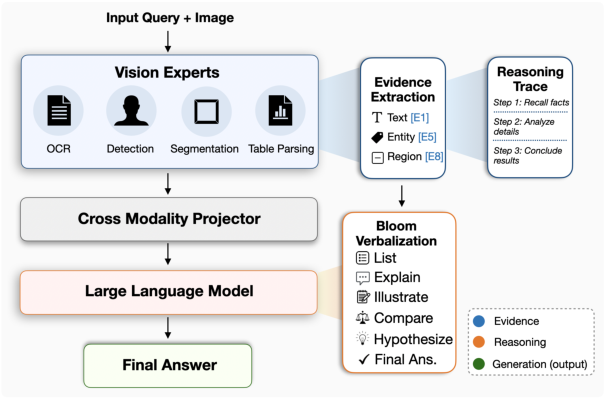
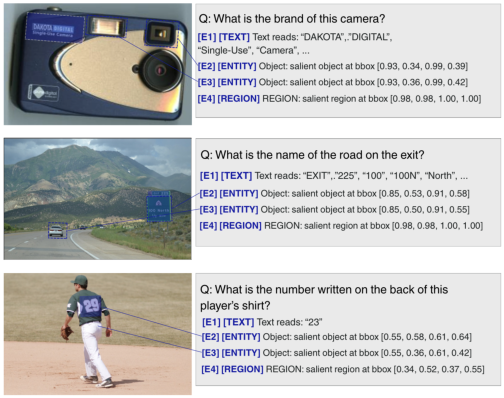
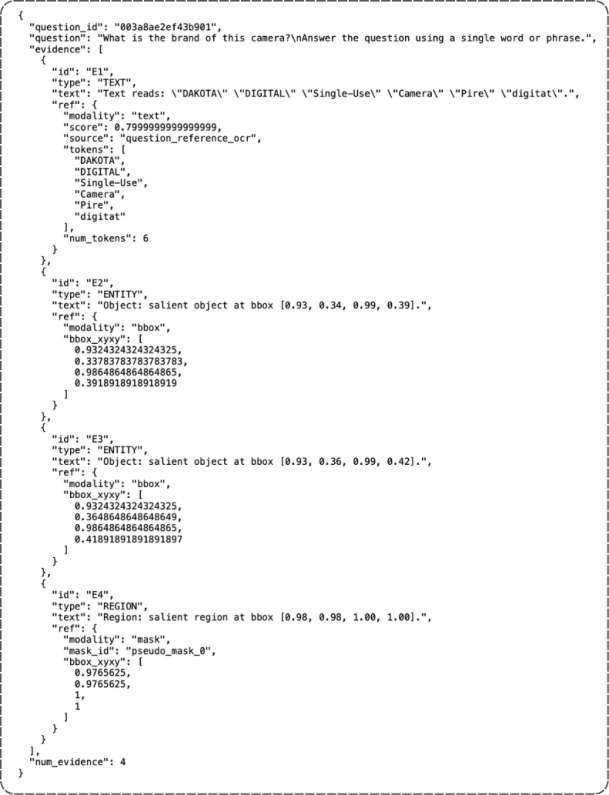
- 1 This literal evidence summary is designed to prioritize fidelity and inspectability: each evidence item is a short, non-inferential statement with an explicit type and grounding reference.
- 2 DETR is used to produce object-centric bounding boxes and labels, and SAM to refine selected regions into instance masks for accurate spatial predicates and boundary-sensitive queries.
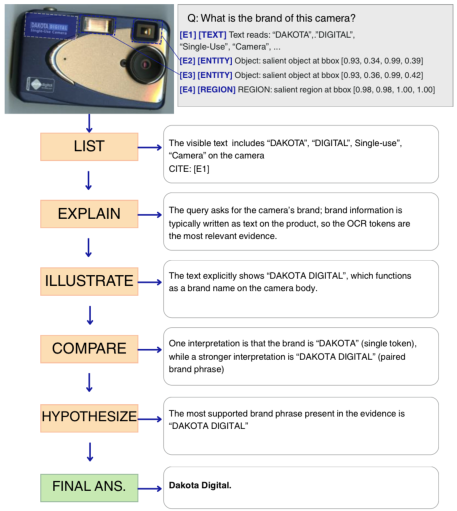
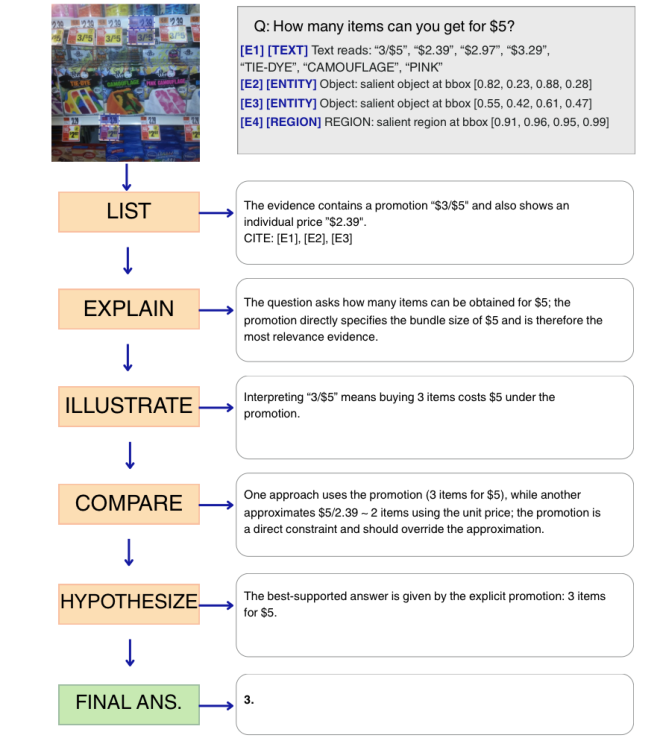
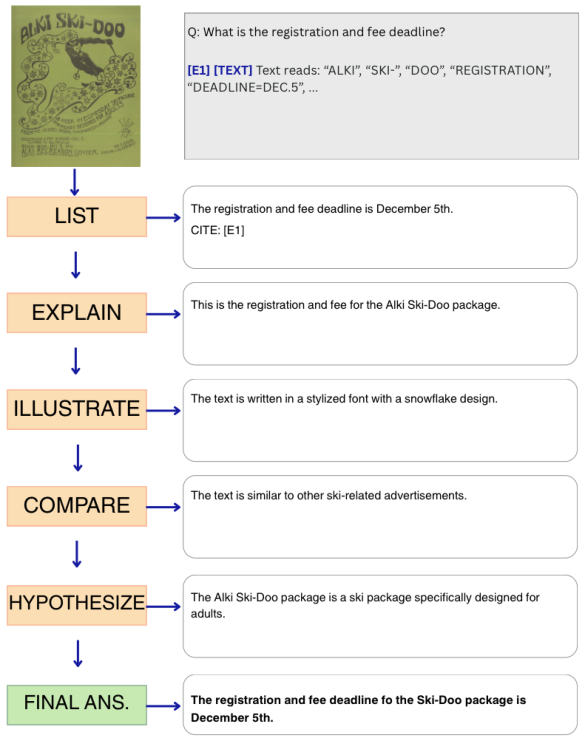
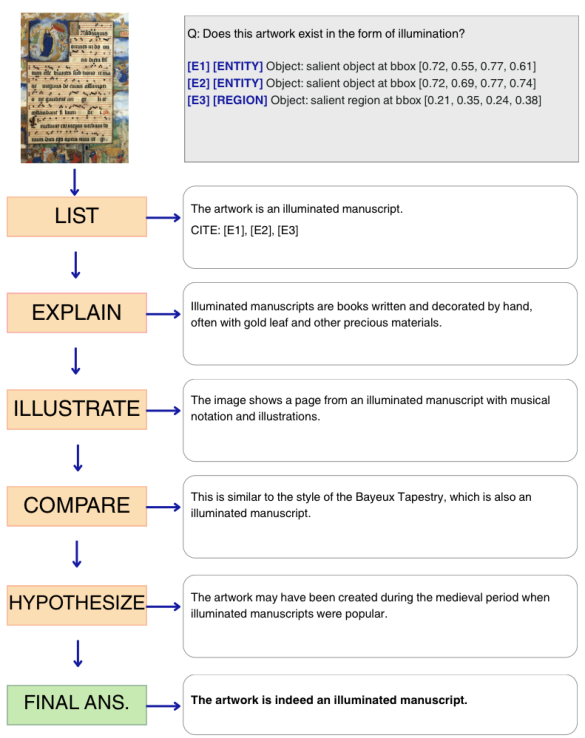
- 3 The figure shows how Bloom verbalization converts a set of typed, citeable evidence items into a structured reasoning progression from low-to high-level cognition.
- 4 This trace record supports fine-grained quantitative analyses of how evidence is selected, propagated across stages, and ultimately used to justify the final answer.
Introduction
From the earliest days of artificial intelligence, researchers and the public alike have been captivated by the idea of building machines that can think and act like humans . Today, with the rapid advances of large language models (LLMs) , this long-standing vision feels closer than ever.
The line separating human and machine abilities is rapidly fading .
These systems are now used routinely in everyday life, and people are increasingly depending on them for decision-making , medicine , and creative tasks .
Methodology
Recent work further suggests that models incorporating cognitive elements tend to correlate with greater task success, where diverse internal representations and metacognitive abilities are particularly critical . Luckily, many of these perceptual functions are already well supported by specialized computer vision (CV) models, since most contemporary CV models are domain-specific and designed to excel at one particular task .
Study Design
To support quantitative analysis without relying on hidden chain-of-thought, we further introduce a lightweight Reasoning Trace Module that parses the Bloom output and evidence store to recover the query-conditioned starting level, executed Bloom steps, and stepwise cited evidence sets, as well as evidence-type usage patterns.
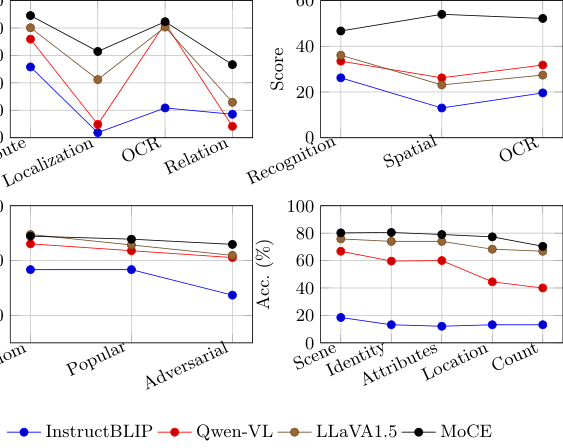
This method evaluated through multiple vision-language benchmark with particular focus on the visual perception and reasoning abilities.
Results & Findings
Likewise, when an LVLM is equipped with specialized CV models (OCR, open-vocabulary detection, segmentation, layout/geometry cues), the system gains explicit and fine-grained visual evidence that can be carried forward as grounding for reasoning. In this sense, specialized CV models are not mere add-ons for accuracy; they are a principled way to approximate the division of labor in human perception.
- Likewise, when an LVLM is equipped with specialized CV models (OCR, open-vocabulary detection, segmentation, layout/geometry cues), the system gains explicit and fine-grained visual evidence that can.
- In this sense, specialized CV models are not mere add-ons for accuracy; they are a principled way to approximate the division of labor in human perception.
- In constructing this concept into the VLM’s architecture, We propose an evidence-driven framework that uses routed vision experts for evidence extraction and employs a Bloom-inspired taxonomy.
- Given an image and a query, we first build an evidence store using an LLM-guided router that selects a small subset of relevant vision experts.
- The selected experts produce structured perceptual outputs, which are then normalized into a unified evidence store through atomic verbalization.
This literal evidence summary is designed to prioritize fidelity and inspectability: each evidence item is a short, non-inferential statement with an explicit type and grounding reference.
DETR is used to produce object-centric bounding boxes and labels, and SAM to refine selected regions into instance masks for accurate spatial predicates and boundary-sensitive queries.
How PDFdigest Helps You Understand Research
Instant Paper Analysis
Get structured summaries and key findings from dense PDFs in seconds.
Visual Explanations
Turn complex methods, figures, and results into clearer visual breakdowns.
AI-Powered Q&A
Ask focused questions and get answers grounded in the paper.
Practical Applications
where each O (e) may contain modality-specific observations such as OCR text lines with bounding boxes, detection labels with boxes, segmentation masks, or parsed tables/charts.
Mixture of Experts
This section reviews the concept of adaptive mixtures of local experts, detailing how modern implementations enhance efficiency and scaling in multimodal learning, particularly in vision-language models (VLMs).
LLMs and LVLMs of Human Cognition
This section explores the intersection of cognitive science and foundation models, examining how LLMs and LVLMs can be evaluated and modeled to reflect human cognitive processes.
Limitations and Cautions
A useful limitation and caution is that this article summarizes the available paper text and extracted evidence; readers should consult the source paper before treating any interpretation as definitive.
The paper’s conclusions may depend on its source selection, definitions, assumptions, and the scope of its analysis, so follow-up reading is important.
Source Paper Figures and Captions
Frequently Asked Questions
Importantly, the Bloom output is produced as text tokens that can be fed directly to the final LLM together with the image and query. It does not directly act as the final answerer; instead, it produces a Bloom-structured answer as text tokens.
Recent work further suggests that models incorporating cognitive elements tend to correlate with greater task success, where diverse internal representations and metacognitive abilities are particularly critical . Luckily, many of these perceptual functions are already well supported by specialized computer vision (CV).
This literal evidence summary is designed to prioritize fidelity and inspectability: each evidence item is a short, non-inferential statement with an explicit type and grounding reference. DETR is used to produce object-centric bounding boxes and labels, and SAM to refine selected regions.
where each O (e) may contain modality-specific observations such as OCR text lines with bounding boxes, detection labels with boxes, segmentation masks, or parsed tables/charts. We therefore compare against widely used LVLM baselines that represent different design points in the current literature.
This paper discusses how advanced models that understand both images and text can be improved by using specialized systems that mimic human thinking. It introduces a new framework that helps these models reason better and reduce errors.
Yes. PDFDigest can turn this paper into a structured explanation, key takeaways, visual summaries, and a narrated video when available.