Visual tracking brain computer interface
This paper discusses a new type of brain-computer interface that allows users to control devices continuously using their brain activity, rather than through discrete commands. This technology could improve how we interact with computers in everyday tasks.
Content & Liability Disclaimer
This article and its accompanying video are automated summaries derived from Visual tracking brain computer interface by Changxing Huang, Nanlin Shi, Yining Miao, Xiaogang Chen, Yijun Wang, Xiaorong Gao. The original research was conducted solely by the paper's authors; PDFdigest did not conduct any of the research and makes no claims of ownership over the underlying scientific work.
The video narration is generated by artificial intelligence and references the paper's authors for attribution. The video is not narrated by any of the paper's authors. This content may contain inaccuracies, omissions, or misinterpretations of the original research. First-person language (e.g., "we found", "our results") reflects the original authors' voice, not PDFdigest's. Always read the original paper for accurate, verified information before making any decisions based on this content.
This content is provided "as is" without any warranties, express or implied. Simulated systems OÜ, its officers, directors, employees, and agents shall not be liable for any direct, indirect, incidental, special, consequential, or punitive damages arising from your use of, reliance on, or access to this content, including but not limited to errors, omissions, or misinterpretations of the original research. This disclaimer applies to the fullest extent permitted by applicable law.
- 1 The aim of Stage II is to train the corrected velocity weight for generating more efficient velocity for continuous cursor control (see Decoding algorithms for Velocity weight).
- 2 The strategy evaluates prediction confidence based on the hypothesis testing framework that has been used in the previous studies.
- 3 The decoding algorithm of the snake game employs a dynamic stopping strategy based on confidence estimation (see Decoding algorithms for Confidence estimation based on hypothesis testing).
- 4 For the click function, we aim to realize it through dwell time 39 or in combination with the brain-computer interface of motor imagery 40 .
Introduction
Visual BCIs, despite their application in multiple scenarios, are often limited to classification tasks with discrete commands. However, these discrete commands are not suitable for continuous tasks such as drawing, cursor control, and robotic device control.
The main challenge arises from the separation between the visual stimulus and the objects to be controlled.
In 2010, Muenssinger et al. developed a P300-Brain Painting application, which involved choosing elements and parameters for painting 17 .
Visual BCIs, despite their application in multiple scenarios, are often limited to classification tasks with discrete commands.
Research Question
The aim of Stage II is to train the corrected velocity weight for generating more efficient velocity for continuous cursor control (see Decoding algorithms for Velocity weight). The decoding algorithm of the snake game employs a dynamic stopping strategy based on confidence estimation (see Decoding algorithms for Confidence estimation based on hypothesis testing).
Confidence estimation based on hypothesis testing.
The strategy evaluates prediction confidence based on the hypothesis testing framework that has been used in the previous studies.
Methodology
The classical speller task has achieved an impressive Information Transfer Rate (ITR) of 325 bits per minute (bpm), allowing for the output of one of forty discrete commands in just 0.3 seconds 24 . During the tasks, participants gaze at the intended position under the multi-region stimulus paradigm while the cursor tracks the position using EEG predictions.
Study Design
Adding velocity weight that was trained using the least square method, a corrected velocity vector can be predicted to control cursor movement.
To achieve this, the whole visual field is separated into 8 radial stimuli, centering the cursor.
How PDFdigest Helps You Understand Research
Instant Paper Analysis
Get structured summaries and key findings from dense PDFs in seconds.
Visual Explanations
Turn complex methods, figures, and results into clearer visual breakdowns.
AI-Powered Q&A
Ask focused questions and get answers grounded in the paper.
Results & Findings
Consequently, users must constantly shift their attention between the visual stimulation and objects like cursor or robotic arms, creating a significant conflict in this setting. For example, in 2018, Chen et al. employed SSVEP-BCI to achieve robotic arm control, relying on step-by-step target selections 25 .
- Consequently, users must constantly shift their attention between the visual stimulation and objects like cursor or robotic arms, creating a significant conflict in this setting.
- For example, in 2018, Chen et al. employed SSVEP-BCI to achieve robotic arm control, relying on step-by-step target selections 25 .
- However, this approach resulted in a significant time cost during the gaze shift process.
- These studies indicate the inadequacy of discrete decoding methods for achieving continuous control and emphasize the need for innovative solutions within the traditional field of visual.
- In 2019, Edelman et al. introduced and validated a noninvasive framework using EEG to achieve the neural control of a robotic device for continuous random target.
We aspire for future work to employ shorter time steps or build asynchronous systems 38 to achieve real-time visual tracking.
Additionally, we showcase various applications, including painting and gaming, to demonstrate the versatility of this system.
Practical Applications
To put it in the context of continuous control, expressing a preference for a particular radial stimulus could lead to potential directional drift and an increased probability of errors. From a different perspective, non-equivalent stimulus sequences, such as sinusoidal sequences with different frequencies, may hold greater potential in certain scenarios with preferences for specific directions.
Experiments materials and design
Seventeen participants were involved in the study, with EEG data recorded during various tasks. The experimental design included training and testing phases to evaluate the BCI’s performance.
Decoding algorithms
Task-Related Component Analysis (TRCA) was used for spatial filtering to optimize the BCI’s performance by maximizing task-related components and minimizing trial covariance.
Source Paper Figures and Captions
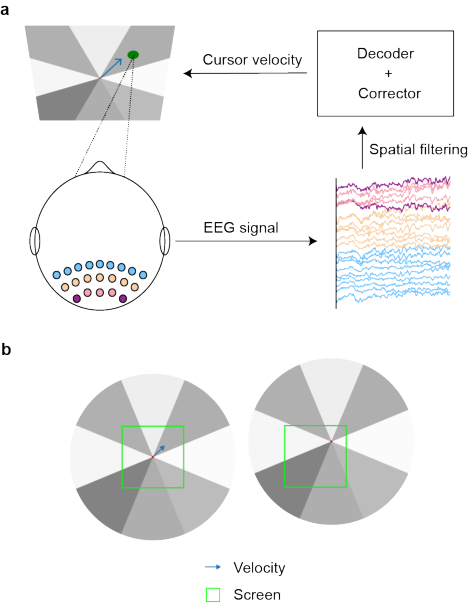
Demonstrates the innovative approach to achieving continuous control in visual BCIs.
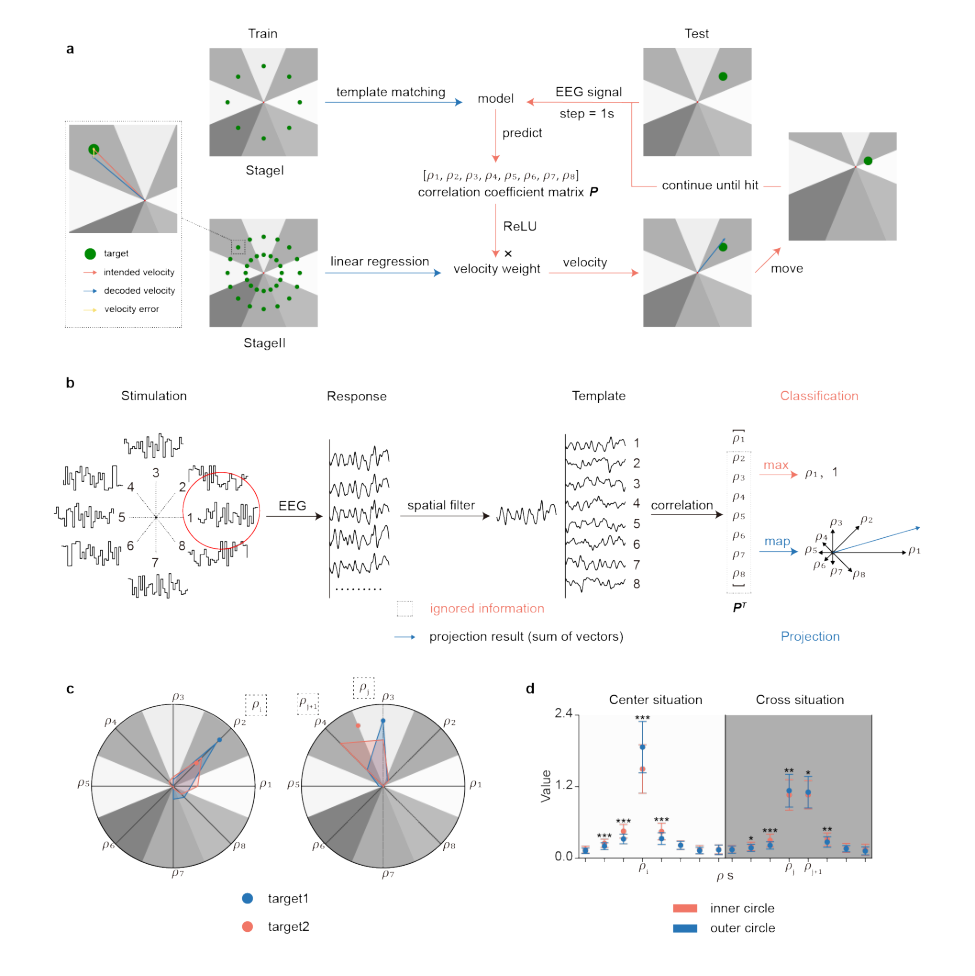
Highlights the methodology used to train participants and evaluate the BCI’s performance.
Frequently Asked Questions
The aim of Stage II is to train the corrected velocity weight for generating more efficient velocity for continuous cursor control (see Decoding algorithms for Velocity weight). The strategy evaluates prediction confidence based on the hypothesis testing framework that has been used.
Adding velocity weight that was trained using the least square method, a corrected velocity vector can be predicted to control cursor movement. To achieve this, the whole visual field is separated into 8 radial stimuli, centering the cursor.
Additionally, we showcase various applications, including painting and gaming, to demonstrate the versatility of this system. To achieve continuous control, each region of the stimulus is modulated by a sequence of uniformly-distributed White Noise (WN; see Figure S1 ).
To put it in the context of continuous control, expressing a preference for a particular radial stimulus could lead to potential directional drift and an increased probability of errors. Therefore, we investigated the issue of cursor jitter to determine the range and.
Visual BCIs, despite their application in multiple scenarios, are often limited to classification tasks with discrete commands. We aspire for future work to employ shorter time steps or build asynchronous systems 38 to achieve real-time visual tracking.
This paper discusses a new type of brain-computer interface that allows users to control devices continuously using their brain activity, rather than through discrete commands. This technology could improve how we interact with computers in everyday tasks.