BAYESIAN NEURAL DECODING USING A DIVERSITY-ENCOURAGING LATENT REPRESENTATION LEARNING METHOD
This paper explores how the brain organizes memories over time, particularly through the study of rats. It introduces a new method for analyzing neural data that improves our understanding of memory processes.
Content & Liability Disclaimer
This article and its accompanying video are automated summaries derived from BAYESIAN NEURAL DECODING USING A DIVERSITY-ENCOURAGING LATENT REPRESENTATION LEARNING METHOD by Tian Chen, Lingge Li, Gabriel Elias, Norbert Fortin, Babak Shahbaba. The original research was conducted solely by the paper's authors; PDFdigest did not conduct any of the research and makes no claims of ownership over the underlying scientific work.
The video narration is generated by artificial intelligence and references the paper's authors for attribution. The video is not narrated by any of the paper's authors. This content may contain inaccuracies, omissions, or misinterpretations of the original research. First-person language (e.g., "we found", "our results") reflects the original authors' voice, not PDFdigest's. Always read the original paper for accurate, verified information before making any decisions based on this content.
This content is provided "as is" without any warranties, express or implied. Simulated systems OÜ, its officers, directors, employees, and agents shall not be liable for any direct, indirect, incidental, special, consequential, or punitive damages arising from your use of, reliance on, or access to this content, including but not limited to errors, omissions, or misinterpretations of the original research. This disclaimer applies to the fullest extent permitted by applicable law.
- 1 Our main focus in this paper is to elucidate the underlying neuronal mechanisms for the memory of sequence of events.
- 2 However, there is no direct evidence that this coding property extends to nonspatial memories (the type of memory typically investigated in human studies).
- 3 Here, our goal is to identify the presented odors (each treated as a class) given the spike train data.
- 4 In this paper, we propose a framework that can be used to explore, visualize, describe, and predict neural patterns.
Introduction
Recent electrophysiological studies have specifically targeted this important issue . These studies commonly involve recording spike train data, which are sequences of spikes (action potentials) produced by neurons over time .
Spiking activities were recorded using 24 tetrodes (bundles of 4 electrodes) in rats tested on well-trained or novel sequences of 5 odors denoted as A, B, C, D, and E.
Many existing statistical methods and machine learning techniques lack the flexibility, rigor, and scalability required for analyzing such complex and high dimensional data.
Readings from a volatile organic compound detector confirmed that odors were cleared from the port 500-750 ms after odor delivery (inter-odor intervals were limited by software to ≥800 ms).
Methodology
To study temporal organization of memory, we have designed an experiment to record neural activity in the CA1 region of the hippocampus as rats performed a nonspatial sequential memory task (see Figure 1 for more details). The task involves the presentation of repeated sequences of odors at a single port and tests the rats’ ability to identify each odor as “in sequence” (InSeq; by holding their nosepoke response until the.
Study Design
Properly analyzing the massive amount of data collected through this experiment is an extremely difficult task.
What makes this task more daunting is the fact that the underlying patterns tend to be highly nonlinear.
Results & Findings
Our main focus in this paper is to elucidate the underlying neuronal mechanisms for the memory of sequence of events. There is considerable evidence that hippocampal neurons can encode sequences of locations .
- Our main focus in this paper is to elucidate the underlying neuronal mechanisms for the memory of sequence of events.
- There is considerable evidence that hippocampal neurons can encode sequences of locations .
- However, there is no direct evidence that this coding property extends to nonspatial memories (the type of memory typically investigated in human studies).
- For each odor presentation (trial), the data typically features spike counts from ∼40-70 neurons and trial identifiers (e.g., Odor presented, InSeq/OutSeq, response correct/incorrect).
- Here, our goal is to identify the presented odors (each treated as a class) given the spike train data.
Although our previous work has revealed important differences in performance and neural activity on Repeats and Skips, this distinction was beyond the scope of the present analyses and not further discussed here.
Our main focus in this paper is to elucidate the underlying neuronal mechanisms for the memory of sequence of events.
How PDFdigest Helps You Understand Research
Instant Paper Analysis
Get structured summaries and key findings from dense PDFs in seconds.
Visual Explanations
Turn complex methods, figures, and results into clearer visual breakdowns.
AI-Powered Q&A
Ask focused questions and get answers grounded in the paper.
Practical Applications
In general, class imbalance is a commonly encountered problem in many real-world problems, where some classes might be infrequent or rare so they are not represented properly in finite samples.
Experimental design and data collection
This section details the experimental setup involving male Long-Evans rats, the apparatus used for odor presentation, and the methodology for recording neural activity during the memory task. It emphasizes the complexity of analyzing the resulting data.
Class imbalance
The paper addresses the challenge of class imbalance in machine learning, discussing various methods to improve performance for underrepresented classes. It introduces a probabilistic approach using DPP to enhance latent representation without the drawbacks of traditional methods.
Variational auto-encoder
This section explains the concept of Variational Auto-encoders (VAE) as a method for learning low-dimensional latent representations. It describes the process of maximizing marginal likelihood and minimizing KL-divergence to achieve efficient inference and data reconstruction.
Source Paper Figures and Captions
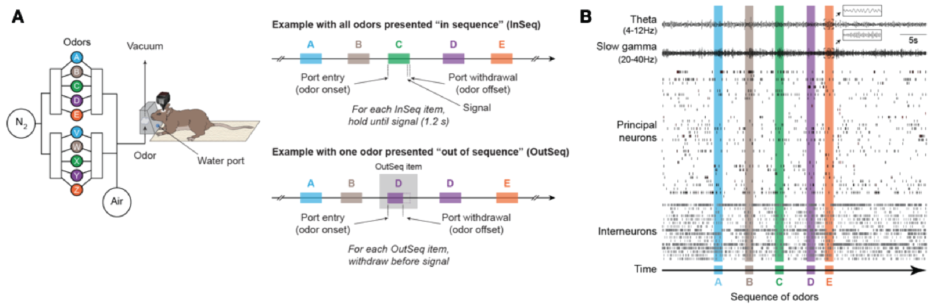
Illustrates the experimental design and the task performed by rats, highlighting the behavioral parallels in memory processing between rats and humans.
Frequently Asked Questions
Moreover, the patterns are typically dominated by a specific behaviour or experimental condition mainly due to the class imbalance problem in the data. To this end, a diversity-encouraging prior, namely determinantal point process (DPP), is used for latent variables.
What makes this task more daunting is the fact that the underlying patterns tend to be highly nonlinear. Briefly, this hippocampus-dependent task involves repeated presentations of sequences of nonspatial items (odors) and requires subjects to determine whether each item is presented “in.
Our main focus in this paper is to elucidate the underlying neuronal mechanisms for the memory of sequence of events. However, there is no direct evidence that this coding property extends to nonspatial memories (the type of memory typically investigated in human.
In general, class imbalance is a commonly encountered problem in many real-world problems, where some classes might be infrequent or rare so they are not represented properly in finite samples. Therefore, the likelihood becomes smaller for subsets with similar elements.
Readings from a volatile organic compound detector confirmed that odors were cleared from the port 500-750 ms after odor delivery (inter-odor intervals were limited by software to ≥800 ms). Although our previous work has revealed important differences in performance and neural activity.
This paper explores how the brain organizes memories over time, particularly through the study of rats. It introduces a new method for analyzing neural data that improves our understanding of memory processes.