workshop: Beyond tabula rasa in RL (BeTR-RL) TIME ADAPTIVE REINFORCEMENT LEARNING
This paper explores how reinforcement learning can be improved to adapt to different time limits when completing tasks, similar to how humans adjust their strategies based on available time.
Content & Liability Disclaimer
This article and its accompanying video are automated summaries derived from workshop: Beyond tabula rasa in RL (BeTR-RL) TIME ADAPTIVE REINFORCEMENT LEARNING by Chris Reinke. The original research was conducted solely by the paper's authors; PDFdigest did not conduct any of the research and makes no claims of ownership over the underlying scientific work.
The video narration is generated by artificial intelligence and references the paper's authors for attribution. The video is not narrated by any of the paper's authors. This content may contain inaccuracies, omissions, or misinterpretations of the original research. First-person language (e.g., "we found", "our results") reflects the original authors' voice, not PDFdigest's. Always read the original paper for accurate, verified information before making any decisions based on this content.
This content is provided "as is" without any warranties, express or implied. Simulated systems OÜ, its officers, directors, employees, and agents shall not be liable for any direct, indirect, incidental, special, consequential, or punitive damages arising from your use of, reliance on, or access to this content, including but not limited to errors, omissions, or misinterpretations of the original research. This disclaimer applies to the fullest extent permitted by applicable law.
- 1 The general goal is to learn the shortest way to a good restaurant, but our specific objective might change from day to day.
- 2 During each episode, one objective is active and the goal is to maximize the expectation over it while using a minimum number of steps:.
- 3 The agents goal is to learn a policy to optimize this objective.
- 4 The first objective is to go to the restaurant with highest food quality:.
Introduction
Modern reinforcement learning (RL) algorithms are able to learn impressive skills, such as playing Chess or Go, often with a higher competency than humans . Given a different context, such as to collect as many opponent pieces in the next 5 moves instead of winning the full game, the algorithms have to learn their behavior from scratch which is time consuming.
The field of transfer learning investigates how artificial agents can be more adaptive to such changes.
Take for example one of our daily routines, going out for lunch.
9 the actions are at first limited to the set A n (s).
Research Question
The general goal is to learn the shortest way to a good restaurant, but our specific objective might change from day to day. But learning takes time and an objective might change from one episode to another.
Given a change in the objective the most appropriate behavior from the library can be selected without need for relearning.
TA-MDPs are extensions of standard MDPs by having a finite or infinite set of objective functions J = (f 1 , f 2 , . . .) with f k : R × N → R.
Methodology
One of the areas where humans are very adaptive and which is the focus of this paper is in the presence of changing time restrictions for a task. Standard model-free RL algorithms such as Q-learning would learn such a task by defining a specific reward function for each objective.
Study Design
With this approach, each objective represents a different task for which a new policy has to be learned.
An important restriction of the method is that the selection of the policy is dependent on an approximation of the expected outcome for the objective (Eq.
How PDFdigest Helps You Understand Research
Instant Paper Analysis
Get structured summaries and key findings from dense PDFs in seconds.
Visual Explanations
Turn complex methods, figures, and results into clearer visual breakdowns.
AI-Powered Q&A
Ask focused questions and get answers grounded in the paper.
Results & Findings
In difference, humans quickly adapt to such changes and still show a high performance. As a result, classical agents might not have time to learn an appropriate policy for each objective.
- In difference, humans quickly adapt to such changes and still show a high performance.
- As a result, classical agents might not have time to learn an appropriate policy for each objective.
- Moreover, we propose two modular, model-free algorithms, the Independent γ -Ensemble (IGE) and the n-Step Ensemble (NSE), to solve such scenarios.
- As a result, it needs to immediately adapt to it.
- As a result, each Q-function defines a different policy π γi and the IGE learns a set of policies via its modules: Π IGE = (π.
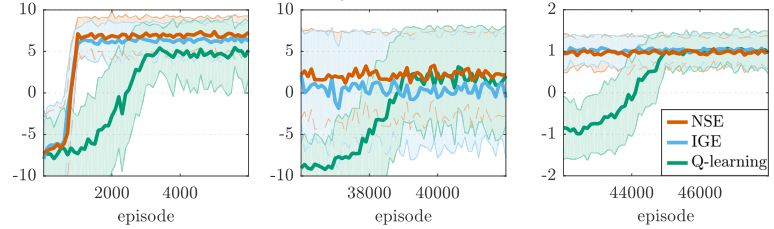
The minimal reward per episode was limited to -10 to make the plots more readable, because some goal formulations can result in a large negative reward during explorations.
As a result, the IGE cannot find the optimal policy for objective f 7 that has g 4 as optimal solution.
Practical Applications
Several restaurants might exist in our neighborhood. If the agent is under stress and has to judge between food quality and the invested time, the reward function could include a punishment (a negative reward) for each performed step until a restaurant is reached.
Thus, the agent might not go to the best restaurant, but to one that is closer.
Moreover, the number of possible objectives can be infinite.
Time Adaptive Mdps
This section formalizes time adaptive RL tasks as Time Adaptive MDPs (TA-MDPs), which extend standard MDPs by incorporating multiple objective functions that evaluate performance based on total reward and time taken. The challenges of adapting to potentially infinite objectives are discussed.
Algorithms
Two algorithms are proposed to solve TA-MDPs: the Independent γ-Ensemble (IGE) and the n-Step Ensemble (NSE). Both algorithms learn a set of policies for different time scales and select the most appropriate policy based on expected outcomes.
Source Paper Figures and Captions
Illustrates the decision-making process of the agent in a time adaptive context.
Frequently Asked Questions
The general goal is to learn the shortest way to a good restaurant, but our specific objective might change from day to day. During each episode, one objective is active and the goal is to maximize the expectation over it while using.
With this approach, each objective represents a different task for which a new policy has to be learned. For each objective 6000 episodes were performed to evaluate how long the agents need to adapt before the task switched to the next objective.
In difference, humans quickly adapt to such changes and still show a high performance. To reduce this problem the current time step t was used as an extra state dimension for the classical Q-learning agent, improving its performance.
Thus, the agent might not go to the best restaurant, but to one that is closer. Therefore, the agent would not learn a policy ending in a terminal state if the greedy action is selected according to the Q-values.
As a result, the IGE cannot find the optimal policy for objective f 7 that has g 4 as optimal solution. The minimal reward per episode was limited to -10 to make the plots more readable, because some goal formulations can result.
This paper explores how reinforcement learning can be improved to adapt to different time limits when completing tasks, similar to how humans adjust their strategies based on available time.