Memory-Efficient Episodic Control: Evidence from Dynamic Online K-Means
This paper presents a new method for improving how machines learn from past experiences in a memory-efficient way. It focuses on making learning faster and more effective by using a smart clustering technique.
Content & Liability Disclaimer
This article and its accompanying video are automated summaries derived from Memory-Efficient Episodic Control Reinforcement Learning with Dynamic Online k-means by Andrea Agostinelli, Kai Arulkumaran, Marta Sarrico, Pierre Richemond, Anil A Bharath. The original research was conducted solely by the paper's authors; PDFdigest did not conduct any of the research and makes no claims of ownership over the underlying scientific work.
The video narration is generated by artificial intelligence and references the paper's authors for attribution. The video is not narrated by any of the paper's authors. This content may contain inaccuracies, omissions, or misinterpretations of the original research. First-person language (e.g., "we found", "our results") reflects the original authors' voice, not PDFdigest's. Always read the original paper for accurate, verified information before making any decisions based on this content.
This content is provided "as is" without any warranties, express or implied. Simulated systems OÜ, its officers, directors, employees, and agents shall not be liable for any direct, indirect, incidental, special, consequential, or punitive damages arising from your use of, reliance on, or access to this content, including but not limited to errors, omissions, or misinterpretations of the original research. This disclaimer applies to the fullest extent permitted by applicable law.
- 1 In consideration of these problems, our aim is to investigate and design novel memory storage approaches for EC algorithms that retain performance while reducing the amount of memory needed.
- 2 Using MFEC and NEC as baseline EC algorithms, we investigate the influence of different memory storage strategies.
- 3 The novel problem that we aim to address, with the online nature of the data distribution in RL, is how to reduce the size of the memory in EC methods.
- 4 And while reducing the memory size, the memory structure still has to support the RL agent in learning from recently-observed states without catastrophically losing past knowledge, referred to as the stability-plasticity dilemma in memory retention .
Introduction
Reinforcement learning (RL), using neural networks as function approximators, have surpassed human performance in a wide range of environments . However, these approaches are sampleinefficient: they can require hundreds of times the experience of a human to reach the same level of performance during the early stages of learning .
Recently, new neuro-inspired algorithms known as episodic control (EC) methods , implementing non-/semi-parametric models, have outperformed the speed of learning of state-of-the-art deep RL algorithms.
EC methods rely on looking up past transitions from memory, where novel states are evaluated based on their similarity to past states.
Combined with the sample-efficiency of EC methods, we believe that it is a promising technique to apply to real-world scenarios where resources can be limited and the acquisition of new data expensive.
Due to limited computational resources we ran experiments with NEC for 3.5 million steps, when using 10 5 items per action.
Research Question
In consideration of these problems, our aim is to investigate and design novel memory storage approaches for EC algorithms that retain performance while reducing the amount of memory needed. Using MFEC and NEC as baseline EC algorithms, we investigate the influence of different memory storage strategies.
Methodology
Recently the behaviour of the hippocampus has been translated into a novel EC RL algorithm, where Q-value estimation is performed as weighted k-NN regression, emulating the hippocampal instance-based retrieval of the past. Here our novel method achieves the best rewards in 10 out of 12 settings, and always when using memory sizes less than 5000.
Study Design
With NEC, DkM is always the best memory storage method (Figure 3 ).
DkM performs well with a memory size of 10 (or greater), which is 5 times smaller than what is required for the LRU method.
How PDFdigest Helps You Understand Research
Instant Paper Analysis
Get structured summaries and key findings from dense PDFs in seconds.
Visual Explanations
Turn complex methods, figures, and results into clearer visual breakdowns.
AI-Powered Q&A
Ask focused questions and get answers grounded in the paper.
Results & Findings
The novel problem that we aim to address, with the online nature of the data distribution in RL, is how to reduce the size of the memory in EC methods. And while reducing the memory size, the memory structure still has to support the RL agent in learning from recently-observed states without catastrophically losing past knowledge, referred to as the stability-plasticity dilemma in memory retention .
- The novel problem that we aim to address, with the online nature of the data distribution in RL, is how to reduce the size of the.
- And while reducing the memory size, the memory structure still has to support the RL agent in learning from recently-observed states without catastrophically losing past knowledge.
- We make the following contributions: Firstly, we evaluate 5 different memory storage strategies, including a novel online clustering algorithm, applied to 2 EC algorithms, in both.
- Secondly, we show that replacing least-recently-used states or using online clustering techniques achieves the best performance across a range of settings and environments.
- In model-free EC (MFEC) the agent is comprised of per-action tables Q EC containing a list of the highest returns ever obtained by taking action a.
As preferring either highly rewarding (REW) or highly surprising states (SUR) as the memory storage strategy achieved poor performance in both Classic Control and Gridworld domains, we did not evaluate these methods on Atari games due to limited computational resources.
The novel problem that we aim to address, with the online nature of the data distribution in RL, is how to reduce the size of the memory in EC methods.
Practical Applications
Maximise Surprise (SUR) : States with the highest prediction error (surprise) could be more useful to store, as compared to states that are well-predicted with the current memory. Maximise Rewards (REW) : States with the highest return may be the best to retain.
Possible improvements could be to make the clustering process itself dependent on the Q-values.
Background
This section provides an overview of reinforcement learning and episodic control, explaining the role of memory systems in the brain and how these concepts are translated into EC algorithms for Q-value estimation.
Prioritised Memories
The paper explores various memory storage strategies for EC algorithms, including maximizing surprise, maximizing rewards, and least recently used (LRU) strategies, to determine which states should be retained in memory.
Source Paper Figures and Captions
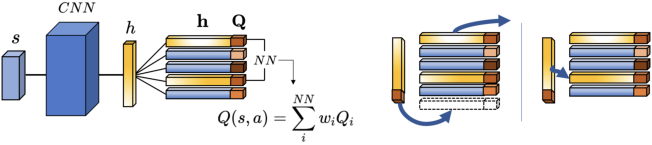
Illustrates the process of state embedding and Q-value estimation in episodic control methods.
Frequently Asked Questions
In consideration of these problems, our aim is to investigate and design novel memory storage approaches for EC algorithms that retain performance while reducing the amount of memory needed. Using MFEC and NEC as baseline EC algorithms, we investigate the influence of.
Recently the behaviour of the hippocampus has been translated into a novel EC RL algorithm, where Q-value estimation is performed as weighted k-NN regression, emulating the hippocampal instance-based retrieval of the past. With NEC, DkM is always the best memory storage method.
The novel problem that we aim to address, with the online nature of the data distribution in RL, is how to reduce the size of the memory in EC methods. And while reducing the memory size, the memory structure still has to.
Maximise Surprise (SUR) : States with the highest prediction error (surprise) could be more useful to store, as compared to states that are well-predicted with the current memory. The surprise of a given state is calculated as the absolute value of the.
As preferring either highly rewarding (REW) or highly surprising states (SUR) as the memory storage strategy achieved poor performance in both Classic Control and Gridworld domains, we did not evaluate these methods on Atari games due to limited computational resources. Combined with.
This paper presents a new method for improving how machines learn from past experiences in a memory-efficient way. It focuses on making learning faster and more effective by using a smart clustering technique.