A Method for Medical Data Analysis: Evidence from Edge Computing Healthcare
This paper introduces a new method for analyzing medical data using a special type of neural network called LogNNet.
Content & Liability Disclaimer
This article and its accompanying video are automated summaries derived from A Method for Medical Data Analysis Using the LogNNet for Clinical Decision Support Systems and Edge Computing in Healthcare by Andrei Velichko. The original research was conducted solely by the paper's authors; PDFdigest did not conduct any of the research and makes no claims of ownership over the underlying scientific work.
The video narration is generated by artificial intelligence and references the paper's authors for attribution. The video is not narrated by any of the paper's authors. This content may contain inaccuracies, omissions, or misinterpretations of the original research. First-person language (e.g., "we found", "our results") reflects the original authors' voice, not PDFdigest's. Always read the original paper for accurate, verified information before making any decisions based on this content.
This content is provided "as is" without any warranties, express or implied. Simulated systems OÜ, its officers, directors, employees, and agents shall not be liable for any direct, indirect, incidental, special, consequential, or punitive damages arising from your use of, reliance on, or access to this content, including but not limited to errors, omissions, or misinterpretations of the original research. This disclaimer applies to the fullest extent permitted by applicable law.
- 1 Due to an effective combination of features in the reservoir and their subsequent classification, LogNNet has promising opportunities for application in clinical decision support systems.
- 2 Almost any object or phenomenon can be associated with several features, which can be used to predict its behavior or relation to any class.
- 3 The constant parameters of the model are set, corresponding to the same values as they do during training.
- 4 After the test data has been verified and the classification metrics meet the criteria for implementing the model in clinical practice, the model can be used to process patient data.
Introduction
IoT is the backbone technology in various areas, including in smart healthcare , smart homes , smart urbanization . The concept of smart healthcare is actively developing in different countries, and the global market for IoT medical devices is growing every year .
The constantly emerging new threats to public health, such as the new coronavirus disease 2019 (COVID-19) pandemic , crate continuous stimulus for the development of new technologies.
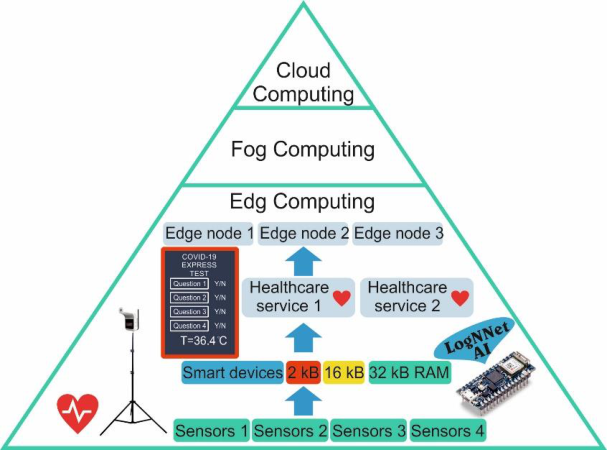
As intelligent data processing requires the use of neural networks and intelligent algorithms, the concept of edge computing is actively developing .
The models are designed to help medical personnel in patient triage, especially in conditions with limited health resources, and to promote the development of mobile services for self-diagnosis at home.
The key point is the presence of artificial intelligence on devices with limited resources.
Methodology
The Internet of Things (IoT) consists of intelligent devices that have limited resources and that are capable of collecting, recognizing, and processing data as well as exchanging processed data between network participants . Therefore, the development of new neural architectures and algorithms capable of working on constrained devices is an important task.
Study Design
Machine learning helps to create data processing rules for the purposes of clustering, classification, and regression, where unsupervised, supervised, and reinforced learning approaches are used .
Popular machine learning algorithms for analyzing medical data are multilayer perceptron (feedforward neural networks with multiple layers, linear classifier) , support vector machines , K-nearest neighbors , the random forest method , logistic regression , and decision trees .
The Internet of Things (IoT) consists of intelligent devices that have limited resources and that are capable of collecting, recognizing, and processing data as well as exchanging processed data between network participants .
Results & Findings
The number of approaches to organize computing include the edge-cloud IoT model, the local edge-cloud IoT model , nanoEdge , and the software-defined network controller in the edge server . These sensors can be wearable sensors, which can measure heart rate, blood pressure, body temperature, and glucose levels, and external sensors are installed at control points.
- The number of approaches to organize computing include the edge-cloud IoT model, the local edge-cloud IoT model , nanoEdge , and the software-defined network controller in.
- These sensors can be wearable sensors, which can measure heart rate, blood pressure, body temperature, and glucose levels, and external sensors are installed at control points.
- Clinical decision support systems often use boosting methods, for example, AdaBoost and the XGBoost classifier , when the algorithms are organized into assemblies to increase predictive.
- The disadvantage of this approach for edge computing is the lack of a clear understanding by users of how these algorithms are arranged, how to install.
- Ways to reduce the memory consumption of neural networks in edge computing include pruning connections after learning , online learning with sparse networks , and quantization-aware.
Due to an effective combination of features in the reservoir and their subsequent classification, LogNNet has promising opportunities for application in clinical decision support systems.
How PDFdigest Helps You Understand Research
Instant Paper Analysis
Get structured summaries and key findings from dense PDFs in seconds.
Visual Explanations
Turn complex methods, figures, and results into clearer visual breakdowns.
AI-Powered Q&A
Ask focused questions and get answers grounded in the paper.
Practical Applications
Let us denote the number of possible classes as M.
The Operation Principle of the Neural Network LogNNet
The operation principle of LogNNet is explained, detailing how input feature vectors are transformed and classified. The architecture includes a matrix for feature transformation and a two-layer linear classifier, with specific equations for matrix filling based on chaotic behavior.
Input
This section describes the input process for LogNNet, detailing how feature vectors are structured and the requirements for data consistency. It emphasizes the importance of having a uniform feature vector dimension and the removal of incomplete data.
Source Paper Figures and Captions

Frequently Asked Questions
One of the most important tasks that needs to be solved by artificial intelligence is the classification of an object represented as a vector of features. In , the value M corresponded to M = 10, as the number of classes was.
Machine learning helps to create data processing rules for the purposes of clustering, classification, and regression, where unsupervised, supervised, and reinforced learning approaches are used . The objective of this study is to create an effective method for analyzing medical data using.
Due to an effective combination of features in the reservoir and their subsequent classification, LogNNet has promising opportunities for application in clinical decision support systems. Almost any object or phenomenon can be associated with several features, which can be used to predict.
In the Conclusion, a general description of the study and its scientific significance is given. Therefore, there is a transformation of the feature vector d into the (P + 1)-dimensional space.
The Internet of Things (IoT) consists of intelligent devices that have limited resources and that are capable of collecting, recognizing, and processing data as well as exchanging processed data between network participants . The models are designed to help medical personnel in.
This paper introduces a new method for analyzing medical data using a special type of neural network called LogNNet.