Music-to-Dance Generation: Evidence from Via Atomic Movements
This paper presents a new way to create dance movements that match music by breaking down dance into smaller, understandable parts called atomic movements. This method helps make the dances more coherent and expressive.
Content & Liability Disclaimer
This article and its accompanying video are automated summaries derived from Music-to-Dance Generation via Atomic Movements by Xinhao Cai, Yixuan Sun, Minghang Zheng, Qingchao Chen, Xin Jin, Song-Chun Zhu, Yang Liu. The original research was conducted solely by the paper's authors; PDFdigest did not conduct any of the research and makes no claims of ownership over the underlying scientific work.
The video narration is generated by artificial intelligence and references the paper's authors for attribution. The video is not narrated by any of the paper's authors. This content may contain inaccuracies, omissions, or misinterpretations of the original research. First-person language (e.g., "we found", "our results") reflects the original authors' voice, not PDFdigest's. Always read the original paper for accurate, verified information before making any decisions based on this content.
This content is provided "as is" without any warranties, express or implied. Simulated systems OÜ, its officers, directors, employees, and agents shall not be liable for any direct, indirect, incidental, special, consequential, or punitive damages arising from your use of, reliance on, or access to this content, including but not limited to errors, omissions, or misinterpretations of the original research. This disclaimer applies to the fullest extent permitted by applicable law.
- 1 Dance can be generated from music using a structured approach.
- 2 Atomic movements are the building blocks of dance, making it easier to create complex choreography.
- 3 The proposed method improves the quality of generated dances, making them more natural and aligned with music.
Introduction
The paper discusses the importance of generating dance conditioned on music, emphasizing the need for structural organization in choreography. It critiques existing neural approaches for lacking segment-level coherence and proposes a new perspective that views dance as sequences of atomic movements.
Method
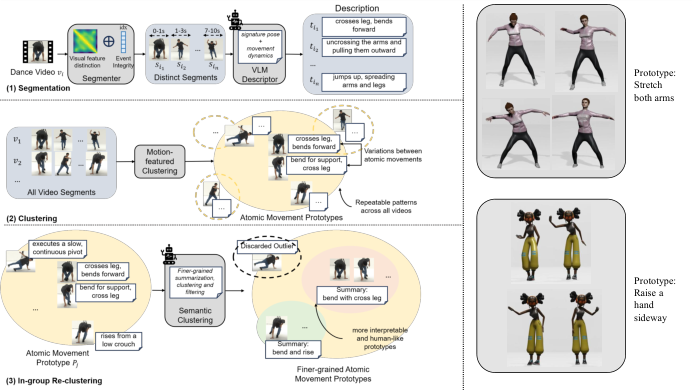
The method section describes the framework and processes used to generate dance movements from music, focusing on the segmentation and clustering of dance data into atomic movements.
Human Motion Generation
Recent advancements in multimodal models have spurred interest in human motion generation. The paper highlights the limitations of applying text-to-motion frameworks to dance, which requires artistic and compositional characteristics that are not captured by existing methods.
How PDFdigest Helps You Understand Research
Instant Paper Analysis
Get structured summaries and key findings from dense PDFs in seconds.
Visual Explanations
Turn complex methods, figures, and results into clearer visual breakdowns.
AI-Powered Q&A
Ask focused questions and get answers grounded in the paper.
Music-to-Dance Generation
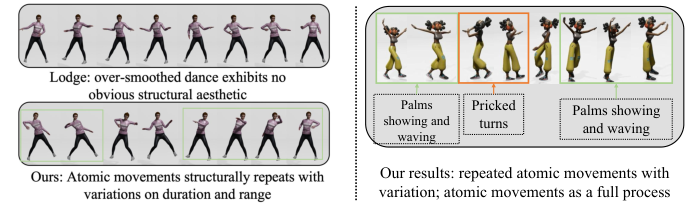
The section reviews advancements in generative models for music-to-dance generation, noting the dominance of larger music-motion datasets. It critiques existing methods for lacking process information and structural coherence, contrasting them with the proposed atomic movement approach.
Periodic Music Input
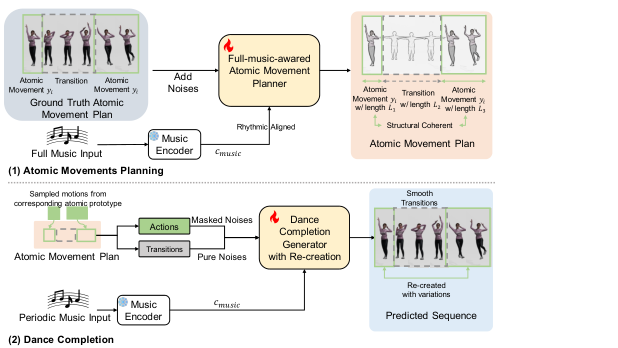
This section outlines the process of atomic movement planning and dance completion, detailing how the model utilizes full music input to create rhythmic and structurally coherent dance sequences.
Source Paper Figures and Captions
![Adaptive segmentation via visual similarityInput: Paired T -frame dance video V = {v1, . . . , vT } and T -frame 3D dance motion M = {m1, . . . , mT }, N , minimum motion segment length Lmin Output: motion segment count K, cut points B = {b k } K k=1 and motion units S = {si} K+1 i=1 . 1: Extract per-frame visual features F = {f1, . . . , fT } using an I3D encoder. 2: Compute a frame-wise similarity matrix A ∈ R T ×T where Apq = cos(fp, fq). 3: ct ← A [t,:] ∈ R T // Each row t of A encodes the similarity between frame t and all other frames. 4: ct ← [ct; t/T ] ∈ R T +1 // Append normalized frame index to ct to encourage temporally local grouping. 5: Perform N -means clustering on { ct} T t=1 to obtain frame labels {lt} T t=1 . 6: Set cut points at label transitions: B = { t | ℓt ̸ = ℓt-1, 2 ≤ t ≤ T }. 7: Iteratively merge segments shorter than Lmin with the shorter of its temporal neighbors until all segments satisfy minimum length, yielding B = {b k }, K = |B|. 8: Segment M into motion units S = {si} K+1 i=1 , where si = M [b i-1 , b i ) , with b0 = 1 and bK+1 = T + 1.](https://pdfdigest.com/wp-content/uploads/nala/output/paper_seWnxiDq9NjhSw78_figure_03.png)
Frequently Asked Questions
This paper presents a new way to create dance movements that match music by breaking down dance into smaller, understandable parts called atomic movements. This method helps make the dances more coherent and expressive.
The paper discusses the importance of generating dance conditioned on music, emphasizing the need for structural organization in choreography. It critiques existing neural approaches for lacking segment-level coherence and proposes a new.
The method section describes the framework and processes used to generate dance movements from music, focusing on the segmentation and clustering of dance data into atomic movements.
Yes. PDFDigest can turn this paper into a structured explanation, key takeaways, visual summaries, and a narrated video when available.