Confidence-Aware Subject-to-Subject Transfer Learning for Brain-Computer Interface
This paper presents a new method to improve brain-computer interfaces by using data from subjects who provide reliable signals, making the technology more effective and easier to use.
Use the local video fallback
Content & Liability Disclaimer
This article and its accompanying video are automated summaries derived from Confidence-Aware Subject-to-Subject Transfer Learning for Brain-Computer Interface by Dong-Kyun Han, Dong-Young Kim, Serkan Musellim, Ji-Hoon Jeong. The original research was conducted solely by the paper's authors; PDFdigest did not conduct any of the research and makes no claims of ownership over the underlying scientific work.
The video narration is generated by artificial intelligence and references the paper's authors for attribution. The video is not narrated by any of the paper's authors. This content may contain inaccuracies, omissions, or misinterpretations of the original research. First-person language (e.g., "we found", "our results") reflects the original authors' voice, not PDFdigest's. Always read the original paper for accurate, verified information before making any decisions based on this content.
This content is provided "as is" without any warranties, express or implied. Simulated systems OÜ, its officers, directors, employees, and agents shall not be liable for any direct, indirect, incidental, special, consequential, or punitive damages arising from your use of, reliance on, or access to this content, including but not limited to errors, omissions, or misinterpretations of the original research. This disclaimer applies to the fullest extent permitted by applicable law.
- 1 BCIs can be challenging due to differences in brain signals between individuals.
- 2 The proposed method focuses on using data from subjects who are likely to provide accurate information.
- 3 By filtering out unreliable data, the system can perform better without needing lengthy calibration.
Ii. Methods
This section outlines the proposed BCI framework that excludes low-confidence subjects during training. It details the co-teaching approach used to filter samples and the confidence-aware subject selection process.
I. Introduction
The introduction discusses the significance of BCIs and the challenges posed by EEG variability. It highlights the need for calibration procedures and introduces transfer learning as a potential solution to improve model generalization across subjects.
Iii. Experiments
The experiments section describes the datasets used for validation, including the 2020 international BCI competition track 4 and the OpenBMI dataset, and outlines the experimental setup and results.
How PDFdigest Helps You Understand Research
Instant Paper Analysis
Get structured summaries and key findings from dense PDFs in seconds.
Visual Explanations
Turn complex methods, figures, and results into clearer visual breakdowns.
AI-Powered Q&A
Ask focused questions and get answers grounded in the paper.
Source Paper Figures and Captions
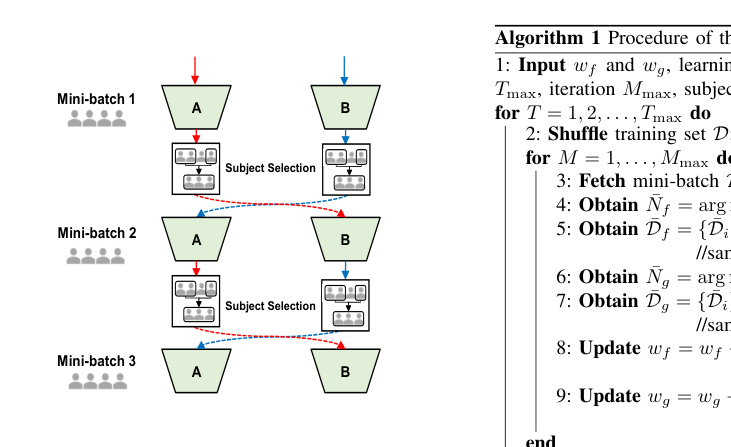
Illustrates the methodology for excluding low-confidence subjects in the training process.
Frequently Asked Questions
This paper presents a new method to improve brain-computer interfaces by using data from subjects who provide reliable signals, making the technology more effective and easier to use.
This section outlines the proposed BCI framework that excludes low-confidence subjects during training. It details the co-teaching approach used to filter samples and the confidence-aware subject selection process.
The introduction discusses the significance of BCIs and the challenges posed by EEG variability. It highlights the need for calibration procedures and introduces transfer learning as a potential solution to improve model.
Yes. PDFDigest can turn this paper into a structured explanation, key takeaways, visual summaries, and a narrated video when available.