Action-Factored Multi-Agent: Evidence from Quantum Device Tuning
This paper introduces a new method for tuning quantum devices using a type of machine learning called reinforcement learning. The method helps multiple agents work together more effectively, reducing interference and improving the tuning process.
Content & Liability Disclaimer
This article and its accompanying video are automated summaries derived from Action-Factored Multi-Agent Reinforcement Learning for Scalable Quantum Device Tuning by Edwin De Nicolo, Rahul Marchand, Cornelius Carlsson, Pranav Vaidhyanathan, Natalia Ares. The original research was conducted solely by the paper's authors; PDFdigest did not conduct any of the research and makes no claims of ownership over the underlying scientific work.
The video narration is generated by artificial intelligence and references the paper's authors for attribution. The video is not narrated by any of the paper's authors. This content may contain inaccuracies, omissions, or misinterpretations of the original research. First-person language (e.g., "we found", "our results") reflects the original authors' voice, not PDFdigest's. Always read the original paper for accurate, verified information before making any decisions based on this content.
This content is provided "as is" without any warranties, express or implied. Simulated systems OÜ, its officers, directors, employees, and agents shall not be liable for any direct, indirect, incidental, special, consequential, or punitive damages arising from your use of, reliance on, or access to this content, including but not limited to errors, omissions, or misinterpretations of the original research. This disclaimer applies to the fullest extent permitted by applicable law.
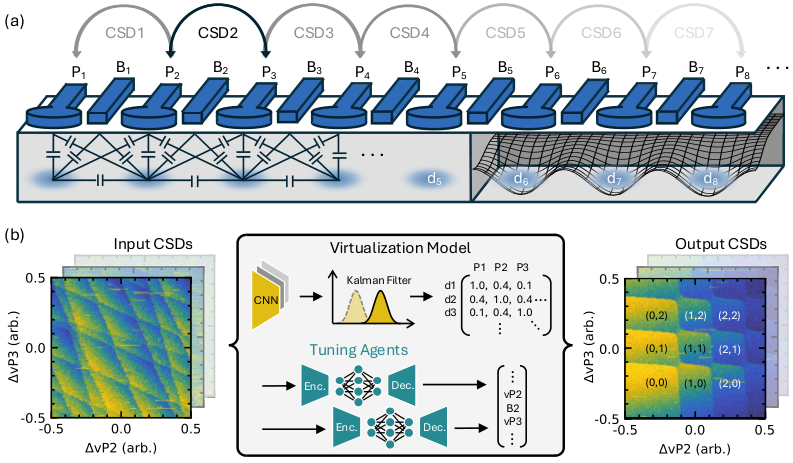
- 1 As shown in Fig. 1b , the objective is to reach a voltage configuration that brings all charge occupations and tunnel-couplings to a predefined target.
- 2 The agents' goal is to maximize the cumulative return J = E π θ T t=0 N i=1 r t i , which in our cooperative setting is equivalent to optimizing a common global objective .
- 3 When C t Φ -1 t ≈ I, this objective has small mixed action terms and is close to the separable surrogate.
- 4 To update the shared policy parameters θ, local advantages are aggregated and the joint PPO clipped surrogate objective is maximized across all agents i and batch time steps t:.
Introduction
Reinforcement learning (RL) provides a general framework for sequential decision-making under uncertainty, where agents learn policies through interaction with an environment . Combining RL with deep neural networks has achieved human-level performance on complex, high-dimensional tasks , and its extension to continuous control domains has allowed agents to learn efficiently from sensory inputs .
This opens practical applications for robotics and locomotion, and more recently, has bridged RL with the field of quantum computing for tasks such as error-robust quantum gate design , analog pulse shaping , real-time qubit feedback , and voltage tuning of quantum dots .
While RL, and machine learning in general, is becoming central to quantum control , a key challenge lies in scaling these computational methods efficiently to larger devices .
Future work will focus on hardware-in-the-loop validation and robustness to experimental non-idealities.
Research Question
As shown in Fig. 1b , the objective is to reach a voltage configuration that brings all charge occupations and tunnel-couplings to a predefined target. The agents’ goal is to maximize the cumulative return J = E π θ T t=0 N i=1 r t i , which in our cooperative setting is equivalent to optimizing a common global objective .
When C t Φ -1 t ≈ I, this objective has small mixed action terms and is close to the separable surrogate.
To update the shared policy parameters θ, local advantages are aggregated and the joint PPO clipped surrogate objective is maximized across all agents i and batch time steps t:.
Methodology
Using CSDs as input, the underlying feature-tracking task for gate virtualization has been offloaded to vision models, including Convolutional Neural Networks (CNNs) , U-Net-like architectures and Transformers , but requires additional pre-processing for larger systems . Most notably, GPG introduced parametrized swarm policies over a proximity graph, InforMARL proposed graph attention over local neighborhoods, and MADDPG-M learns explicit communication channels alongside task policies.
Study Design
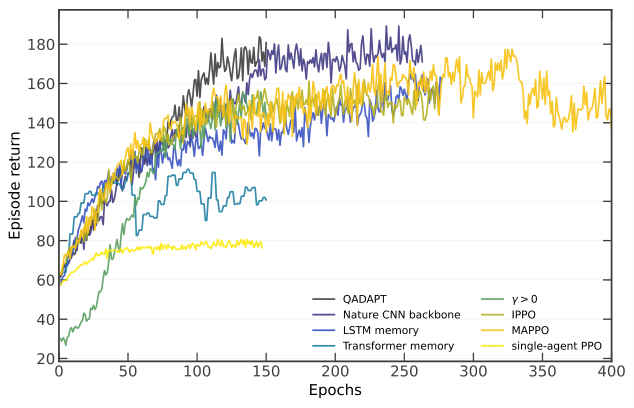
We train QADAPT on a 4-dot system using a modified Proximal Policy Optimization (PPO) method for stable and sample-efficient learning in continuous control tasks .
Therefore, we model the task as a contextual bandit, eliminating temporal credit assignment (discount factor γ = 0).
How PDFdigest Helps You Understand Research
Instant Paper Analysis
Get structured summaries and key findings from dense PDFs in seconds.
Visual Explanations
Turn complex methods, figures, and results into clearer visual breakdowns.
AI-Powered Q&A
Ask focused questions and get answers grounded in the paper.
Results & Findings
There exist two main gate types; plunger gates predominantly control the electrochemical potential of quantum dots, hence their charge occupations, and barrier gates modulate the tunnel coupling between dots. Measuring the system’s response as a function of two gate voltages produces images known as charge stability diagrams (CSDs).
- There exist two main gate types; plunger gates predominantly control the electrochemical potential of quantum dots, hence their charge occupations, and barrier gates modulate the tunnel.
- Measuring the system’s response as a function of two gate voltages produces images known as charge stability diagrams (CSDs).
- To address these bottlenecks, we present QADAPT (Quantum Arrays of Dots in Automated Parallel Tuning), a multi-agent reinforcement learning (MARL) framework for tuning quantum devices at.
- • Zero-Shot Scalability and Empirical Evaluation: We demonstrate that QADAPT zeroshot generalizes across different system sizes, unseen device configurations, and various non-idealized physical effects without retraining.
- We empirically evaluate our framework against various state-of-the-art baselines and demonstrate superior performance across all benchmarks.
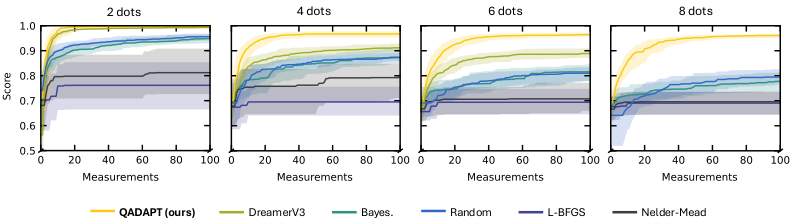
For example, training DreamerV3 on 2/4/6 dot-arrays in the benchmark comparison of Fig. 2 required Transferability to various device sizes is a key limitation of other baseline MARL approaches.
As the length of the quantum dot array increases from 2 to 8 (moving left to right), QADAPT maintains rapid convergence, out-performing all benchmark methods, including: model-based reinforcement learning (DreamerV3), Bayesian optimisation using Gaussian processes, the gradient free Nelder-Mead optimiser.
Practical Applications
These diagrams contain relevant tuning and cross-talk information, which may be inferred from the position and curvature of the line features they contain. This may occur, for example, near target configurations where transition lines in CSDs are sparse.
We consider how QADAPT would generalize to two-and three-dimensional arrays, where quantum dots may have more than two nearest neighbors.
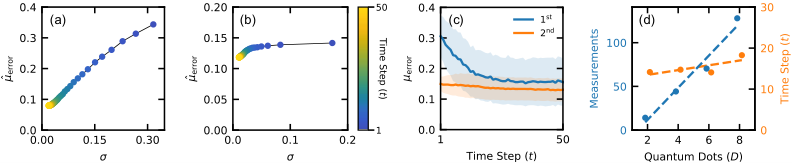
While the bandit reduction avoids long-horizon planning that would be destabilized by such effects, they may nonetheless hamper the online learning of Φ if cross-capacitance values vary significantly between tuning steps.
A further limitation of QADAPT may stem from the strict assignment of agent types among barrier and plunger categories.
Problem Formulation and Simulation Setting
The tuning process is modeled as a Decentralized Partially Observable Markov Decision Process (Dec-POMDP) with agents representing device gates. The section outlines the state, actions, and rewards involved in the tuning process.
Adaptive Gate Virtualization
This section describes how QADAPT learns a factored representation of the action space to mitigate interference from capacitive cross-talk. It details the use of a CNN and Kalman filter to estimate capacitances and update control variables.
Source Paper Figures and Captions
Frequently Asked Questions
As shown in Fig. 1b , the objective is to reach a voltage configuration that brings all charge occupations and tunnel-couplings to a predefined target. The agents’ goal is to maximize the cumulative return J = E π θ T t=0 N.
Using CSDs as input, the underlying feature-tracking task for gate virtualization has been offloaded to vision models, including Convolutional Neural Networks (CNNs) , U-Net-like architectures and Transformers , but requires additional pre-processing for larger systems . This shares many similarities to the.
IPPO and MAPPO showed that shared PPO policies achieve strong cooperative performance, which HAPPO extended to the heterogeneous agent case. At each time step, CSDs are passed through a lightweight CNN, f virt (•), to estimate the capacitances between each plunger gate.
This may occur, for example, near target configurations where transition lines in CSDs are sparse. We consider how QADAPT would generalize to two-and three-dimensional arrays, where quantum dots may have more than two nearest neighbors.
As the length of the quantum dot array increases from 2 to 8 (moving left to right), QADAPT maintains rapid convergence, out-performing all benchmark methods, including: model-based reinforcement learning (DreamerV3), Bayesian optimisation using Gaussian processes, the gradient free Nelder-Mead optimiser, the gradient-based.
This paper introduces a new method for tuning quantum devices using a type of machine learning called reinforcement learning. The method helps multiple agents work together more effectively, reducing interference and improving the tuning process.