Multi-Agent Reinforcement Learning for: Evidence from RAT
This paper explores how vehicles can choose the best communication method to improve their performance in various driving scenarios. It uses advanced algorithms to make these decisions more efficiently.
Content & Liability Disclaimer
This article and its accompanying video are automated summaries derived from Multi-Agent Reinforcement Learning for C-V2X RAT Selection by Moritz Schaffenroth, Uwe Kölbel, Heike Lepke, Alexander Prinz, Alfred Höß. The original research was conducted solely by the paper's authors; PDFdigest did not conduct any of the research and makes no claims of ownership over the underlying scientific work.
The video narration is generated by artificial intelligence and references the paper's authors for attribution. The video is not narrated by any of the paper's authors. This content may contain inaccuracies, omissions, or misinterpretations of the original research. First-person language (e.g., "we found", "our results") reflects the original authors' voice, not PDFdigest's. Always read the original paper for accurate, verified information before making any decisions based on this content.
This content is provided "as is" without any warranties, express or implied. Simulated systems OÜ, its officers, directors, employees, and agents shall not be liable for any direct, indirect, incidental, special, consequential, or punitive damages arising from your use of, reliance on, or access to this content, including but not limited to errors, omissions, or misinterpretations of the original research. This disclaimer applies to the fullest extent permitted by applicable law.
- 1 Recent work by Khalid et al. has shown that hybrid V2X selection can improve the one-way end-to-end latency, reliability and packet reception ratio of the communication when compared to static technology selection.
- 2 Since the paper does not clearly state in which setting the model was trained and to have a comparable setting we trained it as a shared policy and in a non-stationary setting.
- 3 In both training and evaluation, the traffic simulation is first advanced to a defined start time so that vehicles are already present in the scenario before communication decisions are executed.
- 4 The DDQN model uses also 60 iterations, but with a message receive target of 100, and the episode steps were capped at 200 steps which lead to a total of ∼ 6.7 × 10 5 environment-steps.
Introduction
The landscape of V2X enabled applications is rapidly expanding. They proposed a selection algorithm based on a decision tree to select between 5G/UU, C-V2X, and dedicated short range communication (DSRC) based on CAM-message statistics.
This work highlights the advantage use of DRL for the RAT selection problem.
Mancini et al. study joint access selection with DSRC and visible light communication (VLC) and a complex state that e.g., considers distances between vehicles.
However, the hybrid Uu/PC5 selection is a multi-agent setting where multiple agents compete for limited resources such as channel occupancy time and influence each other through their channel choice.
Methodology
Yacheur et al. formulate the decision problem as deep reinforcement learning (DRL) task and compare their solution to single radio access technology (RAT) selection and a multiple-criteria decision analysis (MCDM) algorithm and assess it under two situations: Congested and non-congested. KPI Unit Definition On-time delivery ratio latency-compliant deliveries / expected packets On-time reliability ratio latency-compliant deliveries / arrived packets Mean delay [s] mean end-to-end delay over arrived packets Hybrid duplicate.
Study Design
Controlled vehicles Method Best overall configurations Mean delivery ratio Delay [ms] Hybrid duplication [%] one DDQN 7 0.508 96 12.119 MAPPO 9 0.535 102 9.645 all DDQN 3 0.548 57 8.762 MAPPO 13 0.567 58 8.892.
Results & Findings
Future use cases like see-through for passing and cooperative perception have heterogeneous quality-of-service (QoS) requirements and communication with a single technology e.g., PC5 or Uu link can lead to performance limitations in terms of latency, reliability, or coverage. While PC5 enables direct low latency communication with ultra-low latency: ∼1 milliseconds , the Uu link (5G) provides advantages such as higher bandwidth, extended communication range, connectivity to remote infrastructure but demands.
- Future use cases like see-through for passing and cooperative perception have heterogeneous quality-of-service (QoS) requirements and communication with a single technology e.g., PC5 or Uu link.
- While PC5 enables direct low latency communication with ultra-low latency: ∼1 milliseconds , the Uu link (5G) provides advantages such as higher bandwidth, extended communication range.
- Recent work by Khalid et al. has shown that hybrid V2X selection can improve the one-way end-to-end latency, reliability and packet reception ratio of the communication.
- They find that in their scenario the packet reception rate (PRR) increases from 66 % to more than 90 %.
- However, their approach focuses on a single technology whereas we focus on the selection between multiple technologies such as Uu link and PC5.
Since we only used two maps, which are both from the same region we cannot determine the generalization property.
In future work, we will apply the selection algorithm to a real-world testbed in order to examine the performance of the algorithm.
How PDFdigest Helps You Understand Research
Instant Paper Analysis
Get structured summaries and key findings from dense PDFs in seconds.
Visual Explanations
Turn complex methods, figures, and results into clearer visual breakdowns.
AI-Powered Q&A
Ask focused questions and get answers grounded in the paper.
Practical Applications
This approach is explainable but might be limited under non-stationary situations as it occurs in multi-agent settings. Hybrid duplicates refer to packets received via both channels, as there could be also duplicates over the same channel in case of re-transmissions.
This approach is explainable but might be limited under non-stationary situations as it occurs in multi-agent settings.
I. Introduction
The introduction discusses the expanding landscape of V2X applications and the limitations of using a single communication technology. It highlights the advantages of hybrid V2X selection and reviews previous work on decision algorithms for RAT selection.
Ii. Simulation Stack
This section describes the digital twin framework used for communication simulation, integrating mobility simulation with traffic simulator SUMO and communication simulation with ns-3. It details the custom channel selection model implemented for the study.
Iii. Rl Formulation
The reinforcement learning formulation outlines the observations and action space for the RAT selection problem. It explains the centralized training with decentralized execution paradigm and the reward structure used for training the agents.
Iv. Experimental Setup
The experimental setup details the evaluation process, including the scenarios, app-mixes, and control levels for the simulations. It describes how the learned policies were tested under different conditions.
Source Paper Figures and Captions
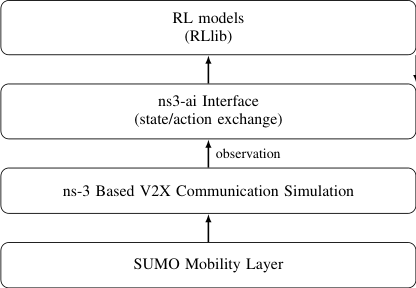
Illustrates the integration of various simulation components and the custom channel selection model.
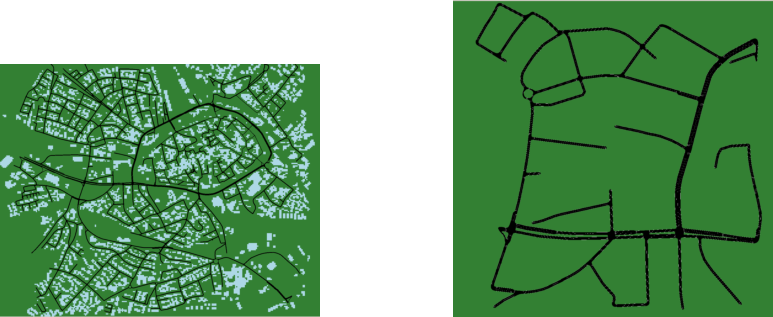
Shows the different scenarios under which the learned policies were tested.
Frequently Asked Questions
Prior work on a related field has applied multi agent reinforcement learning to optimize radio resource selection focusing on mitigating packet collisions and improving spectrum efficiency. The remaining app-mixes consist of nine selected V2X use cases from , but have different default.
Yacheur et al. formulate the decision problem as deep reinforcement learning (DRL) task and compare their solution to single radio access technology (RAT) selection and a multiple-criteria decision analysis (MCDM) algorithm and assess it under two situations: Congested and non-congested. KPI Unit.
Recent work by Khalid et al. has shown that hybrid V2X selection can improve the one-way end-to-end latency, reliability and packet reception ratio of the communication when compared to static technology selection. Since the paper does not clearly state in which setting.
This approach is explainable but might be limited under non-stationary situations as it occurs in multi-agent settings. We define a simpler reward which is a composite function that balances individual QoS with overall efficiency.
This approach is explainable but might be limited under non-stationary situations as it occurs in multi-agent settings. Since we only used two maps, which are both from the same region we cannot determine the generalization property.
This paper explores how vehicles can choose the best communication method to improve their performance in various driving scenarios. It uses advanced algorithms to make these decisions more efficiently.