An Exam for Active Observers: Evidence from Exam Active Observers
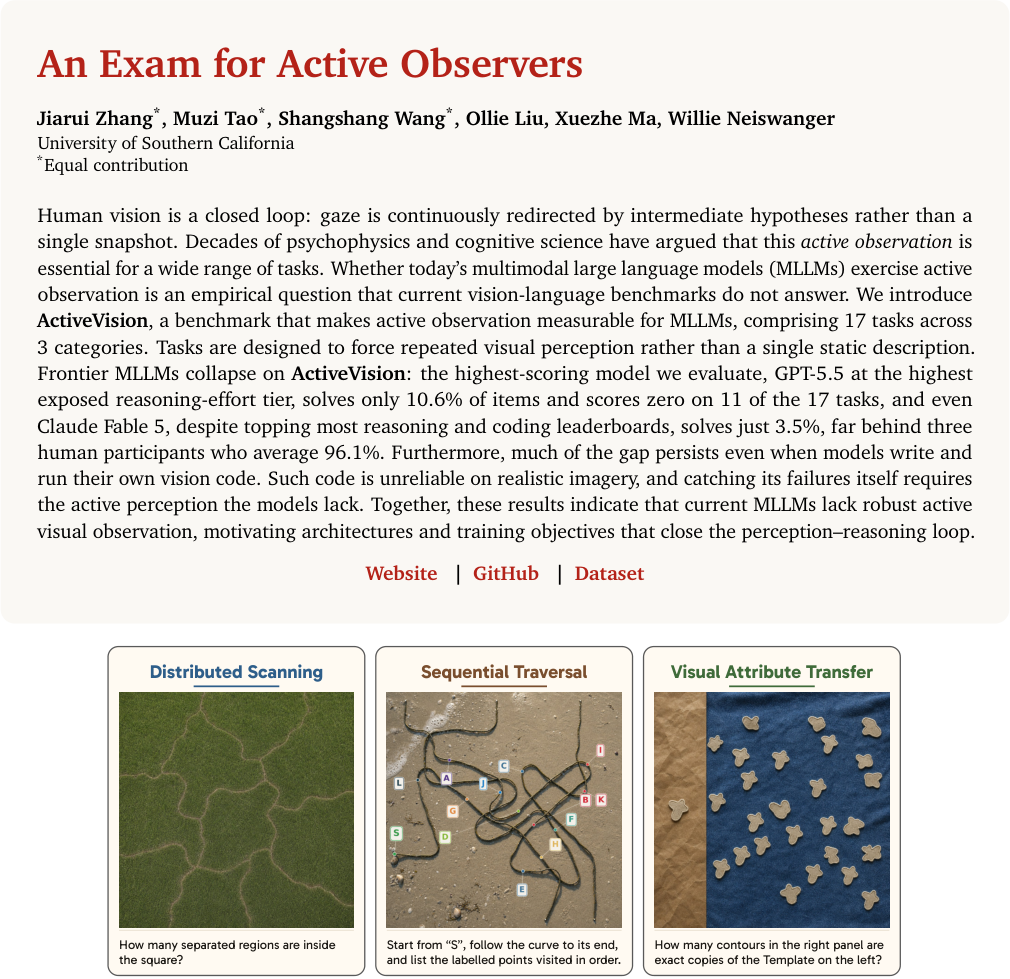
This paper discusses how human vision works and introduces a new test to see if advanced AI models can observe and understand visual information like humans do. The results show that current AI models struggle with this task.
Content & Liability Disclaimer
This article and its accompanying video are automated summaries derived from An Exam for Active Observers by Jiarui Zhang, Muzi Tao, Shangshang Wang, Ollie Liu, Xuezhe Ma, Willie Neiswanger. The original research was conducted solely by the paper's authors; PDFdigest did not conduct any of the research and makes no claims of ownership over the underlying scientific work.
The video narration is generated by artificial intelligence and references the paper's authors for attribution. The video is not narrated by any of the paper's authors. This content may contain inaccuracies, omissions, or misinterpretations of the original research. First-person language (e.g., "we found", "our results") reflects the original authors' voice, not PDFdigest's. Always read the original paper for accurate, verified information before making any decisions based on this content.
This content is provided "as is" without any warranties, express or implied. Simulated systems OÜ, its officers, directors, employees, and agents shall not be liable for any direct, indirect, incidental, special, consequential, or punitive damages arising from your use of, reliance on, or access to this content, including but not limited to errors, omissions, or misinterpretations of the original research. This disclaimer applies to the fullest extent permitted by applicable law.
- 1 Human vision involves active observation, where we look at things multiple times to understand them better.
- 2 Current AI models, despite being advanced, do not perform well on tasks that require this kind of active observation.
- 3 The study introduces a new benchmark called ActiveVision to measure how well AI models can observe and interpret visual information.
Introduction
The introduction discusses the concept of active observation in human vision, emphasizing its importance for various tasks. It critiques current MLLMs for their lack of active observation capabilities, despite their advancements in other benchmarks.
Methods
The article should be read as a source-grounded explanation of the paper’s argument, evidence, and analysis rather than as a new independent experiment. The summary is grounded in the paper text and the extracted evidence used by PDFDigest.
PDFDigest preserves the distinction between the paper’s own claims, its cited evidence, and plain-language explanation for readers.
Vision-Centric Benchmarks for MLLMs
This part discusses previous benchmarks aimed at isolating visual perception from linguistic priors, noting their saturation and the ongoing perceptual limitations of MLLMs.
How PDFdigest Helps You Understand Research
Instant Paper Analysis
Get structured summaries and key findings from dense PDFs in seconds.
Visual Explanations
Turn complex methods, figures, and results into clearer visual breakdowns.
AI-Powered Q&A
Ask focused questions and get answers grounded in the paper.
Active Vision in Cognitive Science and Computer Vision
The section outlines the theoretical foundations of active vision, citing studies that demonstrate how task prompts influence gaze allocation and the necessity of active control for solving perceptual problems.
Animate vision
The section likely explores the concept of animate vision, although specific details are not provided in the abstract.
Source Paper Figures and Captions
Frequently Asked Questions
This paper discusses how human vision works and introduces a new test to see if advanced AI models can observe and understand visual information like humans do. The results show that current AI models struggle with this task.
The introduction discusses the concept of active observation in human vision, emphasizing its importance for various tasks. It critiques current MLLMs for their lack of active observation capabilities, despite their advancements in.
The article should be read as a source-grounded explanation of the paper’s argument, evidence, and analysis rather than as a new independent experiment. The summary is grounded in the paper text and the extracted evidence used.
Yes. PDFDigest can turn this paper into a structured explanation, key takeaways, visual summaries, and a narrated video when available.