Comparative Reasoning Brings A Vision-language Framework for into Focus
This paper presents a new framework that helps doctors compare medical images more effectively, improving diagnosis and treatment decisions.
Content & Liability Disclaimer
This article and its accompanying video are automated summaries derived from A Vision-language Framework for Comparative Reasoning in Radiology by Tengfei Zhang, Ziheng Zhao, Xiaoman Zhang, Lisong Dai, Pengcheng Qiu, Ya Zhang, Yanfeng Wang, Weidi Xie. The original research was conducted solely by the paper's authors; PDFdigest did not conduct any of the research and makes no claims of ownership over the underlying scientific work.
The video narration is generated by artificial intelligence and references the paper's authors for attribution. The video is not narrated by any of the paper's authors. This content may contain inaccuracies, omissions, or misinterpretations of the original research. First-person language (e.g., "we found", "our results") reflects the original authors' voice, not PDFdigest's. Always read the original paper for accurate, verified information before making any decisions based on this content.
This content is provided "as is" without any warranties, express or implied. Simulated systems OÜ, its officers, directors, employees, and agents shall not be liable for any direct, indirect, incidental, special, consequential, or punitive damages arising from your use of, reliance on, or access to this content, including but not limited to errors, omissions, or misinterpretations of the original research. This disclaimer applies to the fullest extent permitted by applicable law.
- 1 Current AI systems often analyze medical images one at a time, missing important comparisons.
- 2 The new framework, MedReCo, allows for better retrieval of similar past cases.
- 3 MedReCo-VLM can generate descriptions of changes between images, aiding in understanding patient progress.
Introduction
The introduction discusses the limitations of current AI in medical imaging, which typically analyzes images in isolation. It emphasizes the importance of comparative reasoning in radiology, where radiologists often compare current findings with historical cases or prior studies to make informed diagnoses.
Results
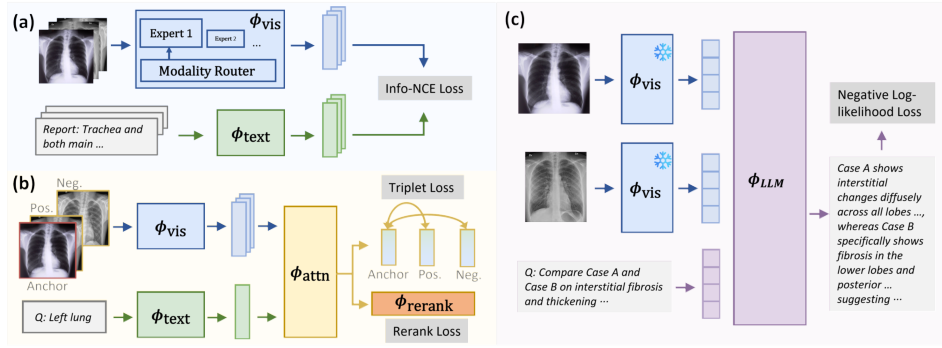
The results section evaluates the performance of MedReCo and MedReCo-VLM on tasks related to comparative reasoning. MedReCo demonstrated superior retrieval capabilities across various clinical settings, while MedReCo-VLM excelled in generating meaningful descriptions of changes between images.
Reference comparison with controllable image retrieval
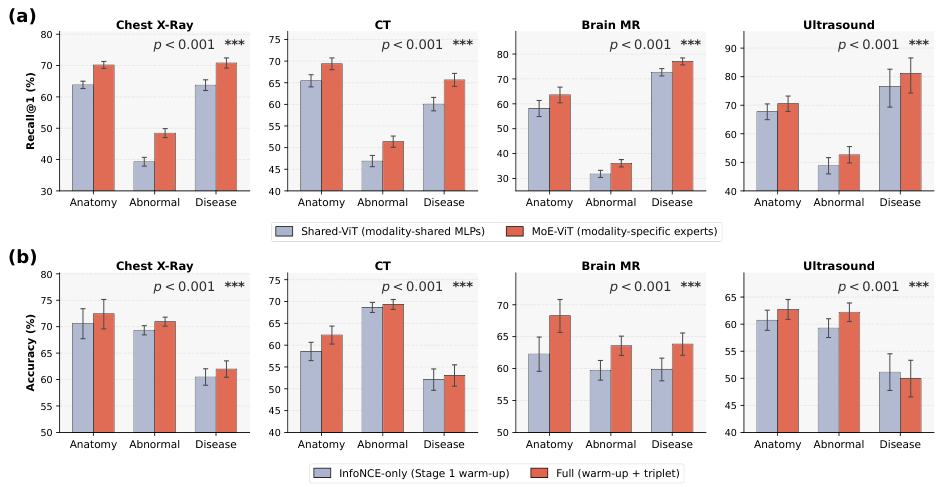
This section details the evaluation of MedReCo’s ability to retrieve clinically analogous cases based on entity-specific similarity. The performance was measured using Recall@k metrics, showing significant improvements over baseline models.
How PDFdigest Helps You Understand Research
Instant Paper Analysis
Get structured summaries and key findings from dense PDFs in seconds.
Visual Explanations
Turn complex methods, figures, and results into clearer visual breakdowns.
AI-Powered Q&A
Ask focused questions and get answers grounded in the paper.
Temporal comparison with generative comparative interpretation
The evaluation of MedReCo-VLM focuses on its ability to generate descriptions of similarities and differences between image pairs. The model was tested on both cross-patient and same-patient longitudinal studies, achieving high accuracy and strong performance in open-ended generation.
Representative retrieval examples
This section provides examples illustrating the effectiveness of MedReCo in retrieving clinically relevant cases compared to baseline models, highlighting the importance of entity-specific retrieval in radiology.
Source Paper Figures and Captions
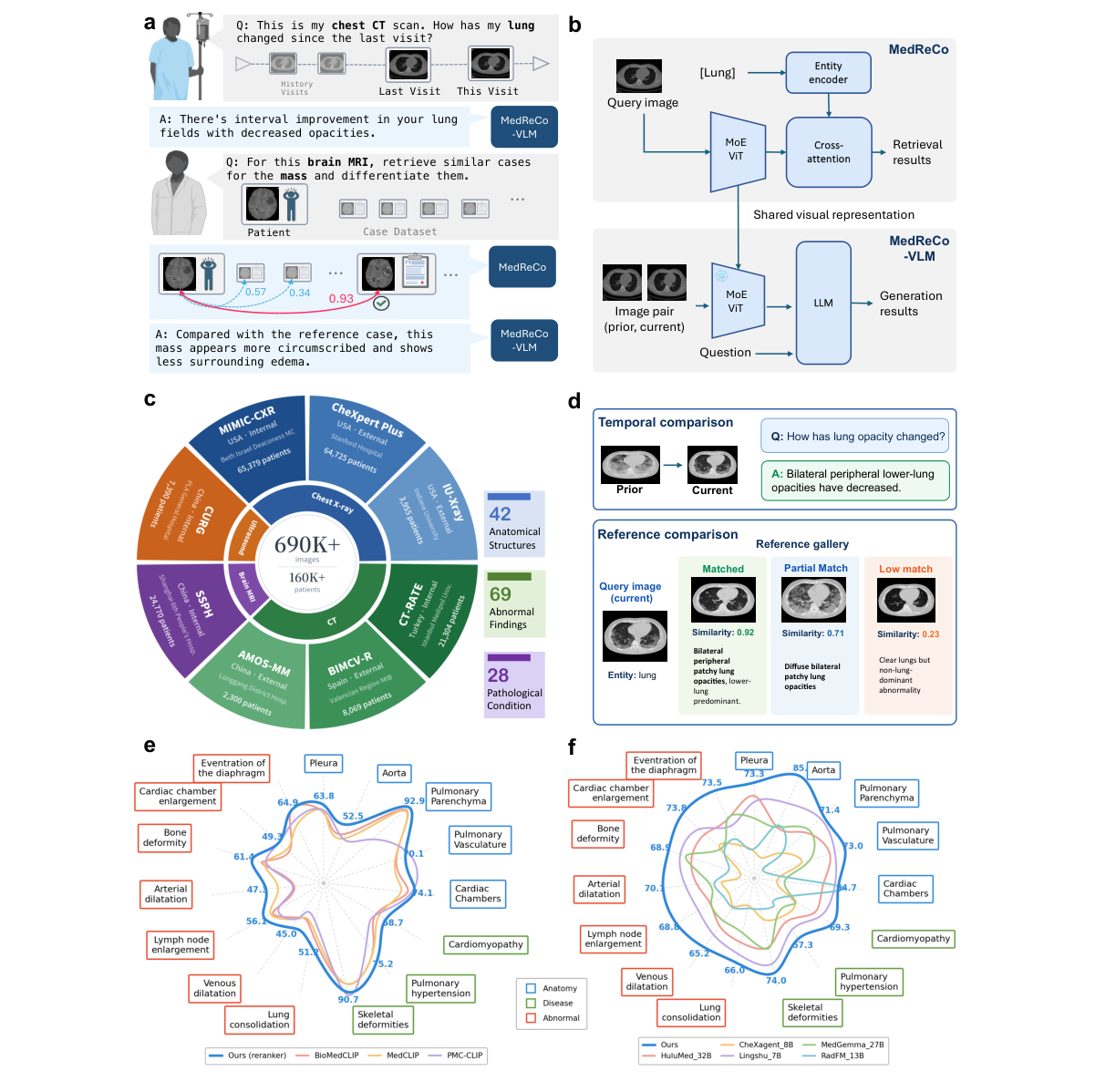
Highlights the need for comparative reasoning in clinical workflows.
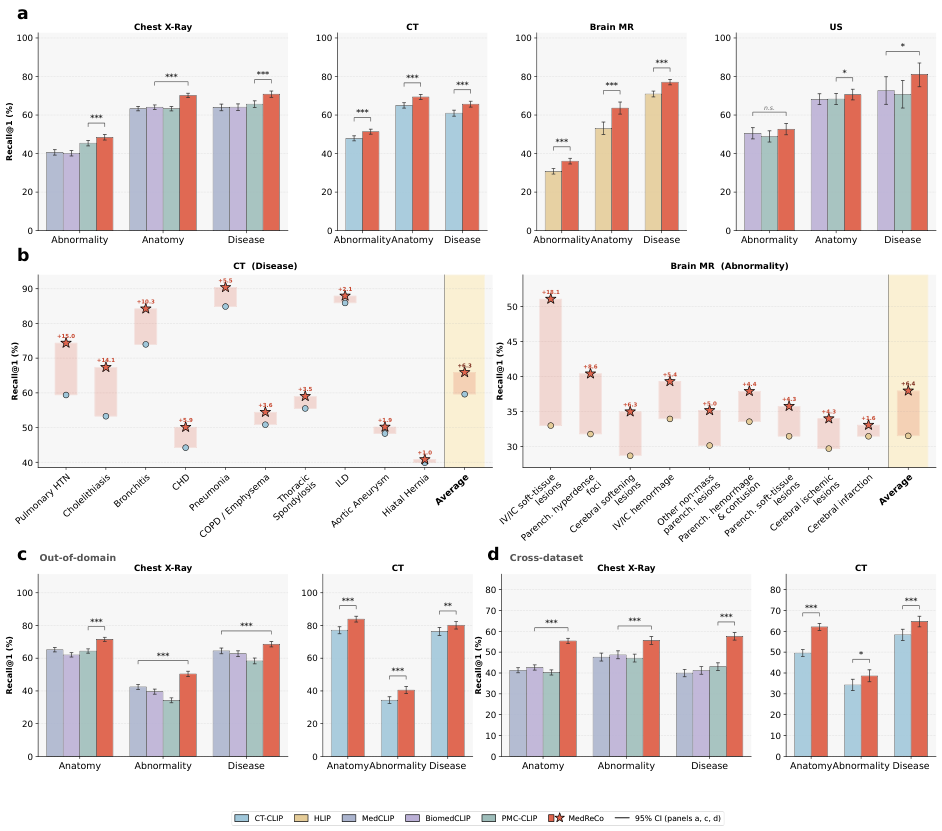
Demonstrates MedReCo’s superior retrieval performance across various imaging modalities.
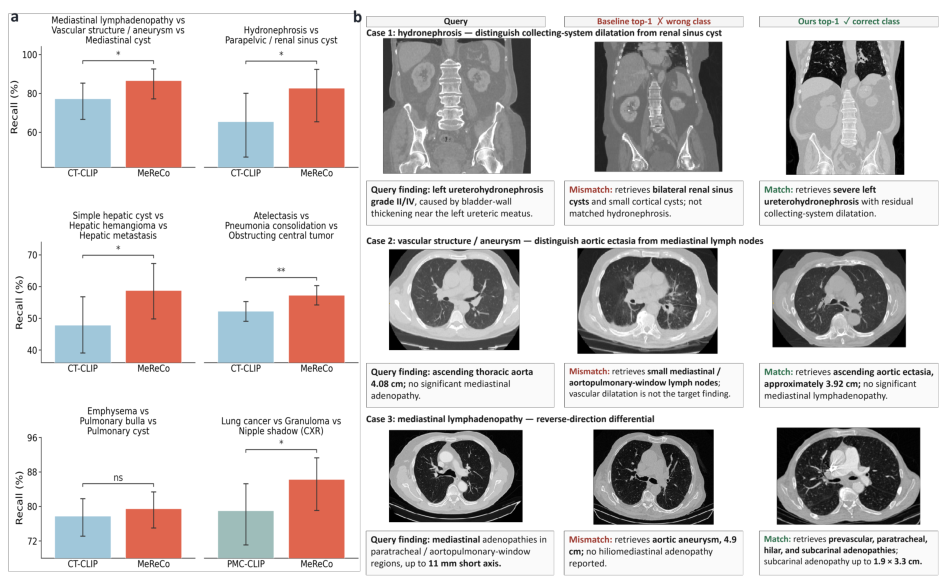
Shows the difference between global visual similarity and entity-matched retrieval.
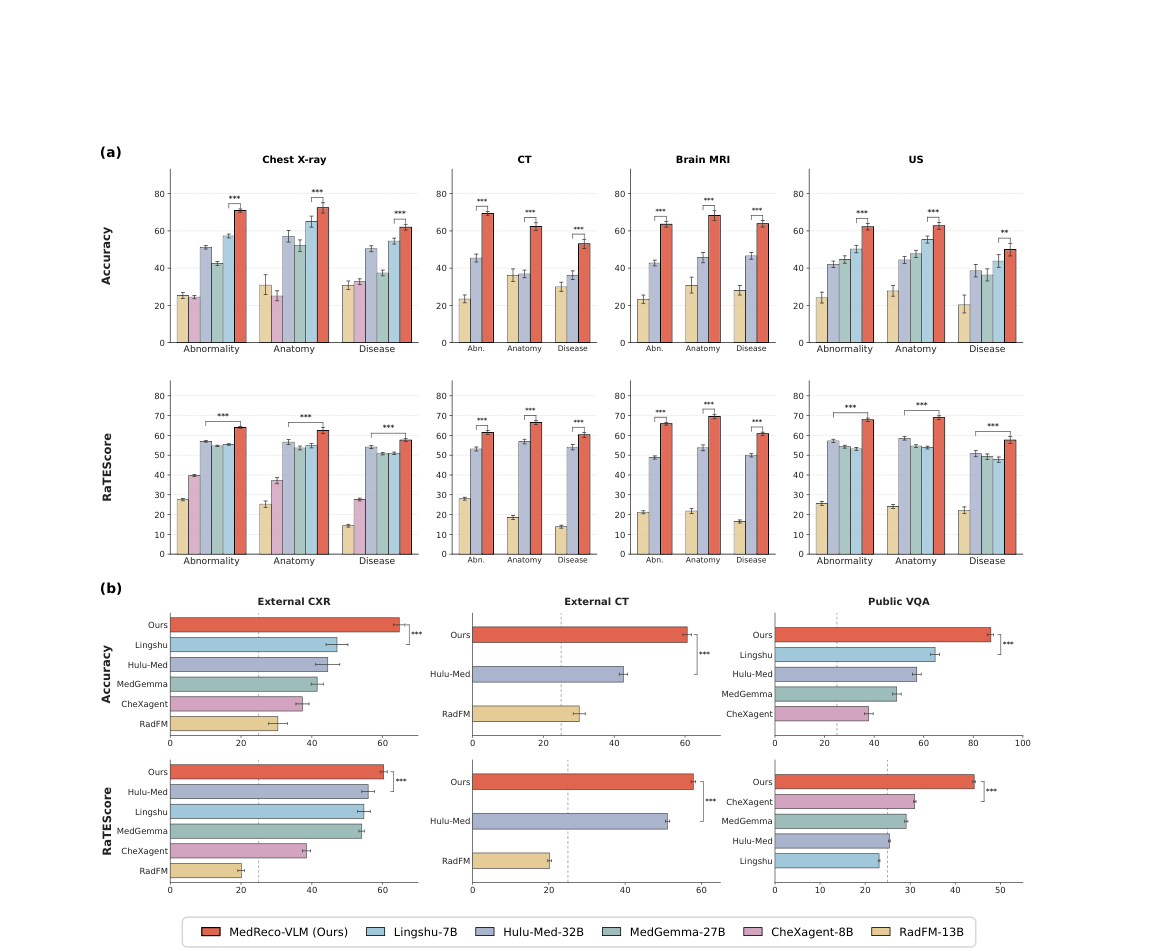
Illustrates the model’s top performance in generative comparative interpretation tasks.
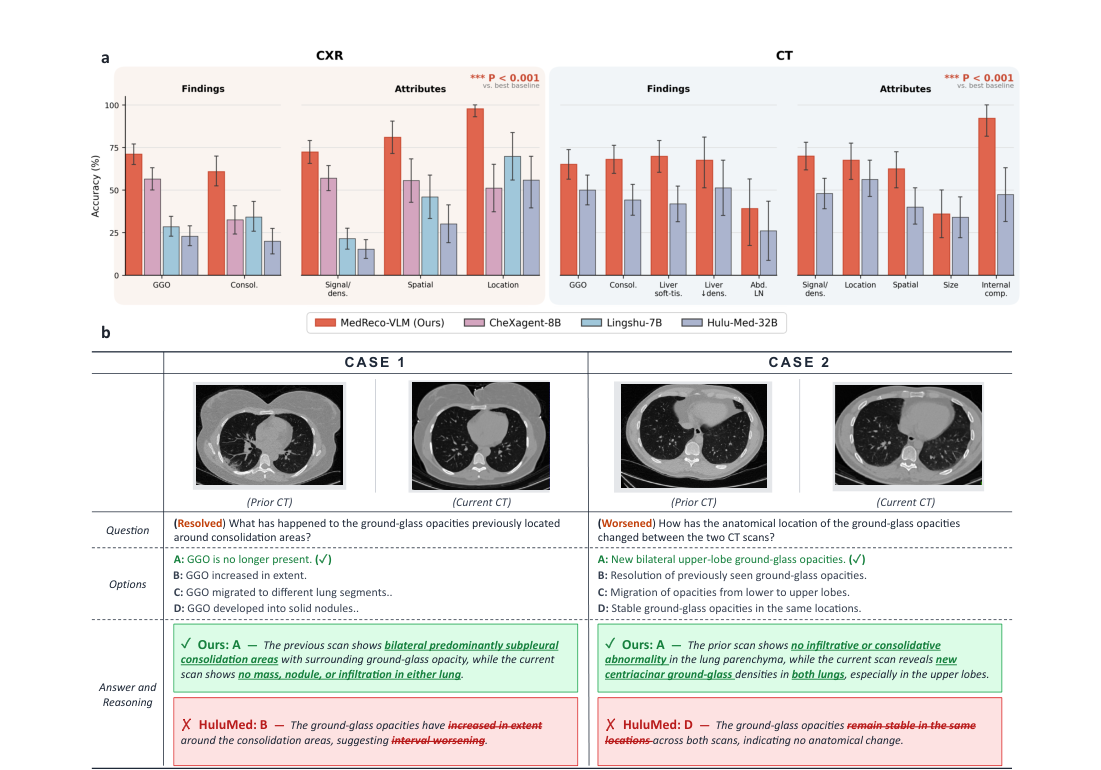
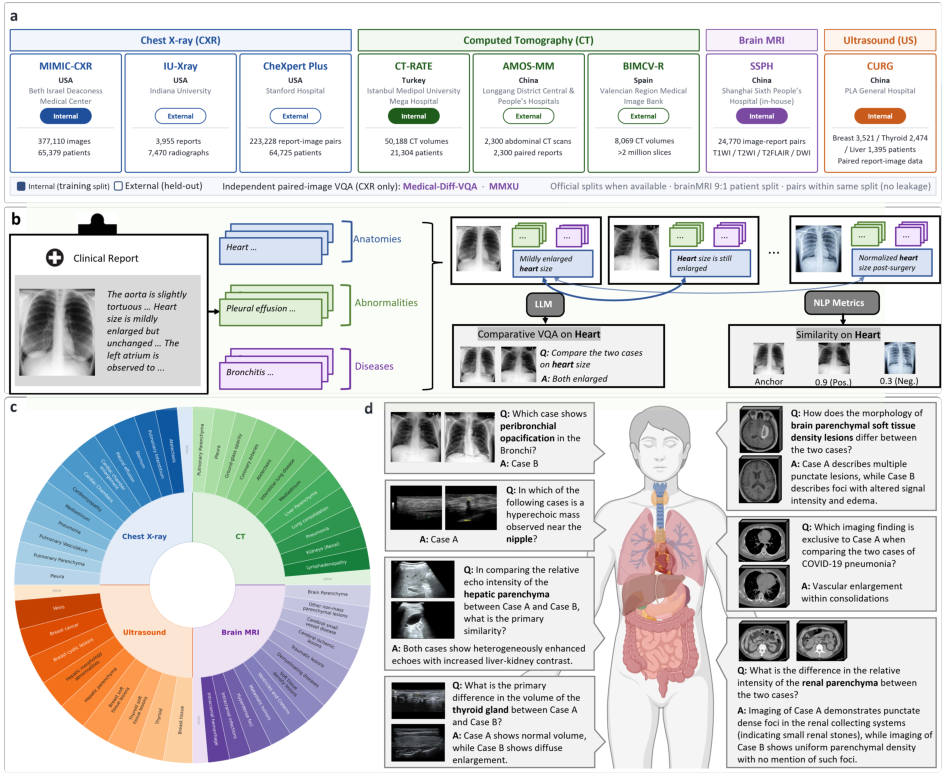
Demonstrates the types of queries evaluated for the model’s performance.
Frequently Asked Questions
This paper presents a new framework that helps doctors compare medical images more effectively, improving diagnosis and treatment decisions.
The introduction discusses the limitations of current AI in medical imaging, which typically analyzes images in isolation. It emphasizes the importance of comparative reasoning in radiology, where radiologists often compare current findings.
The results section evaluates the performance of MedReCo and MedReCo-VLM on tasks related to comparative reasoning. MedReCo demonstrated superior retrieval capabilities across various clinical settings, while MedReCo-VLM excelled in generating meaningful descriptions.
Yes. PDFDigest can turn this paper into a structured explanation, key takeaways, visual summaries, and a narrated video when available.