Learning to generate physical ocean: Evidence from Hybrid Climate Modeling
This paper discusses a new method for generating ocean data that combines traditional climate models with modern machine learning techniques. The goal is to create more accurate and efficient models that can help scientists understand climate change better.
Content & Liability Disclaimer
This article and its accompanying video are automated summaries derived from Learning to generate physical ocean states: Towards hybrid climate modeling by Olaf Ronneberger, Philipp Fischer, Thomas Brox. The original research was conducted solely by the paper's authors; PDFdigest did not conduct any of the research and makes no claims of ownership over the underlying scientific work.
The video narration is generated by artificial intelligence and references the paper's authors for attribution. The video is not narrated by any of the paper's authors. This content may contain inaccuracies, omissions, or misinterpretations of the original research. First-person language (e.g., "we found", "our results") reflects the original authors' voice, not PDFdigest's. Always read the original paper for accurate, verified information before making any decisions based on this content.
This content is provided "as is" without any warranties, express or implied. Simulated systems OÜ, its officers, directors, employees, and agents shall not be liable for any direct, indirect, incidental, special, consequential, or punitive damages arising from your use of, reliance on, or access to this content, including but not limited to errors, omissions, or misinterpretations of the original research. This disclaimer applies to the fullest extent permitted by applicable law.
- 1 In this work, we investigate whether deep generative models can help bridge this gap by directly producing physically consistent oceanic states, inspired by recent success in turbulent flow simulation [Lienen et al., 2023] .
- 2 Formally, we train a denoising model ϵ θ (x s , s) to predict the noise added to the data, where s ∈ [1, S] represents the diffusion step.
- 3 Hydrostatic balance constraint : a key physical characteristic in variables produced by ocean models is to ensure a hydrostatically stable stratification, where density should increase with depth.
- 4 By developing methods to enforce physical constraints during generation, we show how to balance between respecting learned patterns and maintaining necessary physical properties.
Introduction
Ocean General Circulation Models (OGCMs) are fundamental tools in climate science, essential for understanding past climate variations and projecting future conditions. These models require substantial computational resources, particularly during their spin-up phase to reach equilibrium, which requires millions of CPU hours even at coarse spatial resolution.
This computational cost severely limits our ability to explore different parameter calibrations or perform large ensemble simulations necessary for uncertainty quantification.
However, these emulators face two major limitations: their autoregressive nature leads to instability in long-term predictions, and their black-box nature makes them unsuitable for studying mechanisms of climate variability or performing sensitivity analyses.
Future work include training with Exponential Moving Average (EMA) and investigating the use of Latent Diffusion Models.
Research Question
In this work, we investigate whether deep generative models can help bridge this gap by directly producing physically consistent oceanic states, inspired by recent success in turbulent flow simulation [Lienen et al., 2023] .
Methodology
• A method for enforcing physical constraints during the generation process. Our evaluation follows two complementary approaches: first, an a priori analysis of the generated states’ physical properties and spatial patterns, and second, an a posteriori analysis of their viability as initialization points for numerical integration in NEMO.
Study Design
Two key findings emerge from this analysis: the unconstrained model successfully generates fields with realistic spatial structure, and adding a hydrostatic constraint on the generated fields reduces density instabilities by an order of magnitude while maintaining the spatial structure.
How PDFdigest Helps You Understand Research
Instant Paper Analysis
Get structured summaries and key findings from dense PDFs in seconds.
Visual Explanations
Turn complex methods, figures, and results into clearer visual breakdowns.
AI-Powered Q&A
Ask focused questions and get answers grounded in the paper.
Results & Findings
Recent advances in deep learning have led to promising climate model emulators [Wang et al., 2024 , Aouni et al., 2024 , Kochkov et al., 2024 , Watt-Meyer et al., 2023] that can reproduce short-term dynamics with impressive accuracy while requiring significantly less computational resources. • Metrics and evaluation protocols for assessing the physical consistency of generated states and their viability as initial conditions for numerical integration 2 Methods training.
- Recent advances in deep learning have led to promising climate model emulators [Wang et al., 2024 , Aouni et al., 2024 , Kochkov et al., 2024.
- • Metrics and evaluation protocols for assessing the physical consistency of generated states and their viability as initial conditions for numerical integration 2 Methods training of.
- Our approach consists of three main components: (1) training a diffusion model to learn the distribution of oceanic states, (2) generating new states while enforcing physical.
- As illustrated in Figure 1 , we first train our model on a dataset of states from the DINO configuration, each representing a snapshot of the.
- We base our approach on denoising diffusion probabilistic models (DDPM) [Ho et al., 2020] which has shown promising results for generating complex physical fields [Lienen et.
Formally, we train a denoising model ϵ θ (x s , s) to predict the noise added to the data, where s ∈ [1, S] represents the diffusion step.
Hydrostatic balance constraint : a key physical characteristic in variables produced by ocean models is to ensure a hydrostatically stable stratification, where density should increase with depth.
Practical Applications
More sophisticated physical constraints could be developed to better preserve conservation laws while maintaining state diversity. The following figure summarizes the architecture, interested readers might refer to the diffusers library documentation foot_3 for more details.
Generative model and physical constraints
The approach is based on denoising diffusion probabilistic models (DDPM) to generate oceanic states while enforcing physical constraints during the sampling process. A hydrostatic balance constraint is introduced to ensure density increases with depth, allowing for a balance between learned distributions and physical properties.
A Dataset
Details on the training dataset generated from the DINO configuration are provided. The dataset consists of 1800 states of temperature and salinity fields, standardized prior to training, covering a domain from the equator to both poles.
Source Paper Figures and Captions
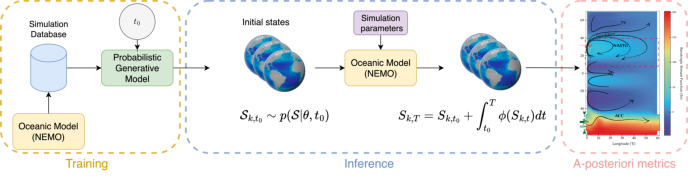
Demonstrates the model’s ability to replicate realistic spatial structures and vertical stratification in oceanic states.
Frequently Asked Questions
In this work, we investigate whether deep generative models can help bridge this gap by directly producing physically consistent oceanic states, inspired by recent success in turbulent flow simulation [Lienen et al., 2023] . These fields are concatenated to form our input.
• A method for enforcing physical constraints during the generation process. Our evaluation follows two complementary approaches: first, an a priori analysis of the generated states’ physical properties and spatial patterns, and second, an a posteriori analysis of their viability as initialization.
Formally, we train a denoising model ϵ θ (x s , s) to predict the noise added to the data, where s ∈ [1, S] represents the diffusion step. Hydrostatic balance constraint : a key physical characteristic in variables produced by ocean.
The density profiles further validate that the model captures the overall stratification structure of the global ocean. More sophisticated physical constraints could be developed to better preserve conservation laws while maintaining state diversity.
Future work include training with Exponential Moving Average (EMA) and investigating the use of Latent Diffusion Models.
This paper discusses a new method for generating ocean data that combines traditional climate models with modern machine learning techniques. The goal is to create more accurate and efficient models that can help scientists understand climate change better.